“Get out of the car before I drag you out myself.”
Officer Grant Halverson's voice struck the intersection hard enough to turn the heads of people who had been waiting patiently for a walk signal. A delivery cyclist slowed beside the curb. Two teenagers stopped beneath the awning of a pharmacy, their phones already rising.
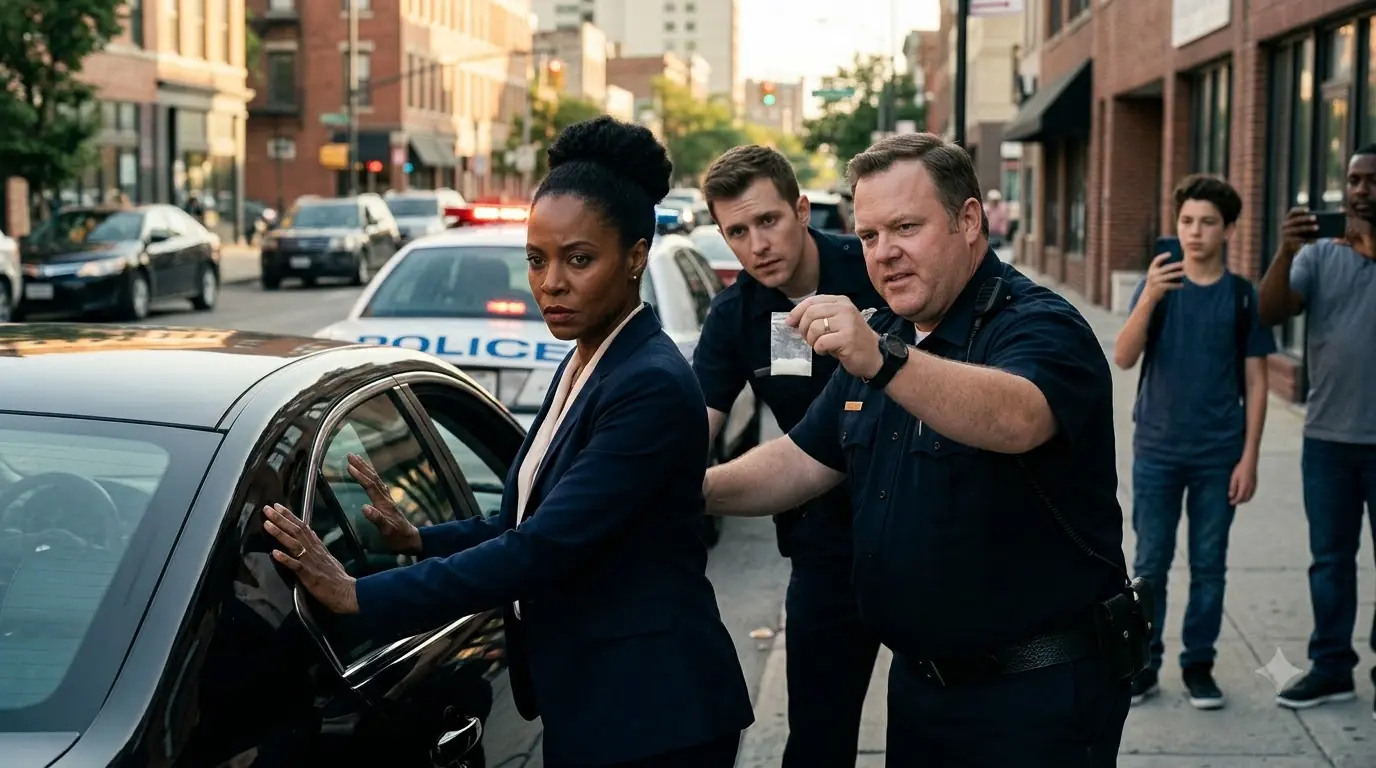
In the driver's seat of a black sedan, Judge Nia Whitaker looked through her open window at the man whose fingers had curled around the edge of her door. He was breathing hard, though he had only walked a few yards from his patrol car, and the expression behind his sunglasses suggested he had been waiting for this moment longer than she had been waiting at the light.
“Officer, I am complying,” she said. “My hands are visible. Please explain why you are opening my door.”
He did not answer. He pulled the door wider, ordered her out again, and seized her wrist the moment her feet touched the pavement. Nia was still turning to face him when he forced her against the hood. Sun-warmed metal pressed through her thin blouse, and the corner of her handbag struck the ground beside her heel. She heard a woman cry out from the bus stop. Halverson shouted, “Stop resisting,” although Nia's hands lay open where he had placed them and her body had gone rigid with the effort not to make a sudden movement.
For a second she could see only the fine dust on the hood of her own car. A reflection of traffic signals trembled in the paint. Somewhere to her left, a child asked why the police officer was hurting that lady, and a frightened adult told him to keep walking. Halverson leaned close enough that she smelled bitter coffee beneath his breath. “People like you always think you're above the rules,” he murmured, making sure the words were for her and not the crowd.
Then his right hand disappeared briefly behind his leg. Nia felt a quick, unfamiliar touch near her waistband and understood what had happened before he straightened. He held a little plastic bag between two fingers, displaying it to the intersection as though he had discovered treasure. “Would you look at that,” he announced. “Guess we know why she didn't want to cooperate.”
“That was not on me,” Nia said, clear and deliberate. “You put it there.”
Halverson laughed. He did not know, or pretended not to know, that the woman pinned to the hood had spent years hearing evidence in cases involving official misconduct. He did not understand that she would remember the angle of his hand, the position of his patrol car, or the brief interval during which his body had blocked his own camera. And he certainly did not know that the people watching through those raised phones would eventually become the first break in a case reaching far beyond one traffic stop.
Eleven minutes earlier, Nia Whitaker had been thinking about whether there was enough rice in her kitchen to make dinner.