"Excuse me. I live here. Could you open the gate, please?"
The guard did not look up. He spat near Fletcher's tire, then let out a short laugh as though the request itself were absurd.
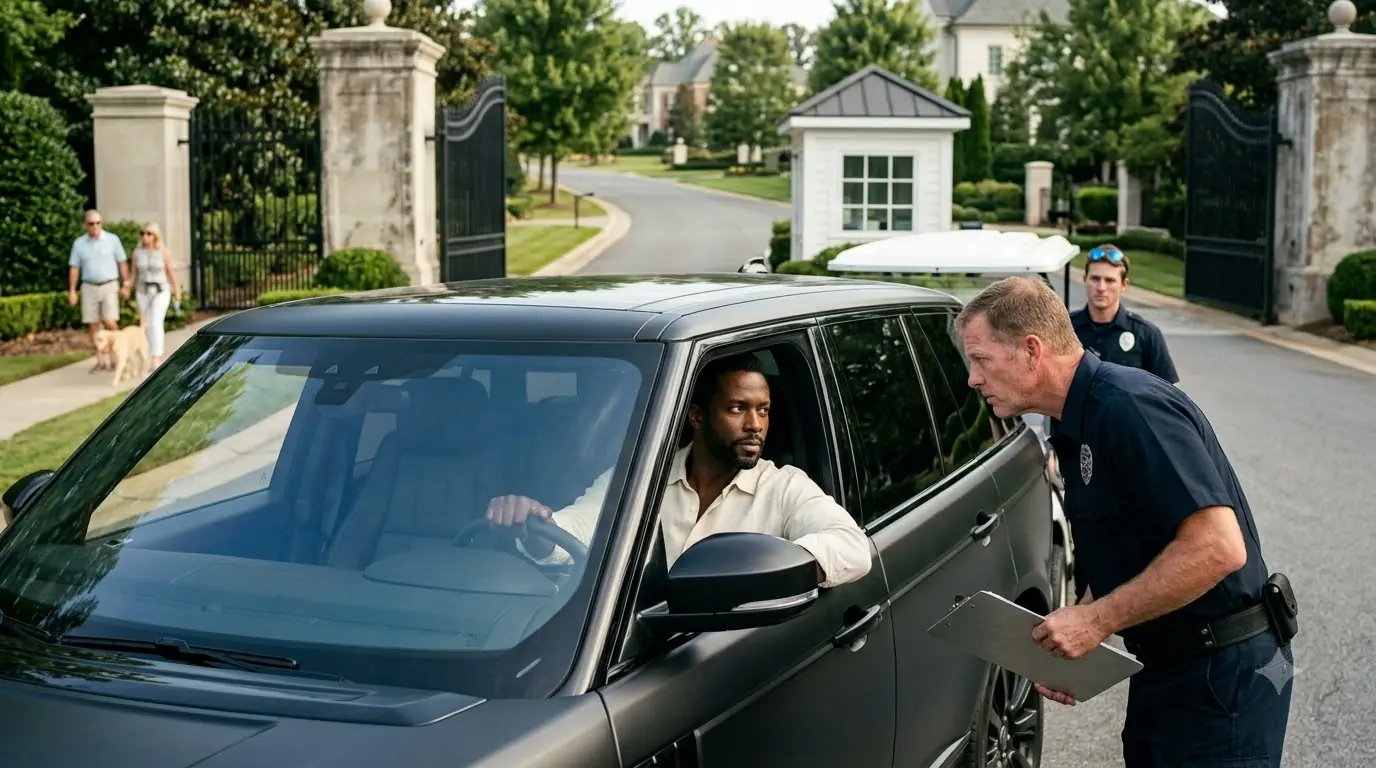
"You live here? I've seen every resident in this community. None of them look like you. Turn this thing around before I call the police. Go back to wherever you came from."
A woman nearby pulled out her phone and started recording. Nobody stepped in. Nobody challenged the guard. One Black man sat alone at the entrance to his own neighborhood while everyone around him watched as if the question of whether he belonged there was still open for debate.
What none of them knew was that Fletcher Owens was not confused, lost, or trespassing. He was exactly where he said he belonged, and one phone call from that gate would soon end careers, destroy reputations, and force an entire community to confront what had happened in broad daylight.
Saturday morning in late September had begun beautifully in Charlotte, North Carolina. The air was thick and warm, the kind of Southern heat that sat on the skin like a damp cloth, while golden sunlight filtered through mature oak trees. Somewhere in the distance, a church bell rang slowly and steadily.
Fletcher Owens stepped out of his front door at 7:30 a.m. His home stood at the end of a private cul-de-sac inside Greystone Estates, a 12,000-square-foot limestone residence with a circular driveway and a marble fountain in the center. It was the largest property in the entire community, and he had paid cash for it eighteen months earlier.
Nothing about Fletcher's appearance that morning suggested the scale of his wealth. He wore a cream linen shirt, gray joggers, and white sneakers, with no watch, no jewelry, and no driver waiting at the curb. He grabbed the keys to his matte black Range Rover and pulled out of the driveway himself.
His destination was Supreme Cuts, a small barbershop twenty minutes away in a predominantly Black neighborhood on the west side. The leather chairs were cracked, the television above the mirror was dusty, and the air smelled of aftershave and hot lather. Electric clippers buzzed beneath the laughter while a basketball game played in the background.
At Supreme Cuts, nobody called him Mr. Owens. He was simply Fletch. He had been sitting in the same chair, hearing the same jokes, and leaving the same fifty-dollar tip for fifteen years, long before the billions and long before magazine covers put his face in airports and boardrooms.
That morning, he stayed for forty-five minutes, argued about the Panthers, laughed at a story about somebody's cousin falling through his own roof, and said goodbye. Then he headed home, unaware that the new security company at Greystone Estates was about to turn an ordinary return trip into a public confrontation.
Greystone Estates consisted of thirty-six homes tucked into wooded hills just outside Charlotte. Every property sat on at least two acres, with long driveways, high fences, manicured lawns, and the kind of quiet that money could purchase. Average home values ranged from four to eight million dollars.
The residents included corporate executives, retired surgeons, and families whose wealth stretched back for generations. The community was almost entirely white. Fletcher Owens was the only Black homeowner in the development.
Three weeks earlier, the HOA had replaced its longtime gate staff with Sentinel Shield Services. The head of security assigned to Greystone was Craig Sutton, fifty-two, thick-necked and crew-cut, a former military man who treated the front gate like a controlled checkpoint. Several residents had already complained that he was too aggressive.
Victoria Ashford, president of the Greystone Estates Homeowners Association, dismissed those complaints. She told board members that Craig had a "firm hand" and that the community needed exactly that kind of presence. More importantly, Victoria personally approved the master resident list that Sentinel Shield received.
The list contained every homeowner's name, photograph, address, vehicle make and model, and license plate number. Fletcher's information was there. Victoria had signed off on it herself.
Fletcher had been overseas for a month closing an acquisition in London, so Craig's team had never met him in person. That should not have mattered. Before Fletcher left London, his executive assistant had emailed both the HOA and Sentinel Shield with a simple notice: Mr. Owens returns Saturday, September 28. Please ensure gate access.
The message had been delivered. It had been received. It had also been ignored.
Fletcher Owens was the founder and CEO of Pinnacle Dynamics, a Fortune 200 technology conglomerate valued at $14.2 billion. He had appeared on the cover of Forbes twice and had built the company from nothing. In corporate circles, his calmness under pressure was almost as famous as his business record.
He had grown up on Chicago's South Side, shared one bedroom with two brothers, and qualified for the free-lunch program at school. His mother worked double shifts in a hospital laundry room. Fletcher earned a full scholarship to Northwestern, then an MBA from Wharton, and eventually built a company whose products reached markets around the world.
In business, people said he never raised his voice. He did not lose control during hostile takeovers, board fights, negotiations, or public crises. He listened, documented, and waited until the facts were strong enough to speak for themselves.
His wife, Brenda Owens, understood that temperament better than anyone. A former civil rights attorney, she now ran a nonprofit dedicated to overturning wrongful convictions. Where Fletcher was quiet and patient, Brenda was direct, fearless, and legally precise.