"You're standing on my porch dripping mud," Brenda Sutton said, looking at my boots as if I had brought something contagious into her home. "What exactly do you want, Nate?"
Rainwater ran off the hem of my jacket and onto the white stone steps. Behind her, through the open doorway, I could see a chandelier hanging above an entryway twice the size of my kitchen.
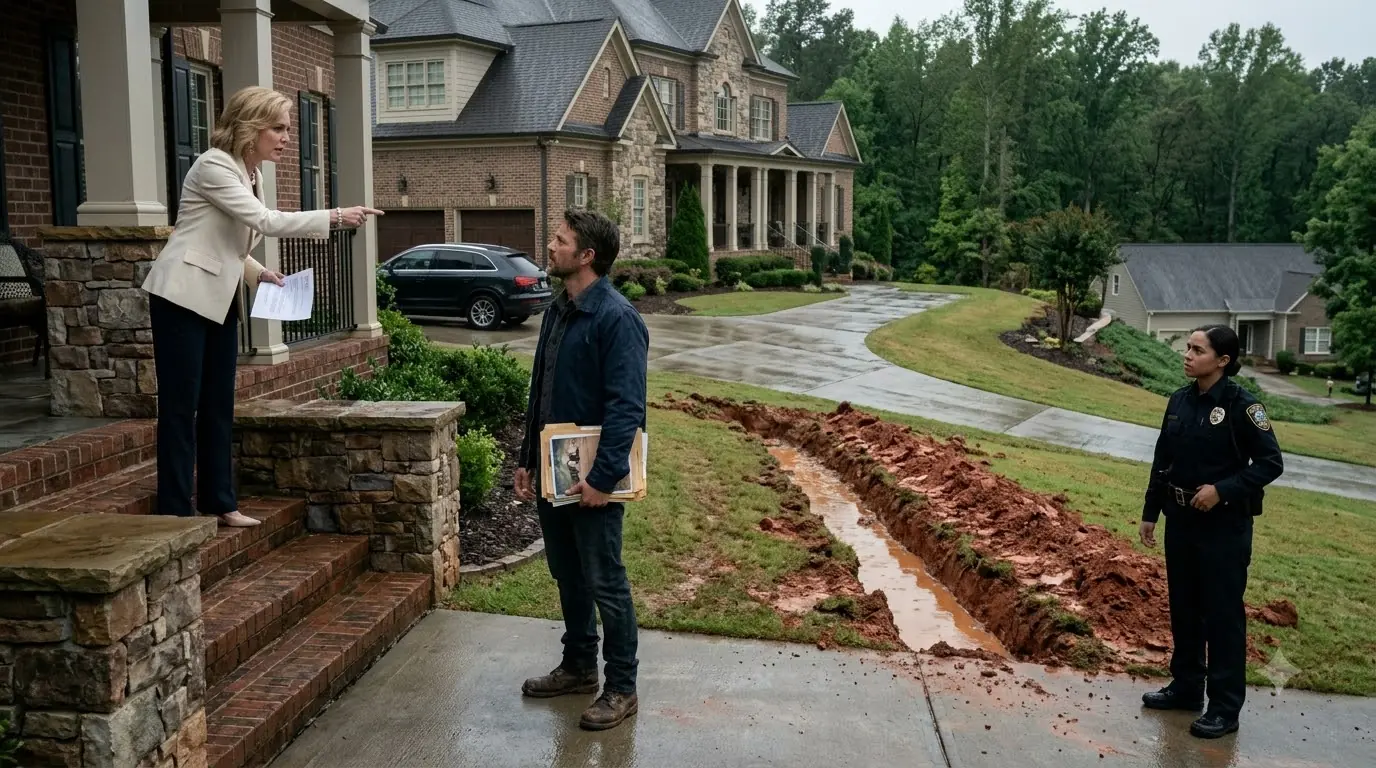
My daughter had spent half the previous night upstairs in her purple blanket while muddy water soaked the room where she kept her mother's books, and the woman in front of me was worried about her porch.
"The trench across the green space is sending stormwater onto my property," I told her. "It breached the pond's overflow berm. The water came through the north foundation vents last night, and Emma's room took damage. I need the board to stop that flow before the next storm."
Brenda rested one hand against the doorframe. She was wearing a cream robe that probably cost more than my sump pump and holding a mug with gold lettering that said CHOOSE JOY. Her eyes moved past me to my old pickup parked at the curb, and the corner of her mouth lifted.
"Not my problem," she said. "You bought the cheapest lot on the street. That's what people like you can afford."
I had been called a lot of things in sixteen years of engineering work. I had been yelled at by developers whose permits were delayed, threatened by contractors who thought safety calculations were negotiable, and laughed out of conference rooms by people who had never opened a drainage manual. But there was a particular coldness to hearing a neighbor speak that way about the house where you were trying to raise a child after losing her mother.
"People like me?" I asked.
"Don't make me spell it out." She leaned forward. "Tear down that ridiculous retaining wall by Friday, or I'll have it demolished and bill you double. And get off my porch. I can smell you from here."
My fingers tightened around the folder under my arm. Inside were photographs of a two-hundred-foot drainage cut, survey measurements, and public records that Brenda had not yet seen. I had come hoping for a practical conversation, one adult giving another an opportunity to prevent further damage. In that moment I understood that Brenda wasn't interested in preventing anything except a challenge to her authority.
"I'll put your position in writing," I said.
"Put it wherever you like. I'm president of this association. You'll learn what that means."
She closed the door before I could answer. I stayed on the step long enough to hear the lock turn, then walked back into the cold morning air. I did not shout or strike the door or tell her what I had discovered in the county's old records. I only wrote down the time, her words, and the condition of the steps I had left wet, because by then I was beginning to understand that every detail might matter.