Detective Caleb Roark knew something was wrong before his truck had fully turned into the driveway.
It was not the gray box truck parked halfway across the curb.
It was not even the open garage door.
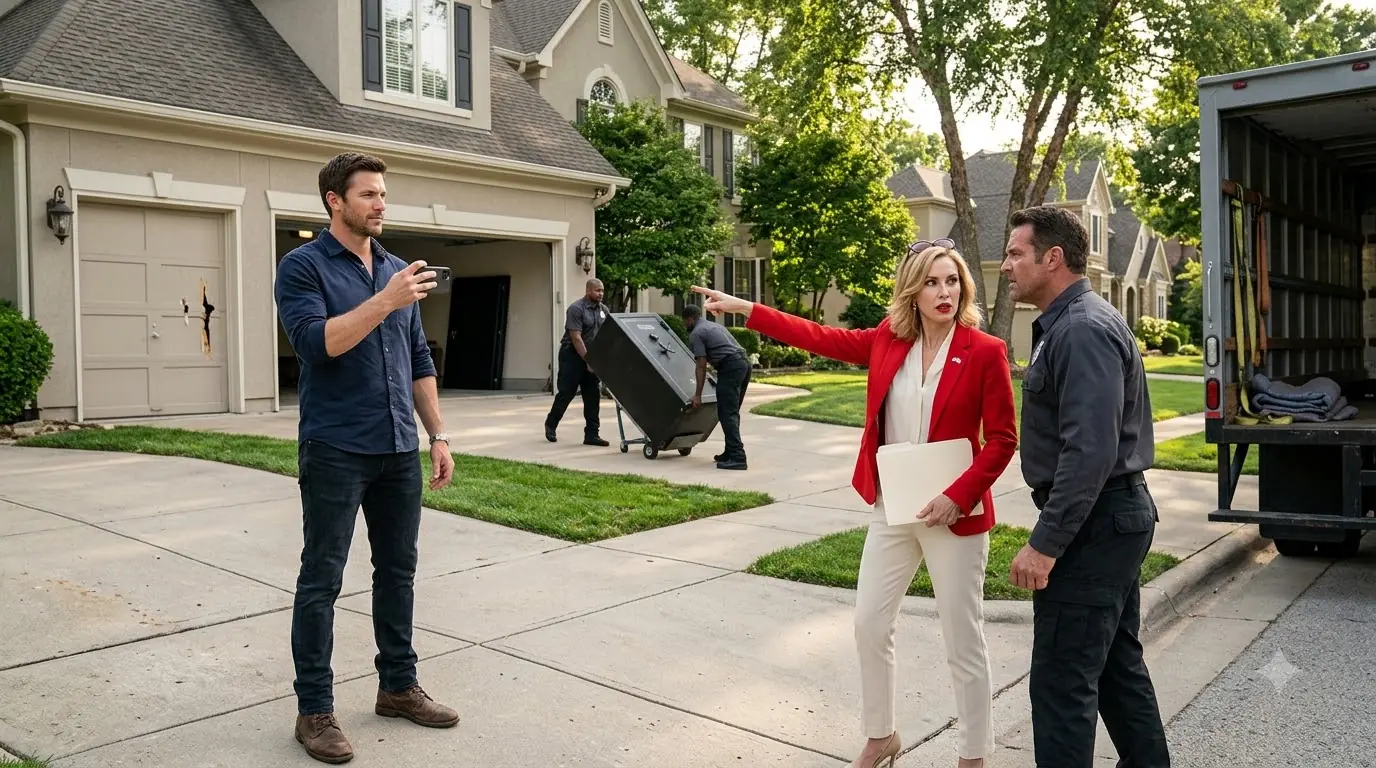
It was the way three men were moving.
They moved with the practiced confidence of people who believed nobody was going to stop them.
One man controlled an industrial dolly from behind. Another steadied the load from the side. A third stood near the rear doors of the unmarked truck, watching the street.
On the dolly sat Caleb's safe.
Nearly three hundred pounds of black steel was rolling down the same driveway Caleb had pressure-washed the previous weekend.
For one strange second, he simply stared through the windshield.
Then training replaced surprise.
Caleb did not jump from the truck.
He did not shout.
He did not reach for the badge clipped inside his jacket.
Instead, he shifted into park, left the engine running, lifted his phone, and started recording.
The first image he captured was the truck.
Gray Ford commercial chassis.
Temporary magnetic sign on one door.
Rear plate clearly visible.
Then the men.
Uniform patches.
Faces.
Employee numbers stitched above their shirt pockets.
The dolly.
His safe.
The damaged side entrance to the garage.
Only after all of that did Caleb open his door.
A warm October wind moved fallen leaves across the quiet street of Briar Hollow Estates.
The neighborhood looked peaceful enough to belong in a real-estate brochure. Two-story homes sat behind trimmed lawns and ornamental trees. Halloween decorations had begun appearing on porches. Somewhere nearby, a leaf blower whined steadily.
Nothing about the street suggested that a burglary was occurring in broad daylight.
That was precisely why Caleb kept recording.
The largest of the three guards noticed him first.
Travis Boone.
Caleb knew the name even before he read it on the man's uniform.
Whitcomb Community Security.
Caleb had seen the company mentioned in invoices, incident reports, and four homeowner complaints sitting in his investigative file.
Travis placed one hand on the safe as if Caleb had arrived during a routine delivery.
“Mr. Roark?”
Caleb kept the phone pointed toward him.
“That's me.”
Travis nodded.
“We're executing an emergency property recovery authorization on behalf of the Briar Hollow Estates Homeowners Association.”
Caleb glanced at the safe.
“Are you?”
“Yes, sir.”
“Interesting.”
Travis seemed irritated by the word.
He reached into a leather folder and removed a document.
“Association records show an outstanding balance of eighteen thousand four hundred sixty dollars. That includes accumulated violation penalties, enforcement costs, attorney fees, and security recovery charges.”
Caleb walked closer, but not too close.
“Let me see it.”
Travis held the page toward him.
Caleb photographed it before touching anything.
The heading read:
EMERGENCY PROPERTY RECOVERY AUTHORIZATION.
Below that was Caleb's name, address, and an itemized debt he had never seen before.
The bottom carried the signature of Mallory Whitcomb, president of the Briar Hollow Estates Homeowners Association.
There was also a notary stamp.
Caleb's attention stopped there.
It was slightly crooked.
Tilted left.
Less than five degrees.
Meaningless to almost anybody else.
To Caleb, it was the first truly important thing he had seen.
For six months, Major Crimes had quietly investigated four incidents involving homeowners from three different private communities.
Each case looked different at first.
One resident claimed a security company had removed antique jewelry to satisfy delinquent association fines.
Another said watches and electronics disappeared during what the HOA called a compliance inventory.
A third homeowner reported that legally owned valuables had been removed under a document described as an emergency asset hold.
The fourth had simply sold his home and left town after months of escalating fines, convinced fighting the association would cost more than surrendering.
The supposed legal documents in those files had different names and slightly different language.
But three carried a notary impression that leaned left.
Same angle.
Same irregular spacing.
Same faint defect along the lower edge of the stamp.
Caleb looked up.
Travis Boone was watching him.
“You done?”
“For now.”
“Then I suggest you stay out of the way.”
Caleb's eyes went toward the damaged side door.
“You broke into my garage.”
“We entered under association authority.”
“No.”
Travis gave a tired smile.
“Mr. Roark, I understand homeowners don't always agree with enforcement. You can dispute the debt through the board.”
Caleb almost laughed.