The sound was so sharp that the string quartet stopped playing before anyone understood what had happened.
A woman in a midnight-blue gown stood beside the head table of Atlanta's Grand Harrington Hotel, her face turned slightly to one side, while Victoria Whitmore lowered the hand she had just used to strike her.
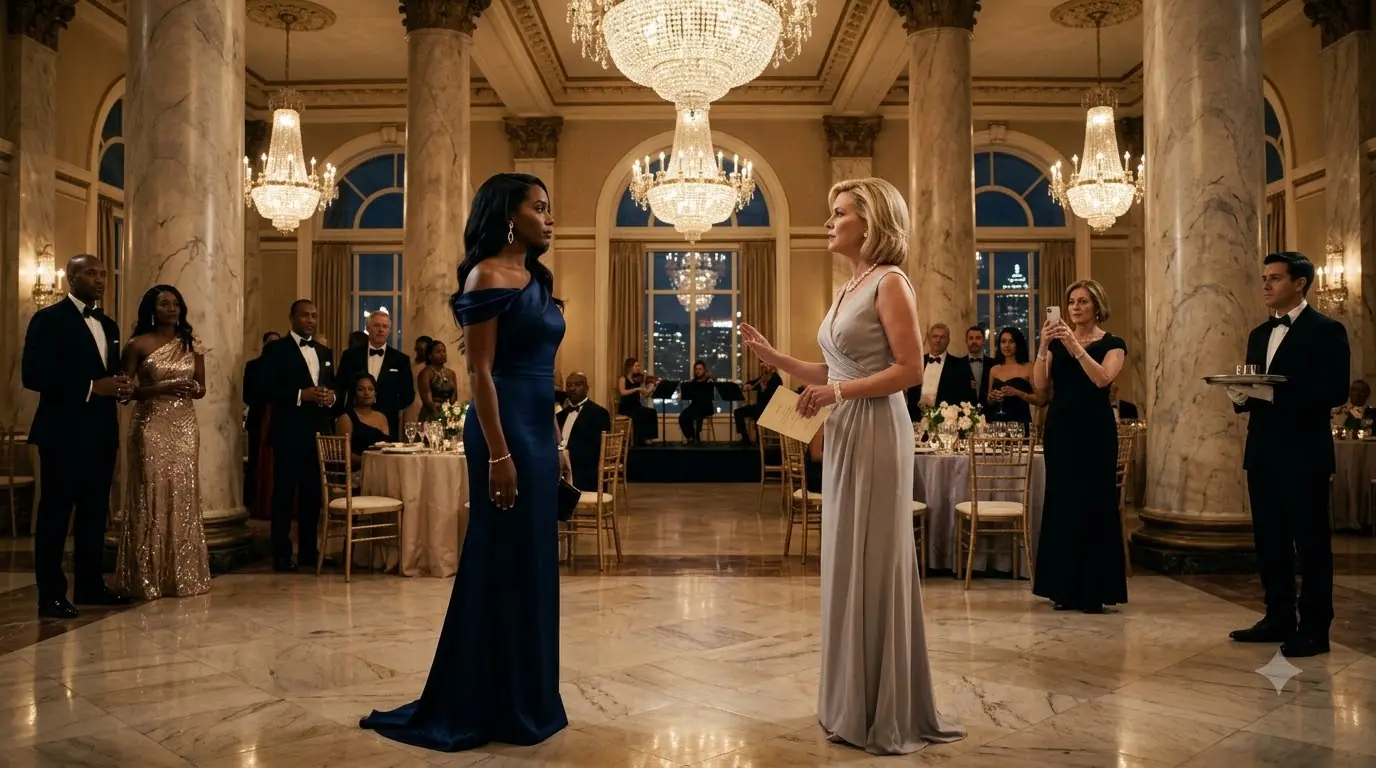
Around them, glasses hung suspended halfway to lips, a waiter stood motionless with a silver tray, and forty of the city's most influential guests watched the same terrible moment without stepping forward. Victoria's voice carried through the silence. "People like you don't belong here."
The woman did not answer immediately. She touched her cheek with two fingers, lowered her hand, and looked at Victoria with an expression so composed that several witnesses later remembered it more clearly than the slap itself. A pale mark was appearing along her cheekbone, but she neither retreated nor raised her voice. She reached into her evening clutch and took out her telephone. It would take less than half a minute for the consequences to begin.
"David," she said when the call connected, "cancel the meeting." She listened briefly, then added, "Suspend tomorrow's signing. Tell the committee I have a material concern about the people we're acquiring." Nothing in her tone suggested anger, and nothing suggested that she expected to be contradicted. She ended the call and looked once more at the woman blocking her way. "You may move now," she said quietly.
The guests nearest the table did not know they had just witnessed the end of an eleven-month negotiation. They did not know that the woman in blue was Maya Brooks, founder and chief executive of Apex Meridian Technologies, or that the company she had built from a twenty-thousand-dollar loan was now valued at almost forty billion dollars. They certainly did not know that the Whitmore family's largest chance to preserve its business depended on her approval of a proposed one-billion-dollar acquisition. In the elegant confusion of the ballroom, she had appeared to be a solitary guest who could be pushed aside without consequence.
Maya knew something the Whitmores had forgotten. In business, the most revealing decisions often happen outside the meeting where the documents are signed. A person might be gracious when a contract depended on it and cruel when nothing seemed to be at stake. As a Black American woman building her own company, she had spent eighteen years learning to tell the difference. Tonight, in less than a minute, a family famous for its impeccable manners had shown her exactly who they believed deserved those manners.
Earlier that evening, at 6:12, Maya had still been in her office, reading the final diligence memorandum beneath the muted glow of a desk lamp. Atlanta moved in small patterns of light beyond the fourteenth-floor windows, while the conference spaces behind her had gone dark. She had spent most of the day reviewing manufacturing forecasts, discussing an acquisition financing structure, and asking questions her advisers considered excessively detailed for a chief executive. Her deputy chief of staff had left a navy garment bag near the sofa. The gown inside was elegant without announcing what it cost.