“Go out with your ex,” I told my wife. “But when you come home tonight, don’t expect our marriage to still be waiting for you.”
For half a second, Vanessa’s smug smile vanished. It was the smallest change in her face, just a tightening around her mouth and a brief loss of confidence in her eyes, but after eight years of marriage I knew every version of her expression.
I knew the smile she used with clients, the one she used when she wanted something from me, the one she wore when she was embarrassed and pretending not to be, and the one she had begun using during arguments over the past year. That last smile was different. It said she had already decided I was unreasonable and was only waiting for me to prove it.
“What’s that supposed to mean?” she asked.
I didn’t answer.
The kitchen between us was still warm from the dinner I had cooked. A pot of pasta sat on the back burner with the sauce beginning to form a skin because neither of us had touched it. Two plates waited on the small walnut table beneath the window, and beside them stood the bottle of red wine I had opened twenty minutes earlier because I had believed, stupidly or optimistically, that Friday night still meant we might eat together.
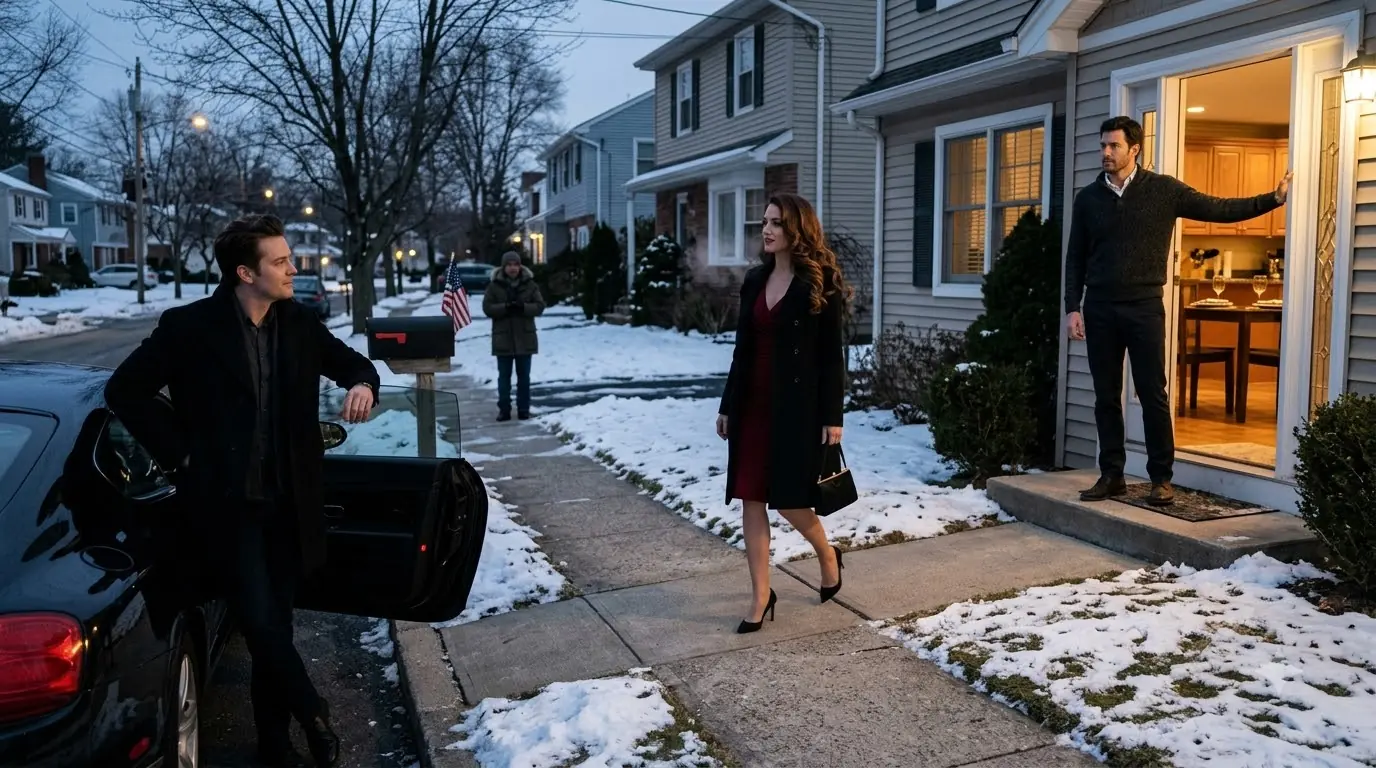
Outside, the bitter New Jersey wind snapped the small American flag beside our mailbox. The forecast said temperatures would fall below freezing before midnight. The branches of the maple in our front yard scratched softly against the siding, and every few seconds headlights moved across the kitchen wall as cars passed on the residential street. Inside, Vanessa stood in the red dress I had not seen since our anniversary dinner in Manhattan sixteen months earlier.
That hurt more than I expected.
Not because of the dress itself. Clothes were clothes. I had never wanted to be the kind of husband who monitored what his wife wore or demanded explanations for makeup, jewelry, or a night out. What hurt was remembering how carefully she had chosen that dress for me once.
She had stepped out of our bedroom in it, turned in front of the mirror, and asked whether it was too much. I had told her she looked beautiful. She had laughed and kissed me before we even left the house.
Now she had chosen it to go clubbing with her ex-boyfriend.
His name was Daniel Price. Vanessa repeated that name several times during the argument as if specificity made the situation innocent.
“His name is Daniel,” she said, keys swinging from one finger. “You know who he is. I’ve told you about him.”
“I know who he is.”
“Then stop acting like I’m sneaking off with some stranger.”
“I’m not acting like anything.”
“You are. You’re standing there doing that quiet thing because you want me to feel guilty.”
I looked at her. “Do you?”
She exhaled hard through her nose. “This is exactly what I mean.”
The conversation had started twenty-three minutes earlier when she came downstairs dressed to leave and casually announced that Daniel was picking her up in Jersey City. At first I thought I had misunderstood. She had said she was meeting “people from college,” something she had mentioned twice during the week. When I asked who was going, she named two women I vaguely knew and then Daniel as though he were an afterthought.
I asked whether Daniel was the same Daniel she had dated for almost three years before we met.
She said yes.
I asked whether she thought going to a club with an ex-boyfriend while married was something we should have discussed before she put on a dress and called the car.
That was when her tone changed.
“You don’t own me.”
“I didn’t say I did.”
“You’re acting like I need permission.”
“I said we should talk about it.”
“Same thing.”
“No, Vanessa. It isn’t.”
Then came the familiar sequence. I was insecure. I was controlling. I was making a normal social evening into a crisis because I could not handle the idea that someone she once dated could still exist in the same city.
She told me mature adults trusted each other. She said healthy marriages allowed independence. She asked whether I wanted her to stop having a life just because she wore a ring.
I listened longer than I should have, mostly because this was not the first argument in which she managed to place me on trial for asking a question.
For months, every uncomfortable fact in our marriage had been transformed into evidence of a flaw in me.
When I asked about the late-night phone calls, I was paranoid.
When I asked why her “girls’ nights” in Jersey City had become twice-weekly events, I was suffocating her.
When I noticed that a man named Adrian Voss called her at 1:18 one morning and that the entry had disappeared from her call history before breakfast, I was invading her privacy.
When I asked whether there was something she wanted to tell me, she stared at me across our bedroom and said, “You’re lucky I still come home.”
I never forgot that sentence.
It sounded casual when she said it, almost bored. But something in me registered it as a fact she had accidentally revealed. Home had become a favor she was doing me. Fidelity had become generosity. Our marriage was no longer something we both protected. It was something she could threaten to withdraw whenever I became inconvenient.
That Friday evening, she finally said it without disguise.
“If you don’t like me going clubbing with my ex, maybe we should just end this marriage.”
She stood across from me in the kitchen with one hand around her phone and the other holding her keys. Her posture was loose, almost amused. She expected a reaction. I could see it with sudden clarity.
She wanted the fight.
She wanted jealousy, anger, desperation. She wanted me to ask if Daniel still loved her. She wanted me to demand that she stay home so she could accuse me of control. She wanted me to beg her to choose our marriage over a night out, because once I begged, she would hold the power to decide whether I had begged convincingly enough.
I had done versions of that before.
Not tonight.
“Okay,” I said.
Her smile faltered.
“Okay?”
“Okay.”
“That’s all you have to say?”
“What would you like me to say?”
She stared at me.