CHAPTER 1: THE SILENCE SHE MISTOOK FOR SURRENDER
"Sign the assessment or I take your dock, old man. " Vanessa Coleman's boot cracked my porch board as she shoved the notice into my chest. You don't own that lake frontage, Mrs. Coleman. "I own this HOA. That's enough. " She just violated a deed she'd never bothered to read.
I didn't correct her, didn't raise my voice. I just glanced at the little black camera bolted under my eave, the one she'd never noticed, and let the silence sit there like a held breath. She smiled at that silence, mistaking it for surrender. "Smart man," she said, already turning for her BMW. She had no idea my land was platted in 1969, 22 years before her HOA existed.
No idea a folder was already growing with her name on every page. I could have ended this on my porch with one sentence, but that would have let her stop before she'd gone far enough to never talk her way out again. Was my silence weakness or the only way to make sure she couldn't lie her way free later? My name is Daniel Reeves, 55 years old, retired building safety inspector, and for 31 years I made my living reading structures the way other men read faces, looking for the crack nobody wanted to admit was there yet. I live alone now in the cabin my father built with his own hands in 1971, log by log, on the north shore of Silver Pine Lake.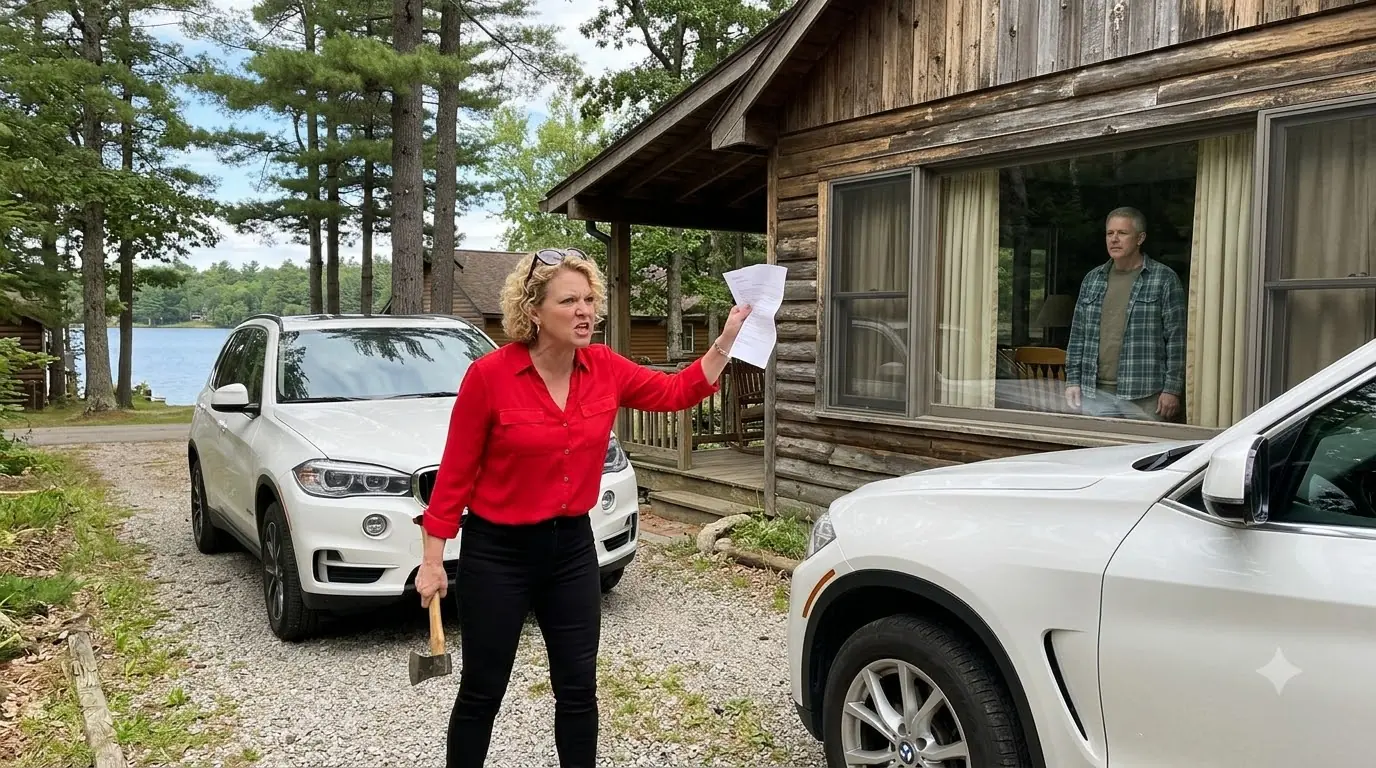
He used to say a building never fails all at once. It fails in silence first, a hairline in the foundation, a beam that groans a little louder each winter, long before anyone hears the crash. I spent three decades getting paid to notice that silence before it became a headline. That training doesn't turn off just because you retire. So when Vanessa Coleman started mailing violation notices for a dock my father built with lumber salvaged from an old grain elevator, I didn't see an angry neighbor.
I saw a stress crack, and cracks don't lie about where they came from. They just take time to show their whole shape. I've never been a man who raises his voice first. Not because I lack one, because in my old job, the inspector who shouted got ignored, and the inspector who waited, measured, and wrote it down got buildings condemned. Documentation outlives outrage every time.
I made coffee that morning, sat at the same pine table my father built, and reread her notice twice. "Wrong shade of brown," it said, about a fence that had weathered the same way for 40 years. How many people mistake a slow, deliberate man for a man with nothing to say? I already had a folder started. I just didn't tell her that yet.
I have one rule I've carried since my first year inspecting foundations. Never condemn a structure before it finishes failing on its own. Call it early, and the owner argues, appeals, drags in a second opinion, and the case drowns in doubt. Wait until the crack runs the full length of the wall, and no lawyer on Earth can talk his way around it. People think patience is passive.
It isn't. It's the most active thing I know how to do. So, when Vanessa's second notice arrived, my unsightly dock, the one my father built from grain elevator lumber the year I was born, I didn't call her. I didn't post about it. I photographed the notice, dated the file, and set it beside the first one.
There's a difference between staying quiet because you're afraid, and staying quiet because you're building something the other person can't see yet. I've been on both sides of that line in my life, and I know exactly which one erodes a man, and which one sharpens him. My father used to say something similar about houses. The ones that survive floods aren't the loudest ones warning everybody about the water. They're the ones with a foundation poured deep enough that the water simply can't reach what matters.
I decided early that Vanessa was going to keep going. People who mistake silence for surrender almost always do. It's a kind of hunger. The quieter I stayed, the bolder her signature at the bottom of each notice became. That told me more than any conversation could have.
Isn't it strange how the people most convinced of their own power are usually the ones who've never once been told no? I wasn't naive about what waiting would cost me. I knew there'd be a morning I'd want to shout back, a night I'd lie awake replaying her voice on my porch and wonder if I was being a fool instead of a strategist. Knowing the difference between the two in the moment is the hardest discipline I've ever practiced. Harder than any exam I sat for as an inspector.
But I also knew this. The day I finally spoke, I wanted it to be a day nobody could argue with. Not a shouting match on a porch. A fact laid on a table with a date stamp older than her entire organization. So I kept the folder growing.
I kept the coffee warm and I let her believe, one letter at a time, that I simply didn't understand what she could do to me. How much easier is it to underestimate someone the moment they choose not to fight back? Here is what I stood to lose if I waited too long. The dock itself. First, Vanessa's folder already had a contractor's estimate attached for its mandatory removal, dated two weeks out.
Then the fence. Then, if the pattern held, the cabin's lake frontage designation itself. The one thing that made this land worth more than the assessment fees she kept inventing. But that wasn't the real stake. Not the one that kept me up at night.
The real stake was the cabin's name on the county rolls. Still listed under my father's estate. Never fully transferred to my name after he passed. Vanessa's landscaping maintenance liens, if they went unpaid past 90 days, could attach to the property before probate even finished untangling the paperwork. I'd watched it happen to two other families already.
A grieving son too slow to act and a house he grew up in sold out from under him for less than a used truck. I wasn't just protecting a dock. I was protecting the only physical thing left of my father. Every log he'd notched, every board he'd measured twice before cutting once. How much does a person owe to a house that raised them long after the person who built it is gone?
If I move too soon, I might win a small argument and lose the war. A technicality overturned on appeal, a judge unimpressed by a retiree's grudge against his HOA. If I move too late, there'd be nothing left to win back at all. So, I called Andrea Kim, an old friend from my inspection days who'd since moved into the state Attorney General's office. Not to report anything yet, just to ask a careful sideways question.
Was anyone, anywhere, already looking at patterns like this? Her answer changed everything. Is it possible to lose the thing you're protecting simply by protecting it in the wrong order? Too fast or not fast enough? Andrea didn't say much on that first call.
She never does when something's live. But, there was a pause after I described the landscaping maintenance invoices. A pause I recognized from her courtroom days. It was the sound of someone recalculating who they were talking to. "How many invoices? " she asked, "And to which company? " I read her the name off Vanessa's own letterhead.
Coleman Grounds and Grading LLC. Same address as the BMW's registration I'd photographed in my own driveway 3 weeks earlier. Another pause, longer this time. "Daniel," she said, "Don't do anything yet, but don't stop watching either. " That single sentence told me more than a full confession would have. If this were nothing, she'd have laughed it off.
Instead, Andrea had just confirmed, without confirming anything, that I wasn't imagining a pattern. I was standing at the edge of one. That was the first real sign that Vanessa wasn't going to stop at my dock and fence. A woman running a private grading company out of her own HOA office doesn't stop at petty citations. She scales.
She needed homeowners to sell, not just comply. Sell fast. Sell cheap. Sell before anyone thought to check a deed. I thought about the three names Andrea had mentioned once, almost in passing.
Elderly owners two streets over who'd sold within weeks of a personal visit from Vanessa. I'd assumed it was coincidence. Coincidence doesn't usually come with a matching invoice trail. How many people get labeled difficult simply for noticing a pattern before anyone else admits it exists? I didn't call Vanessa.
I didn't confront her. I drove instead to the county records office the next morning, requested the original plat map for Silver Pine Lake, and waited at the counter while a clerk who'd known my father pulled a folder thick with dust. "1969. " She confirmed. 22 years before any homeowners association existed here at all. I folded the copy into my jacket pocket and said nothing to anyone.
Not yet. If you already hold the card that ends the game, does playing it early make you strong or does it just end the game before your opponent finishes proving what kind of player they are? The chance to end it early came sooner than I expected. Three days after the records office, at the mailbox cluster by the entrance road, where half the neighborhood happened to be standing when Vanessa pulled up in the BMW. "Mr.
Reeves. " She said, loud enough for the Hendersons to hear over their own mail. "I hope you're taking these notices seriously. Some people think slow walking a violation makes it disappear. It doesn't. It just makes the fine bigger. " I had the plat map folded in my jacket pocket at that exact moment.
I could have unfolded it right there, in front of six neighbors, and watched her face change in real time. It would have felt good for about 4 seconds, but 4 seconds of satisfaction wasn't the same as an ending nobody could reverse. "I hear you," I said, nothing more. I didn't raise my voice, didn't mention the deed, didn't so much as glance toward the paper in my pocket. She smiled, that particular smile people get when they think they've won something.
"Good," she said. "I'd hate for this to get complicated. " It already was complicated. She just didn't know how much, or in which direction. Walking back to the cabin, I turned over a question I'd asked myself plenty of times during 31 years of inspections. What's the cost of correcting someone the moment they're wrong versus the cost of letting them keep going until the whole structure of their own making collapses under them.
The first option feels satisfying. The second option is the only one that actually holds up in the end. I thought about the two elderly families Andrea had mentioned. The ones who'd sold their homes for pennies within weeks of a personal visit like the one I just had. If I expose the deed now, over a mailbox argument, I'd win a private battle and let every other pattern she'd built keep running quietly in the background.
The fraud wouldn't stop. It would just relocate. So I said nothing else. I let her drive off believing she'd delivered a warning to an old man who didn't have the stomach to fight back. How many people confuse a controlled silence for a defeated one?
Right up until the moment it costs them everything. I went home, added the mailbox conversation to my file with a timestamp, and kept the plat map exactly where it had been the whole time, folded, unused, waiting. Over the next few weeks, I did what I'd done for 31 years on every job site that made me nervous. I stopped reacting and started reading the whole structure, not just the crack in front of me. I drove past the two sold houses Andrea had mentioned, slow, the way you'd look at a foundation from the street before ever stepping onto the property.
Both had new owners already. Both had sold within 6 weeks of a personal visit from Vanessa. Neither family, according to the neighbors still left, had wanted to sell at all. I pulled the county's public assessment records for both addresses. Prices 20% to 30% under market.
Both closings handled by the same title company. Both sellers listed as motivated in the agent notes. A phrase that meant nothing on its own and everything once you saw it twice. I didn't call either family, not yet. I didn't know what I'd say that wouldn't spook someone into panic before I had enough to actually help them.
How much of what looks like coincidence is really just a pattern nobody has bothered to line up side by side. Instead, I kept building quietly. Dates, invoices, plat maps, the mailbox conversation, all of it filed under a single folder I didn't name after Vanessa. I named it after my father's cabin instead, Silver Pine 1971. It felt like the right thing to be protecting.
If a person is willing to let three families lose their homes quietly, what makes anyone think they'll stop at losing one man's dock? I started treating my own life like a job site under inspection, documenting everything, assuming nothing was too small to matter later. First, the camera under my eave. It had been recording for months on a loop, but I finally paid for enough cloud storage to keep 90 days instead of seven. Every visit from Vanessa, every notice she taped to my door, every angle of her BMW parked crooked across my gravel, all of it timestamped, backed up twice.
Second, I called Andrea again. This time on a line she told me was safe to use. "Don't file anything yet," she said. "If it connects to what we're already looking at across the county, a premature report could tip her off before we're ready. But, keep every date.
Keep every dollar figure. If this is what I think it is, timing is the whole case. I asked her what she meant by, "What we're already looking at? " She didn't answer directly. She just asked me to keep gathering quietly, patiently, like it was a foundation pour that needed to cure before anyone built on top of it. So, I did.
I requested certified copies of the plat map, not photocopies this time. The kind with a county seal that holds up in front of a judge. I pulled tax assessment histories on the two sold properties. I found the emergency levee repair assessment Vanessa had charged every homeowner eight months earlier, then drove out to the levee itself. No new concrete, no new drainage pipe, just the same cracked embankment that had been there since before she moved in.
Isn't it strange how the most damning evidence is often just the absence of the thing someone claimed to have built? I photographed the levy from four angles, matched the images to her invoice date, and added it to the folder. Still no confrontation. Still no confrontation. Just documentation, growing heavier every week, while Vanessa kept mailing notices to a man she believed had nothing left to say.
Silence has a cost, and mine came due that week. Vanessa filed a formal lien against the dock. Not a threat this time, an actual document recorded with the county, citing unremedied violations going back four months. My name, in black ink, attached to a debt I'd never agreed I owed. I found out from a neighbor before I found out from her office.
That's how she preferred to work. Let the news travel through the community first, so by the time it reached you, everyone already had an opinion. "She's not messing around, Daniel. " The neighbor said, not unkindly. "Maybe just pay it. Cheaper than a lawyer. " I'd heard some version of that sentence twice now from two different people who meant well and understood nothing.
I didn't correct him either. I said I'd look into it, thanked him, and went inside to add the lien filing to my folder. One more dated document, one more piece of a pattern only I could see the full shape of yet. How much easier would it have been in that moment to just be the man everyone assumed I already was. The lien didn't scare me.
What it confirmed was worse and better at once. Vanessa was willing to put her name on a legal filing built on nothing. That kind of overreach doesn't survive daylight. It just needed the right room to be exposed in. I wasn't in that room yet, but I could see the door now.
The community meeting was Vanessa's stage and she used it well. 40 homeowners in folding chairs, coffee in paper cups, and Vanessa at the front with a microphone she didn't need in a room that size. She'd added an agenda item "Ongoing noncompliance, Reeves property. " Right there on the printed handout. My name next to a violation count like a scoreboard. "Some residents," she said, not looking at me, though everyone knew exactly who she meant, "seem to think the rules don't apply to them because their family got here first.
I want to be clear. A deed from decades ago doesn't override an HOA's authority today. " A ripple of laughter. Not cruel, just the sound of a room agreeing with the person holding the microphone. I sat in the back row and said nothing. "I've given Mr.
Reeves every opportunity to resolve this like an adult," she continued. "At some point, silence just means someone knows they're wrong. " She'd said it out loud in front of 40 witnesses on a night the meeting minutes would record verbatim. "Silence just means someone knows they're wrong. " I almost smiled. She just told an entire room exactly how she planned to keep misreading me. On the record, in writing, with a date attached.
How many people build their whole confidence on a single misunderstanding, never once checking if it's true? After the meeting, two neighbors caught up to me in the parking lot. "You're really not going to say anything? " one asked, genuinely puzzled, maybe a little disappointed in me. "Not tonight," I said. I drove home with the meeting minutes already emailed to me from the HOA secretary, a courtesy copy sent to every homeowner named on the agenda.
I printed it, dated it, and added it to the folder, now 3 inches thick. If a person is loud enough about your silence, does that make them powerful? Or does it just mean they've started keeping a written record of their own overreach? The lien was the first domino. Once it recorded with the county, other systems started noticing on their own, without me lifting a finger.
A contractor Vanessa had hired to assess dock removal showed up unannounced one morning, tape measure in hand, and got as far as my property line before I stepped outside. I didn't yell. I asked calmly whether he had a court order or a signed easement authorizing entry. He didn't. He left within 2 minutes, visibly uncomfortable, and I'd learn later, he mentioned the exchange to another contractor at the lumber yard, who mentioned it to someone else.
Small towns move information faster than any subpoena. Then the county clerk's office called me directly, which had never happened in 6 months of notices. A woman named Patricia, who'd apparently processed the lien filing herself, asked if I was aware that the parcel in question had a recorded plat date that predated the HOA's incorporation documents. She wasn't supposed to say that much. She said it anyway, in the careful tone of someone who'd noticed something and didn't love what it implied about her own office's paperwork.
I thanked her and said I was aware. I didn't explain further. I added her name and the date of the call to my file. Andrea called 2 days later, her voice different than before, sharper, more official. "Daniel, I need you to understand something. " This isn't just your case anymore.
We've had three other counties flag similar patterns. HOA presidents, related contracting companies, elderly homeowners pressured to sell under assessment threats. Yours is the cleanest paper trail we've seen. The plat map alone could unravel the whole assessment scheme if it's timed right. Timed right there it was again, the thing everyone kept telling me mattered more than being correct.
"How long? " I asked. "Weeks, not months," she said. We need one clean, undeniable moment. Something public enough that she can't spin it afterward. I hung up and sat at my father's table for a long while thinking about how many people, Patricia at the clerk's office, the contractor at the lumberyard, two elderly families who'd already lost their homes, had each noticed a fragment of the same track without ever seeing the whole wall.
How many small, quiet observers does it take before a pattern becomes impossible to deny? I didn't sleep much that night, not from fear, from the particular restlessness of knowing the ending was close and still not being allowed to reach for it yet. Patricia called again the following week, this time not about the plat map. I probably shouldn't mention this, she said, but Mrs. Coleman came in yesterday asking how quickly a lien could convert to a forced sale.
She specifically asked about elderly homeowners with no mortgage on record. I thought you should know someone's paying attention to which of you can't easily fight back. I thanked her and said nothing else. She didn't ask why I wasn't more alarmed. Maybe she assumed I already knew.
Maybe she just didn't want to know how much I actually knew. There was another person, too. Harold, two docks down, 81 years old, who stopped me at the boat launch and said, quieter than usual, you're not like the others who got a visit from her, are you? " Not quite a question, I didn't answer directly. "Keep your paperwork somewhere safe, Harold. " I said, "All of it. Every notice she's ever sent you. " He looked at me a long moment, then nodded like a man filing away an instruction he didn't fully understand yet, but trusted anyway.
How many people sense the truth about someone long before they have the words or the proof to say it out loud. I drove home thinking about how many quiet witnesses were accumulating around this, each holding one piece, none holding the whole picture except me and Andrea. That imbalance wouldn't last much longer. It wasn't supposed to. The lien had a clock on it, and that clock was the deadline I'd been waiting for without ever saying so out loud.
90 days from filing, unpaid liens on Silver Pine Lake properties converted automatically to a forced sale petition. A quirk of the county's old assessment code that Vanessa clearly knew and was clearly counting on. Day 61, a certified letter arrived confirming it in writing. 29 days remaining before the cabin my father built could be scheduled for auction. 29 days, not months, not a vague someday, an actual date circled in red on the calendar by my kitchen table.
I called Andrea that same afternoon, and for the first time in weeks, I heard urgency in her voice instead of caution. "That timeline works in our favor," she said. "We need the reveal to happen before day 90, not after. If we wait past the deadline, it looks reactive, like you're using us to dodge a legitimate debt instead of exposing a fraud. "So, when? "" I asked.
"There's a legislative visit already scheduled for HOA reform. The Attorney General's touring three counties next week, announcing new oversight rules. Silver Pine is on the list because of the complaint volume here. It's public. It's innocent.
Nobody has to know it's anything more than a photo opportunity. A photo opportunity that happened to be scheduled at my cabin. How much of justice is really about being right? And how much is about being right at the exact moment someone can't argue their way out of it? I didn't sleep well counting down those 29 days, watching the number shrink a little more each morning, knowing the folder was finally thick enough, knowing the deed was finally old enough, knowing that everything I'd swallowed for 6 months had been leading to a single afternoon I couldn't move up and couldn't afford to miss. " Andrea drove out 3 days before the visit, this time in person, and spread everything across my kitchen table like pieces of a structure finally ready to be assembled.
The certified plat map, county seal intact, dated 1969. The lien filing with Vanessa's own signature and the assessment figure that didn't match any actual work performed. The emergency levee repair invoice, matched against my photographs of the untouched embankment, four angles, timestamped. The $90,000 landscaping contract paid to Coleman Grounds and Grading LLC, a company whose registered agent, according to the state business registry Andrea had pulled that week, was Vanessa's husband, Robert Coleman. "This last one is what turns it from a local dispute into a pattern," Andrea said, tapping the registry printout.
"Three counties, same invoice structure, three different HOA presidents, all with a spouse or relative running the maintenance company on the other end. Yours is the only one with a plat map clean enough to disprove jurisdiction outright. " She pulled out one more document, a list of the two families who'd sold near me, plus a third Andrea's office had found in a neighboring county, all sold within weeks of a personal visit, all at 20% to 30% under assessed value, all through the same title company. We have enough, she said. We've had enough for 2 weeks. What we didn't have was the moment.
The moment was 3 days away. I asked her what would happen once the reveal came. She was honest with me, which I appreciated more than reassurance would have. If she reacts the way people like this usually react, publicly, defensively, in front of witnesses, it writes itself. If she stays calm and lawyers up quietly, it takes longer, but the paper trail still convicts her eventually.
Either way, you don't lose the cabin. That part's already been secured administratively, once the plat map hit our system. I hadn't realized until that sentence how much weight I'd still been carrying about the cabin itself. The actual wood, the actual dock, the physical proof my father had ever existed on this shore. Andrea gathered the documents back into a single sealed folder and looked at me the way she used to look at case files right before trial.
You did the hard part already, Daniel. Six months of not saying anything. That's harder than anything I do in a courtroom. I didn't feel like it had been hard, exactly. It had felt like waiting for a foundation to cure before you trust it with weight.
Is the version of justice built slowly, quietly, over months, ever weaker than the version that arrives in a single loud moment? Or is it simply the version nobody can knock down afterward? 3 days. I marked it on the calendar, right below the lien deadline that no longer scared me at all. 2 days before the visit, Vanessa posted in the neighborhood group chat a screenshot of the lien filing, my name circled in red, captioned, "Some people think their family name puts them above the rules.
The county disagrees. Auction proceedings begin in 26 days if unresolved. #accountability #HOAstrong. " 43 comments in an hour. Most agreed with her. A few tagged me directly, asking if I had anything to say for myself. I had plenty to say.
I said none of it. Then came the visit to my mailbox that afternoon. Not a notice this time, but Vanessa herself, smiling in a way I hadn't seen from her before. Satisfied, finished. "I heard you might be selling," she said.
"Smart move. Honestly, save yourself the embarrassment of an auction. I know a buyer who'd take it off your hands fast. Fair price, given the circumstances. " A buyer she knew. Fast, fair, given the circumstances she'd created herself.
"I'm not selling," I said. "That's your choice," she said, already walking back to her car. "I just think you're out of options, Mr. Reeves. I usually am right about these things. " She drove off looking like a woman who'd already redecorated my dock in her head.
That night was the closest I came to breaking my own rule. Sitting alone at my father's table, reading 43 strangers' comments agreeing that I was the problem, watching the lien countdown tick down to 26 days, I felt something I hadn't let myself feel in 6 months. Real doubt. Not about the facts, about the cost of holding them back this long. What if Andrea's timeline slipped?
What if the Attorney General's visit got postponed, the way public schedules sometimes do? What if I lost the actual physical cabin while I was busy being patient and strategic and smart about it? Is it possible to be completely right and still lose everything, simply because the truth didn't arrive in time? I thought about calling Andrea that night and asking her to move faster, screenshot the lien filing back to the county myself, do something, anything, other than wait one more day for a photo opportunity that suddenly felt fragile and far away. I didn't call.
I sat with the doubt instead, the way I used to sit with a hairline crack on a job site before deciding whether it meant something or nothing. Not comfortable, not calm, just present with it long enough to know it wasn't fear making the decision for me. 43 comments, 26 days, one woman 2 mi away, certain she'd already won. How much does it cost a person to keep believing in a plan on the one night it looks like it might not work. My father never talked much about the years before he built this cabin.
I only learned pieces of it after he died. That he'd grown up watching his own father lose a family orchard to a man who moved fast, argued loud, and had better lawyers than facts. My grandfather fought back immediately, every time, on every point, and lost the orchard anyway, piece by piece, because he never once let a single injustice sit long enough to become undeniable. My father built this cabin log by log on land he made sure was properly platted, properly recorded, properly his. Not because he was paranoid, but because he'd watched what happens when you don't have paper strong enough to survive an argument.
Measure twice, he used to say, and not just about lumber. I understood sitting with my doubt that night that this patience wasn't really a strategy I'd invented. It was something inherited, passed down from a man who'd learned the hard way that being right isn't the same as being protected. He would have hated the auction notice. He would have hated Vanessa's smile at my mailbox even more.
But I think he would have understood exactly why I hadn't unfolded that plat map yet, why I was letting 26 days count down instead of 10, why I'd let a woman post my name to 43 strangers rather than end it in a group chat where nothing sticks and nobody remembers who was right by morning. Some fights aren't won by being correct. They're won by making sure correctness has nowhere left to hide from. What do we actually inherit from the people who raised us? The land itself or the patience it took them to keep it?
I thought about Harold, two docks down, quietly gathering his old notices because I'd asked him to. I thought about the two families who'd already lost their homes, who hadn't had anyone tell them to wait, to document, to hold on three more months. I hadn't been fast enough to save them. I could still be exact enough to make sure nobody sold cheap out of fear again after this. That was worth one more sleepless night.
The morning of the visit, my driveway filled with vehicles that had no business looking as ordinary as they did. A dark sedan with government plates parked exactly where Vanessa usually left her BMW, two unmarked cars behind it, Andrea's own car last, closest to the porch. Nobody in the neighborhood knew yet that this was anything more than what the press release said it was, a routine visit from the Attorney General's office touring three counties announcing new HOA oversight legislation, choosing Silver Pine Lake as a stop because of community engagement around recent reform proposals. True, technically, just not the whole truth. Inside my cabin, the Attorney General herself sat at my father's pine table, the same table where I'd read Vanessa's first notice six months earlier, the same table where Andrea had spread every document three days before.
For six months, Vanessa had mistaken Daniel's silence for weakness while every notice, invoice, lien, and threat became another piece of evidence. By the morning the Attorney General arrived at his cabin, the truth was finally ready to surface somewhere she could no longer control.
>>>>>>NEXT CHAPTER 2: WHEN THE PAPER TRAIL FINALLY CLOSED IN<<<<<<