She Ordered Him to Remove 43 Longhorns — Then He Asked One Quiet Question
Reader Theme:
Font Size:
24px
""Your cattle are in violation of community standards. You have five days to remove every animal from this property or we will pursue enforcement action. "" She said it the way someone says a thing they have rehearsed, standing at the edge of my gravel drive in a blazer the color of a storm cloud, a clipboard pressed against her chest like a shield. Behind her, a white SUV sat idling in the August heat, its air conditioning running, its tires clean. I looked at her for a moment, then I looked past her, out across the pasture where 43 longhorns stood in the yellow grass, their horns wide and curved and unhurried, the way longhorns always are when they have enough room to be what they are. I did not say anything right away.
There was a lot I could have said, what I chose not to say, at least not yet, was this. The land beneath her feet, the road she had driven in on, the gate she had pushed open, the pasture those cattle were standing in, all 12,000 acres of it was mine. Had been mine for 11 months, had been my family's for longer than she had been alive. I held the deed. I had read it.
And nothing in it, not one recorded word, placed this property inside the jurisdiction of Creekstone Bend HOA or anyone who spoke on its behalf. Drop a comment. Tell me where you're from. And if something like this has ever happened to you, I want to hear it. The longhorns shifted in the distance.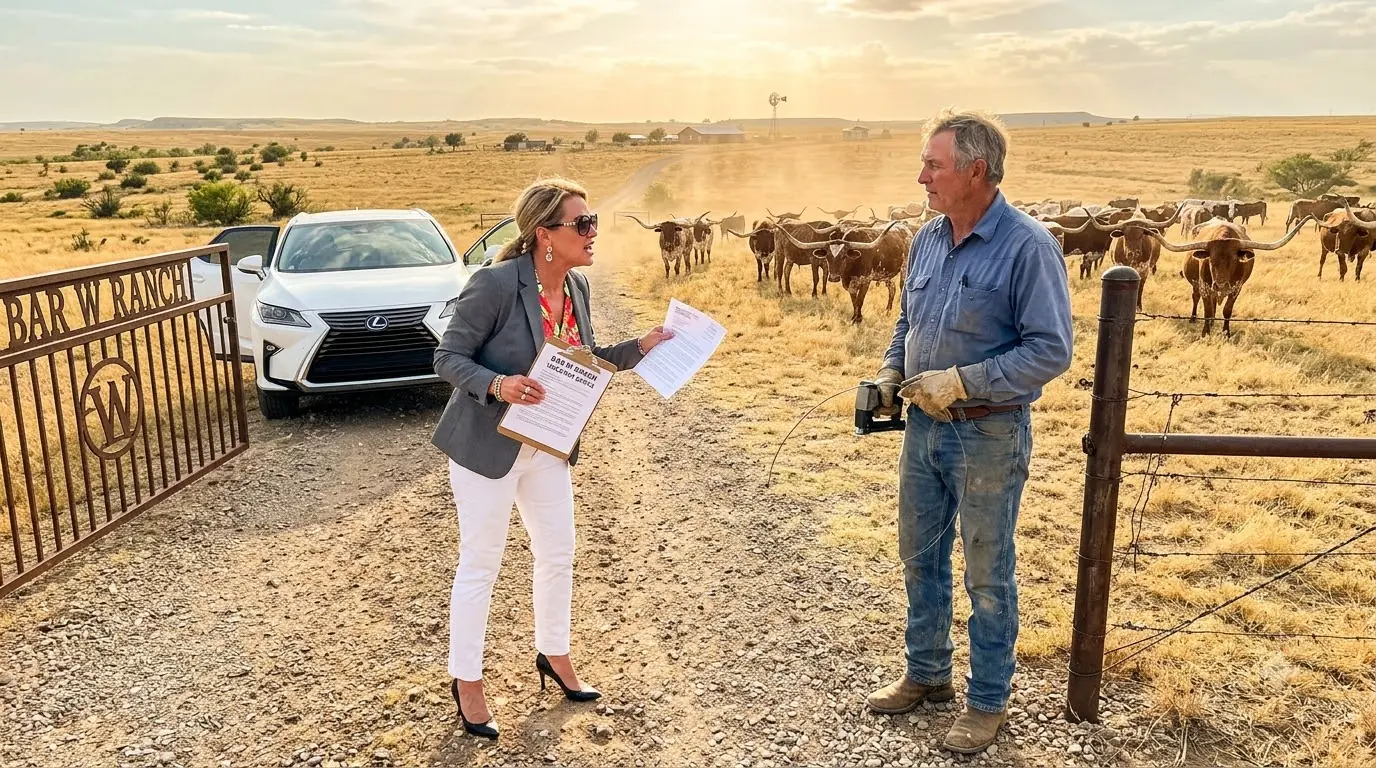
One of them raised its head and looked toward the road with the mild curiosity of an animal that has never needed to worry. I set down the fence stapler I had been holding and waited for her to finish. Her name, she told me, was Diane Collier, director of community standards for Creekstone Bend. She said the title the way someone says a title they have earned, with a slight forward lean that was meant to communicate authority. I noted it.
I noted the clipboard, the laminated badge, the way she glanced at the cattle as if they were an offense the land itself had committed. Then I thanked her for coming, took the document she offered, and told her I would review them carefully. She seemed to expect something more than that. She did not get it. I went inside and put the kettle on and sat down at the kitchen table with her paperwork, and I read every word of it the way my grandfather taught me to read a contract, slowly, twice, with a pencil in hand and nothing else on the table.
My grandfather's name was Emmett Callaway. He came to this part of West Texas in 1951 with a surveyor's plat, a handshake loan from a cattle broker in Abilene, and the kind of stubbornness that only makes sense in retrospect. He had grown up in a county where land meant survival, not aesthetics, and he had spent his early adulthood learning what the land could give you if you did not waste it. He bought the first 300 acres that year. He bought more in 1957, more again in 1964.
And by the time my father was old enough to ride alongside him in the pickup, the property had grown to just over 4,000 acres of short grass prairie, cedar breaks, and two seasonal creeks that ran clear in the spring and went quiet in the summer. My father, Robert Callaway, added to it. Not all at once. Land like this does not come available all at once, but in pieces over decades. Whenever a neighboring parcel came to market and the price was honest.
He was not a speculative man. He bought land he intended to use and used it the way his father had. Cattle, fence maintenance, water management, patience. By the time I was old enough to understand what I was inheriting, the property had grown to just over 9,000 acres and the longhorn herd my grandfather had started with a dozen head had grown to more than 200. My name is James Callaway.
I'm 61 years old and I spent the first 30 years of my work in life as a civil engineer in San Antonio coming back to the ranch on weekends and summers, helping my father with what needed doing, learning the land the way you learn a language, slowly, through repetition and attention until it stops feeling foreign. When my father died 18 months ago, he left the property to me outright. By then, through a final acquisition he had completed just before his health declined, the total acreage had reached 12,040 acres. I moved back full-time 11 months ago. I brought my tools, my files, and what remained of the herd.
I had no plans to sell. I had no plans to leave. I had every intention of continuing what Emmett Callaway had started in 1951. The deed was in a fireproof box in the back bedroom, the same box my father had kept it in, the same box his father had kept it in before him. It was not that a complicated document as deeds go.
It described the property by metes and bounds across 14 pages, referenced the original survey from 1951, incorporated all subsequent recorded acquisitions, and named me, James Robert Callaway, as sole owner of record. No encumbrances, no easements granted to any homeowners association, no covenants, conditions, or restrictions running with the land that bore any relationship to Creekstone Bend or its community standards. The property had never been part of a subdivision. It had never been platted into residential lots. It had been for 73 years a working cattle ranch, and the only authority that had ever governed what happened on it was the family that owned it.
I set Diane Collier's paperwork beside the deed and looked at both of them for a long time. Her documents were dense with language that sounded official but cited nothing. There were references to community guidelines, to aesthetic standards, to a provision she called Section 12 B of the Creekstone Bend covenant and restriction agreement, which she claimed prohibited the commercial keeping of livestock within the community boundary. There was a map attached, a small printed map with a red boundary line drawn around an area that included, apparently, a significant portion of my western pasture. The map had no scale.
It had no survey reference number. It had no recording date. It was, as far as I could determine, something someone had drawn on a computer and printed at the office. There was also a fine. $250 per day beginning on day six if the cattle had not been removed. I read Section 12B twice.
It prohibited the keeping of livestock within the Creekstone Bend Planned Unit Development. The key word I noted with the pencil was within. The question of whether my land was within anything Creekstone Bend had legal authority over was not answered anywhere in Diane Collier's paperwork. It was simply assumed. I put the pencil down.
I picked up the phone and called an attorney named Patricia O'Shea, who had handled the title work on my father's final acquisition and who had a working knowledge of rural property law in this part of Texas that I trusted more than most. I told her what had arrived in my driveway that morning. She was quiet for a moment on the other end of the line and then she said, ""Send me everything. Don't respond to them yet. "" I scanned all of it and sent it that afternoon. Then, I went back outside and checked the fence line along the western pasture.
The one that showed up inside that red boundary on Diane Collier's printed map. The cedar posts were solid. The wire was tight. The longhorns grazed in the late afternoon light, their coats the color of rust and dust, their horns throwing long shadows across the grass. A red-tailed hawk turned slow circles above the far tree line.
Everything was as it had been the day before and the day before that and for 73 years before I was born. I was not angry. I want to be clear about that. What I felt standing at that fence line in the August heat was something closer to professional interest. The same thing I used to feel when a contractor submitted a bid with numbers that didn't add up.
There was a discrepancy somewhere in Diane Collier's paperwork and I intended to find it. Patricia called back two days later. She had pulled the Creekstone Bend Planned Unit Development Plat from the County Recorder's Office. The original recorded plat, not a printed map from someone's office computer. She had also pulled the metes and bounds legal description attached to the HOA's declaration of covenants, conditions, and restrictions.
The document that defined what land the HOA actually had jurisdiction over. She had laid both of them against my deed. James, she said, ""Their western boundary line ends at the Creekstone Bend subdivision perimeter. Your property line begins 112 feet east of their recorded boundary. There is no overlap.
There is no shared parcel. There is no easement, no annexation, no recorded instrument of any kind that extends their jurisdiction to your land. "" I asked her to say that again. She did. The red boundary on Diane Collier's printed map was not a legal boundary. It was a line someone had drawn, possibly in good faith, possibly not, that extended well past the recorded limits of the Creekstone Bend PUD and onto land that had belonged to the Callaway family since before the HOA had existed.
The HOA had been incorporated in 1987. My grandfather had owned this land since 1951. The math was not complicated. Patricia recommended we request a formal survey of the boundary line before doing anything else. She wanted a licensed surveyor to put stakes in the ground and produce a sealed, recorded document that would be admissible in any proceeding.
I told her to proceed. She said the survey would take approximately three weeks, given the size of the parcel and the terrain involved. three weeks was fine. The cattle were not going anywhere. I did not respond to Diane Collier's letter. I did not call her office.
I did not post anything online or speak to any of my neighbors about what was happening, though one of them, a man named Gerald Hutchins, who ran a small pecan operation on the property adjacent to my eastern boundary, had already called me to say that he had seen the white SUV parked at my gate and wanted to know if everything was all right. I told Gerald that everything was proceeding normally and that I would keep him informed. He said, ""You need anything, you call me. "" And I believed him. The survey crew arrived on a Tuesday morning. Four people with GPS equipment and a truck full of stakes and orange flagging tape.
They spent 3 days on the property, moving methodically from corner to corner, cross-referencing the original 1951 survey, the subsequent acquisition documents, and the county's recorded plat maps. I gave them access to everything they needed and stayed out of their way. On the third afternoon, the lead surveyor, a woman named Carol Denham who had been doing boundary work in this county for 22 years, walked back to the house with me and spread her preliminary findings across the kitchen table. The boundary line was exactly where Patricia had said it would be. 112 ft east of the Creekstone Bend perimeter.
Every inch of my western pasture, including the ground Diane Collier's printed map had colored red, was on my land. Had always been on my land. The survey would be sealed, signed, and submitted for recording within 10 business days. Carol Denham looked at the preliminary plat, then at the copy of Diane Collier's letter I had left on the table, and said, ""Well, that's interesting. "" That was all she said. It was enough.
The sealed survey arrived from Carol Denham's office on the ninth day, delivered by courier in a flat cardboard envelope. I signed for it at the door, carried it inside, and set it on the kitchen table beside the deed, and beside Diane Collier's original paperwork, which I had kept in a manila folder labeled with the date of her visit. The survey was 14 pages, including the plat drawn, the metes and bounds legal description, and Carol Denham's professional certification. It referenced the county recording number for the original Callaway deed, the 1951 survey, and each subsequent acquisition. It placed every stake, every line, every corner of my property in precise, recorded, legally defensible language.
The western boundary of my land was 112 ft east of the Creekstone Bend Planned Unit Development Perimeter. The survey confirmed it. The county records confirmed it. The deed confirmed it. There was no instrument, no covenant, no recorded agreement of any kind that gave Creekstone Bend HOA jurisdiction over a single blade of grass on my property.
Patricia filed a formal response to the HOA's demand letter that same week. It was four pages, single-spaced, and it cited the recorded plat number, the survey recording number, the deed instrument number, and the specific language of the Texas Property Code governing the territorial limits of a homeowner's association's enforcement authority. The response did not threaten. It did not demand. It stated, with precision and without embellishment, that the HOA's claimed jurisdiction over the Callaway property had no legal foundation in any recorded instrument, that the boundary depicted on the HOA's printed map did not correspond to any recorded survey or plat, and that any further enforcement action taken against the property or its owner would be treated as a tortious interference with property rights under Texas law.
It enclosed, as exhibits, a certified copy of the deed, a certified copy of the recorded survey, and a copy of the relevant Creekstone Bend PUD plat showing the recorded boundary line. It asked for a written response within 14 days confirming that the HOA had withdrawn its demand and would take no further enforcement action. Patricia sent it by certified mail, return receipt requested. She sent a copy to the HOA's registered attorney of record, whose name appeared on the original demand letter in small print at the bottom of the page. She sent a copy to the county attorney's office as a matter of record.
I kept a copy in the manila folder with everything else. The folder was getting thick. Outside, the longhorns moved through the late morning light in the way they always did, unhurried, wide-horned, occupying the land the way the land was meant to be occupied by animals that belonged to it and an owner who understood what that meant. The grass was dry but holding. The cedar posts along the western fence were solid.
Emmett Callaway had set some of those posts himself back when this part of Texas was quieter than it is now, back when a man's deed was the beginning and end of the conversation. I had the deed. I had the survey. I had the record. The cattle were not going anywhere.
The 14 days Patricia had requested passed without a written response from Creekstone Bend HOA. What arrived instead on the morning of the 15th day was not a letter from their registered attorney. It was a second notice formatted identically to the first bearing Diane Collier's name and title at the bottom, and it escalated the original demand in two directions at once. The fine had been recalculated at $250 per day beginning on day six of the original notice. The HOA now claimed I owed $4,250 in accrued penalties.
And the notice added something new, a claim that the cattle operation constituted a public nuisance under a provision they called Section 14A of their covenant agreement, which they said empowered the HOA to seek injunctive relief in county court if the violation was not cured within 10 additional days. I read it twice with a pencil, the way my grandfather had taught me. Then, I set it in the manila folder, which I had by now moved to a banker's box, and I called Patricia. She had already received her copy. She was not surprised.
She told me that the second notice was a litigation threat dressed in administrative language, and that the reference to injunctive relief was meaningful because it meant Creekstone Bend was now contemplating asking a judge to order the removal of my cattle. She said this was, in her professional opinion, an extraordinary thing to attempt given the state of the record. She also said it was not impossible that they would try because organizations sometimes pursue claims their attorneys have not fully examined, particularly when the board directing the action is confident and the attorney is billing by the hour. I asked her what she recommended. She said we should file a declaratory judgment action in county district court asking the court to formally declare that my property was not subject to the Creekstone Bend covenants, and that the HOA had no enforcement authority over it.
She said a declaratory judgment would accomplish two things. It would put the question before a judge on our terms rather than theirs and it would create a binding legal record that would end the matter permanently. Not just for this dispute, but for any future board that might revisit the same claim. I told her to file. The petition was prepared over the following week.
It was a careful document, 22 pages in its final form, and it told the story of the property the way the records told it. Chronologically, precisely, with every instrument cited by its recording number and date. It began with the original 1951 deed in Emmett Callaway's name, traced each subsequent acquisition through my father's final purchase, and established the chain of title through to my own ownership. It attached the sealed survey from Carol Denham as exhibit A. It attached the recorded Creekstone Bend PUD plat as exhibit B with the HOA's own recorded boundary line highlighted in the plat drawing.
It attached both of Diane Collier's demand notices as exhibit C. And it attached as exhibit D the recorded Declaration of Covenants, Conditions, and Restrictions for Creekstone Bend with the territorial scope language underlined. That language was the center of everything. The Creekstone Bend Declaration, recorded in 1987 with the county clerk, defined the association's jurisdiction as the real property described in the Creekstone Bend Planned Unit Development Plat Book 14 pages 22 through 31 of the official records of the county. That was the boundary.
That was the limit. The declaration did not claim any authority beyond the recorded plat. It could not have because the land beyond that plat belonged to someone else and had since 1951. And no one in 1987 had the legal authority to extend a covenant's reach across a boundary they did not own. The petition asked the court to declare as a matter of law that the Callaway property was not subject to the Creekstone Bend Declaration of Covenants, Conditions, and Restrictions.
That the HOA had no authority to impose fines, issue notices, or seek injunctive relief against the property or its owner. And that the accrued fine of $4,250 was void and uncollectible. It also asked for attorney's fees under the Texas Declaratory Judgments Act, which permits a court to award fees to the prevailing party when the action is brought to settle a genuine dispute about legal rights. Patricia filed it on a Thursday morning. The filing fee was $312.
I paid it without complaint. The case was assigned to the district court and given a cause number. And the HOA's registered attorney of record was served by process server the following Monday. Gerald Hutchins called me that evening. He had heard through the particular telegraph that operates in small rural counties that papers had been filed and he wanted to know how things were progressing.
I told him that the matter was now before the court and that I expected it to be resolved on the merits of the record. He was quiet for a moment, and then he said that he had known this land since before I was born, that he had watched my father work it, and his father before him, and that it had always struck him as a piece of ground that knew what it was. I did not know exactly what he meant by that, but I understood it. The longhorns were doing well. The summer grass was dry, as it always is in August in West Texas, but the water tanks were holding, and the herd was in good condition.
I had 43 head in the western pasture and another 62 in the south pasture, beyond the cedar breaks, where the ground was rougher and the shade came from the trees, rather than from any structure. I checked the fence lines every morning, the way my father had, walking the wire with a stapler on my belt and a pair of pliers in my back pocket, looking for anything that needed attention. Most mornings, there was nothing. Some mornings, there was a post that had worked loose in the caliche soil, or a stretch of wire that had gone slack where a deer had pushed through in the night. I fixed what needed fixing and moved on.
It was useful work. It kept my hands occupied while the legal process moved at its own pace, which is always slower than a person would prefer, and always faster than it feels from the inside. The HOA's attorney filed a response to the petition three weeks after service. It was a motion to dismiss, arguing that the court lacked jurisdiction to hear a declaratory judgment action brought by a property owner who was not a member of the association and had no standing to challenge the association's governing documents. It was a procedural argument, not a substantive one, and Patricia had anticipated it.
She filed a response within 10 days, citing the Texas Declaratory Judgments Act's broad standing provisions and attaching a supplemental declaration from Carol Denham, the surveyor, attesting under oath to the location of the boundary line and the absence of any recorded instrument connecting the Callaway property to the Creekstone Bend PUD. The motion to dismiss was denied. The judge set a hearing date. I noted that. I noted it the way you note the moment when a discrepancy in a set of numbers finally resolves itself into a clean answer.
The record was speaking. It had been speaking since the first day I pulled the deed from the fireproof box, since Patricia had read the plat against the metes and bounds description and found the gap of 112 ft, since Carol Denham had driven her stakes into the caliche and certified what the ground had always known. The court was now going to listen to what the record said. I was not impatient. Patience, in my experience, is not a virtue in the sentimental sense.
It is a discipline, the same discipline my grandfather had when he bought land in pieces over decades rather than all at once, the same discipline my father had when he held the property through drought years and market downturns and never sold an acre he did not intend to sell. Patience is what you practice when you know the record is on your side and the only remaining question is how long it will take the other party to understand that. The hearing was set for the third week of October. I went back out to the western fence line that afternoon. The same stretch of cedar posts and tight wire that Diane Collier had stood near on the August morning when this had all begun.
The light was different now. The summer heat had broken a few weeks earlier and the air carried the particular dryness of a West Texas autumn. Clean and faintly mineral. The smell of caliche dust and dried grass and the distant cedar that my grandfather had always said smelled like something older than memory. The longhorns were in the north pasture today moving slowly along the waterline.
Their horns catching the late afternoon light in the way that never gets ordinary no matter how many times you see it. I stood at the fence and looked out across the land. All of it. The short grass running west toward the cedar breaks. The dry creek bed that would run clear again in the spring.
The low ridge to the south where my grandfather had once pointed and said, ""That's ours to the top of that rise and a quarter mile beyond. "" He had said it with the quiet certainty of a man who had read his deed and trusted what it said. I had inherited that certainty along with the land. It was in some ways the more valuable of the two. The survey stakes were still in the ground along the western boundary. Carol Denham's orange flag and tape faded now but still visible in the grass.
Marking the line between what was mine and what was not. The line had always been there. It had been recorded in 1951 and confirmed in every subsequent instrument. The only thing that had changed was that someone had drawn a different line on a computer and assumed no one would check. I had checked.
The record had answered. The court would now be asked to say so formally and I had no reason to doubt that it would. The longhorns moved along the waterline in the fading light, unhurried as they always were, as they had always been on this land, as they would continue to be when this particular chapter of the property's history was closed and filed and added to the banker's box with everything else. The cedar posts were solid. The wire was tight.
Emmett Callaway had built the first fence on this property with his own hands in a year when the HOA that was now threatening me had not yet been imagined by anyone. His name was on the original deed. My name was on the current one. That was the whole of the matter as far as the record was concerned. And the record, as I had learned from watching my grandfather and my father, and from 30 years of reading engineering documents in which precision was the difference between a structure that held and one that failed, the record does not negotiate.
It does not respond to demand letters or printed maps or titles on laminated badges. It simply says what it says in the language it was recorded in and it waits for someone to read it carefully enough to understand. I had read it. Patricia had read it. Carol Denham had read it and driven stakes into the ground to prove it.
The court had agreed to hear it. The only people who had not yet fully reckoned with what the record said were the people who had written the demand letters, and they were about to. The sun dropped behind the cedar breaks to the west, and the pasture went from gold to gray in the way it does here, quickly and without ceremony. I walked back toward the house along the fence line, running my hand along the top wire the way my father used to, feeling the tension in it, the slight give and return that tells you the wire is doing what wire is supposed to do. Everything was in order.
Everything had always been in order. The hearing was 6 weeks away. I had a banker's box full of exhibits and an attorney who had read every word of every document and found the record to be exactly what it appeared to be. The longhorns had water and grass and 43 square miles of short grass prairie to move through it whatever pace suited them. The cedar posts were solid.
The wire was tight. I went inside and put the kettle on. The third week of October arrived the way October arrives in West Texas, quietly and without announcement, the air carrying a new weight after the long dry heat of summer. The grass gone from yellow to a pale silver gray that caught the morning light differently than it had in August. I drove to the county seat on the morning of the hearing with the banker's box on the passenger seat and Patricia's voice in my ear from the night before, calm and methodical, walking me through what to expect.
She had tried cases in this courtroom before. She knew the judge, not personally, but professionally, the way attorneys come to know the temperament of a bench over years of appearing before it. She told me the judge was precise, that he valued economy of language, and had little patience for procedural theater, and that the record we had assembled would speak clearly in that room. I arrived early. The courthouse was a limestone building from 1924, solid and unadorned, the kind of structure that communicates its purpose without needing to announce it.
I carried the banker's box inside and set it on the plaintiff's table and waited. Patricia arrived 12 minutes later with her own files, organized in the way she organized everything, by exhibit number, tabbed and cross-referenced. She set them beside my box and said, ""How are you feeling? "" I told her I was fine. She nodded as if that was the correct answer, and turned to arrange her papers. The HOA's attorney arrived a few minutes after that.
His name was Brendan Marsh, and he was younger than I had expected, somewhere in his mid-30s, with the careful posture of someone who had recently begun to suspect that his client's position was more complicated than he had initially been told. He set his briefcase on the defense table and did not look across the room. Diane Collier arrived with him, still in the storm cloud blazer, the laminated badge still on her lapel, a tablet now instead of a clipboard. She sat behind the bar in the gallery, not at the table, which meant she was attending as a witness or an observer, not as a party. She looked at the banker's box on my table with an expression I could not quite read.
The judge came in at 9:15. His name was the Honorable Walter Pruitt, and he had been on the district bench for 16 years. He was a compact man with reading glasses pushed up on his forehead in the unhurried manner of someone who understood that the law moved at its own pace and that rushing it accomplished nothing useful. He looked at both tables, picked up the file and said, ""We're here on the Callaway declaratory judgment action. Counsel, are we ready? "" Patricia said, "Yes. " Brendan Marsh said, "Yes. " The judge put his reading glasses on and opened the file.
What followed was not dramatic in the way that courtroom scenes are sometimes described as dramatic. There was no moment of theatrical revelation, no gasp from the gallery, no sudden turning of the tide. What happened was quieter than that and more complete. Patricia presented the record in the order it had been assembled. The deed, the survey, the recorded plat, the HOA's own declaration of covenants with its territorial scope language.
She cited each instrument by its recording number and date. She read the operative language of the Creekstone Bend declaration aloud. The language that defined the association's jurisdiction as the real property described in the Creekstone Bend planned unit development plat. Plat Book 14, pages 22 through 31. And she placed Carol Denham's sealed survey beside it.
Showing the 112 ft of unambiguous separation between the HOA's recorded boundary and the beginning of my land. Brendan Marsh argued the motion to dismiss again, briefly, and the judge denied it again, briefly, for the same reasons the written order had stated. Then, Marsh argued the merits, which was a harder task, because the merits were entirely contained in the record, and the record said what it said. He suggested that the HOA's boundary map represented a reasonable interpretation of the community's historical understanding of its extent. The judge looked at him over his reading glasses and asked which recorded instrument supported that interpretation.
Marsh cited the community guidelines document. The judge asked for the recording number. Marsh did not have one, because the community guidelines document had never been recorded with the county clerk. It was an internal HOA document with no legal force outside the boundaries of the recorded plat. The judge made a note.
He asked Patricia if she had anything further. She said she did not, that the record spoke for itself. He looked at the file for a long moment, the way a man looks at something he has already decided, but wants to be certain about, and then he said, ""The court finds that the plaintiff has established, by clear and unambiguous documentary evidence, that the Callaway property, as described in the deed of record and confirmed by the sealed survey record, lies entirely outside the territorial boundaries of the Creekstone Bend Planned Unit Development, as defined in the association's own recorded declaration of covenants, conditions, and restrictions. "" He continued. He said that the HOA's enforcement notices, its claimed fines, and its threat of injunctive relief were each without legal foundation, as the association had no recorded authority to impose covenants, conditions, restrictions, or penalties on land outside its recorded plat boundaries. He declared the accrued fine of $4,250 void and uncollectible.
He granted the declaratory judgments in full and he awarded attorney's fees to the plaintiff under the Texas Declaratory Judgments Act finding the action necessary to resolve a genuine dispute about legal rights and the plaintiff the prevailing party in that dispute. He signed the order. The clerk stamped it. It was 10:47 in the morning. I looked at the order for a moment.
Then I looked at Patricia who was already organizing her exhibits back into their tabs with the same methodical attention she brought to everything. She looked up and said, ""That's everything we asked for. "" I told her I knew. She almost smiled. Almost. Diane Collier left the gallery before the judge had fully cleared the bench.
I did not watch her go. There was nothing in her departure that required my attention. The order was signed. The record was complete. Whatever she understood or did not understand about what had happened in that room was her own matter to reckon with.
Outside the limestone courthouse sat in the October light the way it had sat for a hundred years, solid and unadorned. The sky above it the particular blue that only appears in West Texas in autumn, deep and clean and without a single cloud. I carried the banker's box to the truck and set it on the passenger seat beside me and drove home. The judgment was recorded with the county clerk four days later. The HOA's attorney sent a letter the following week acknowledging the court's ruling and confirming that all enforcement actions against the Callaway property had been withdrawn.
It was a brief letter, formal and without elaboration. I read it once, added it to the manila folder and put the folder in the banker's box with everything else. The box went on to the shelf in the back bedroom beside the fireproof box that held the deed where it will remain for whoever comes after me as a complete record of what happened and how it was resolved. The board of Creekstone Bend HOA convened a special meeting three weeks after the judgment. I was not there and had no reason to be, but Gerald Hutchins, whose brother-in-law lived inside the subdivision and attended the meeting, told me afterward that two board members had resigned and that the remaining board had voted to commission a formal legal review of the HOA's recorded boundary documents before issuing any future enforcement notices to properties outside the subdivision.
It was, Gerald said, a quieter meeting than the ones that had preceded it. I told him that sounded about right. The longhorns are still in the western pasture. The grass has gone fully silver now in the November cool and the herd moves through it in the unhurried way they always have, their wide horns catching the low angle light of the late year sun, their coats the color of rust and dust and something older than either. The water tanks are holding.
The cedar posts are solid. The wire along the western fence line is tight. The same wire, the same posts, the same boundary it has always been. 112 ft east of a line that belongs to someone else and always did. I walked that fence line on the morning after the judgment came back from the county clerk's office, the way I walk it most mornings, with a stapler on my belt and pliers in my back pocket.
Carol Denham's orange flagging tape was still on the stakes along the western boundary, faded now to a pale orange that was almost the color of the grass. I left it there. It seemed right to leave it, a small physical record of the work that had been done, the measurement that had been made, the line that had been confirmed. My grandfather set the first posts on this property in 1951, in a year when none of what followed had yet happened, when the land was simply land and the deed was simply a deed and the question of who owned what was answered by reading the record carefully and trusting what it said. He had trusted it.
My father had trusted it. I had trusted it. And the record had answered the way it always answers when you have read it correctly and the other party has not. I inherited a 12,000-acre longhorn ranch. HOA demanded I remove my cattle in 5 days.
That is what happened. That is the whole of it. And the lesson, if there is one worth carrying forward, is not complicated. When an institution with apparent authority makes a claim against you, the first question is not whether to comply and not whether to fight. The first question is whether the claim has a legal foundation.
That question is always answered in the record. Not in the demand letter, not in the printed map, not in the title on the laminated badge. In the record, where the instruments are filed and the boundaries are drawn and the chain of title runs back to the first deed and the first survey and the first stake driven into the ground by someone who earned the land and read the document and knew exactly what it said. The kettle was on when I got back to the house. The banker's box was on the shelf.
The deed was in the fireproof box. The longhorns were in the western pasture moving through the silver grass in the November light, unhurried, wide-horned, occupying the land the way the land was meant to be occupied. Everything was in order. Everything had always been in order. If you have a story like this one, a boundary dispute, a deed question, a piece of land someone told you belonged to someone else, leave it in the comments.
I read every one of them. And if you want to be here for the next case, the subscribe button is right there. The next one is a different kind of property and a different kind of claim, but the principle is the same. It always is.
News in the same category

Her Boyfriend Couldn't Stop Looking at Her Sister… So She Finally Asked the Question She Was Afraid to Ask

Black CEO Forced from First Class to Give Seat to White Passenger — He Cancelled $100M Deal

The Rich Kid Called Him “Mop Boy” — Then He Shoved Him in Front of the Whole Gym

Passenger Refuses Seat Next to Black CEO — She Cancels the Entire Flight With One Call

The Champion Humiliated the Old Security Guard — Then He Put His Hands on Him
What if one I stopped calling, stop texting and just disappeared for a while?
Her Father Beat Her Into the Mud — Then the Fourth Strike Never Came

I Said Something I Didn’t Mean… Then His Silence Became the Punishment
The Black Belt Picked the “Easy” Woman — Then the Whole Gym Went Quiet
He Shoved the Nurse in Front of His Dying Father — Then She Stopped Moving
They Humiliated the Old Man in the Diner — Then One of Them Grabbed the Waitress
They Shoved the Waitress Into the Counter — Then Someone Walked Through the Diner Door
The Cop Slammed Him Into His Own Car — Then the Rookie Started Getting Nervous
She Threatened to Take His Dock — Then He Looked at the Camera

The Coach Humiliated His Son in Front of the Whole Gym — Then Dad Stepped Onto the Mat
The Cop Forced Him Into the Rain — Then Something on His Phone Changed Everything
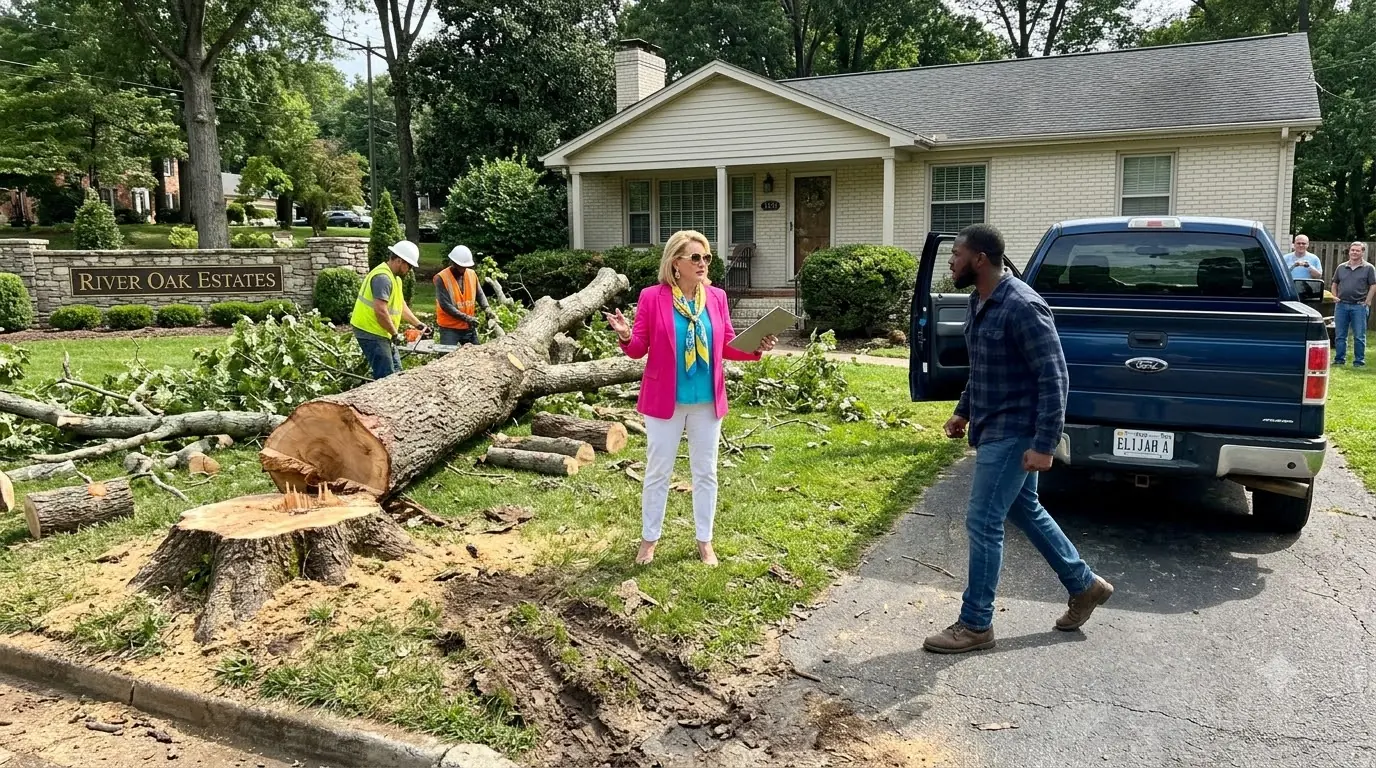
She Cut Down His Family’s Giant Oak — Then He Saw What Was Left