“Tonight, I’m going to sleep with another man, Caleb.” My wife said it with a smile.
Lauren stood in front of the full-length mirror in our bedroom, turning slightly from side to side as though she were getting ready for an anniversary dinner instead of announcing the deliberate destruction of our marriage.
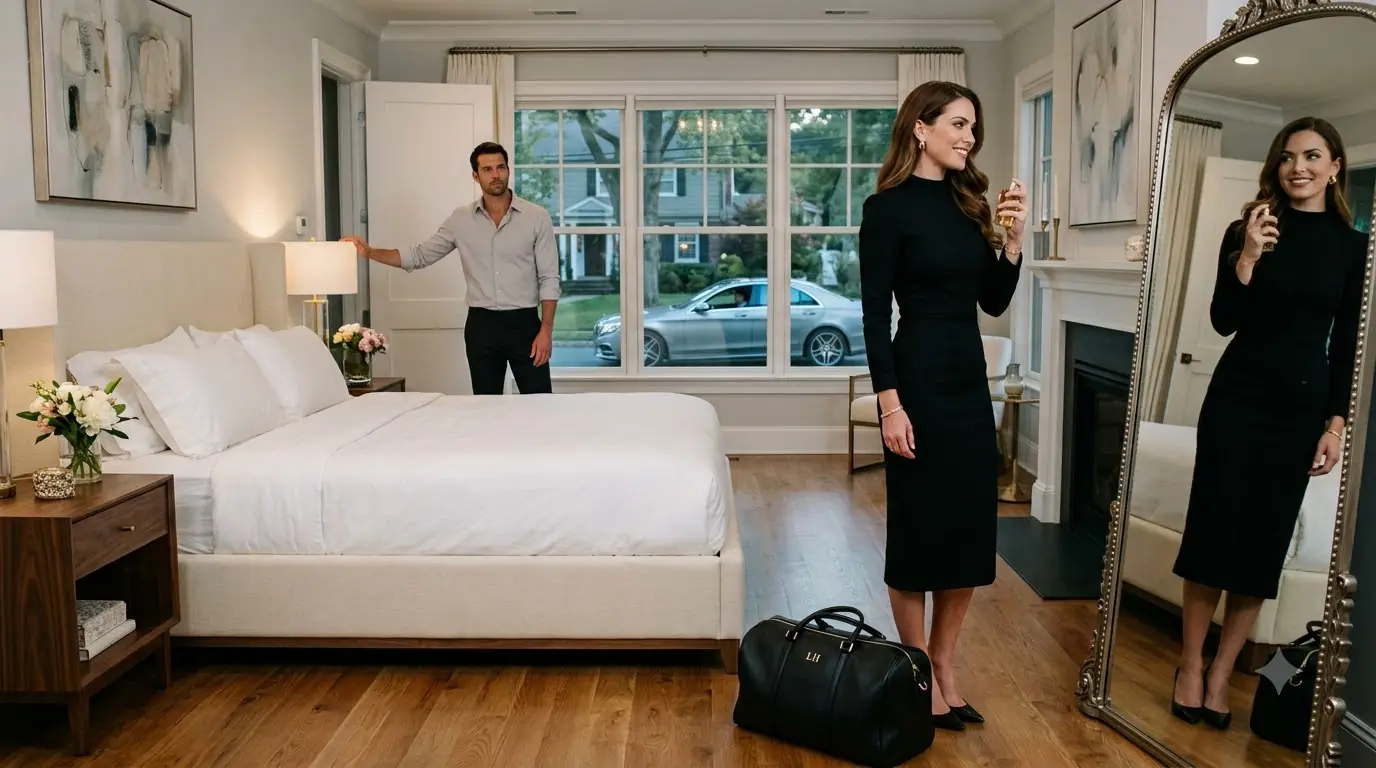
The black dress she wore was one I had never seen before.
It caught the bedroom light every time she moved, tiny flecks of silver flashing along the fabric. She had curled her hair differently, darker around her shoulders, and the perfume in her hand was not the soft citrus scent she normally wore to work.
It was heavier.
Sweeter.
Something chosen for a night that had nothing to do with me.
At her feet sat a small overnight bag.
I stared at the bag longer than I stared at her.
That was the detail that made everything real.
Not the dress.
Not the perfume.
Not even the sentence.
The bag meant she had planned this.
She had chosen clothes for tomorrow morning. Packed cosmetics. Probably a charger. Maybe a toothbrush.
People did not pack overnight bags for mistakes.
They packed them for decisions.
“Who is he?” I asked.
Lauren sprayed perfume along the side of her neck.
“That isn’t the point.”
“It feels like the only point.”
She capped the bottle and set it carefully on the dresser.
For a moment, she continued looking at herself instead of at me.
That bothered me more than I expected.
We had been married for three years, together for almost five, and I knew the small ways Lauren avoided discomfort. She reorganized objects. Checked her phone. Adjusted earrings she had already adjusted.
Anything that allowed her to control something physical while a conversation became emotionally unpredictable.
Finally, she turned.
“I need freedom.”
I almost laughed.
Not because it was funny.
Because it sounded rehearsed.
“Freedom.”
“Yes.”
“From what?”
Lauren folded her arms.
“From this.”
She gestured vaguely around the bedroom.
The room I had painted twice because she decided the first shade of gray looked too blue in afternoon light.
The built-in shelving I had installed over two weekends because she loved a photograph she found online.
The house we had spent nearly a year turning into the home she said she had always wanted.
“This,” I repeated.
“You know what I mean.”
“No. I actually don’t.”
She sighed.
The sigh was impatient.
Almost disappointed, as if I was failing to follow a script she had already completed in her own head.
“I married too young.”
Lauren was thirty-two.
I was thirty-five.
Neither of us had been children when we exchanged vows.
But I said nothing.
She continued.
“Everything with us is planned. Dinner at seven. Work Monday through Friday. Vacations three months ahead. Same house. Same conversations. Same routines.”
“We have jobs.”
“That’s exactly what I mean.”
“We plan vacations because your company requires notice.”
“You’re missing the point.”
“What is the point?”
Her expression hardened.
“The point is that I don’t feel alive anymore.”
There it was.
A sentence I had heard in pieces for months.
Never quite that directly.
Our life was safe.
Therefore, according to Lauren, it had become stale.
Our mortgage was paid on time.
Therefore, it was predictable.
I came home when I said I would.
Therefore, I lacked spontaneity.
I remembered birthdays, scheduled maintenance before things broke, made dinner reservations instead of hoping a restaurant had space.
Somewhere along the way, reliability had been reclassified as a character flaw.
For months, every time Lauren told me she felt trapped, I responded the way I responded to most problems.
I tried to fix it.
When she said she hated her position at a pharmaceutical marketing firm, I supported her decision to leave even though her new role paid less.
When she said the house felt dated, we renovated the kitchen.
When she complained that we never traveled, I rearranged two major projects at work so we could spend ten days in Portugal.
When she said we had become disconnected, I found a couples therapist.
We attended twice.
Lauren said the therapist was “too focused on communication.”
I had not known what to say to that.
Every accommodation seemed to become fresh evidence that I was the problem.
I was too practical.
Too careful.
Too willing to solve things.
Too consistent.
Then Blake Turner appeared.
I knew his name before I knew there was anything to fear from it.
He was a consultant who had worked with Lauren’s new firm on a brand strategy project.
Forty.
Recently separated.
Lived somewhere near New Brunswick.
Drove a silver Mercedes coupe.
Lauren described him at first as “chaotic in a good way.”
That phrase had stayed with me.
I remembered asking what it meant.
She said Blake could decide at five in the afternoon to drive to Manhattan for dinner without worrying about reservations.