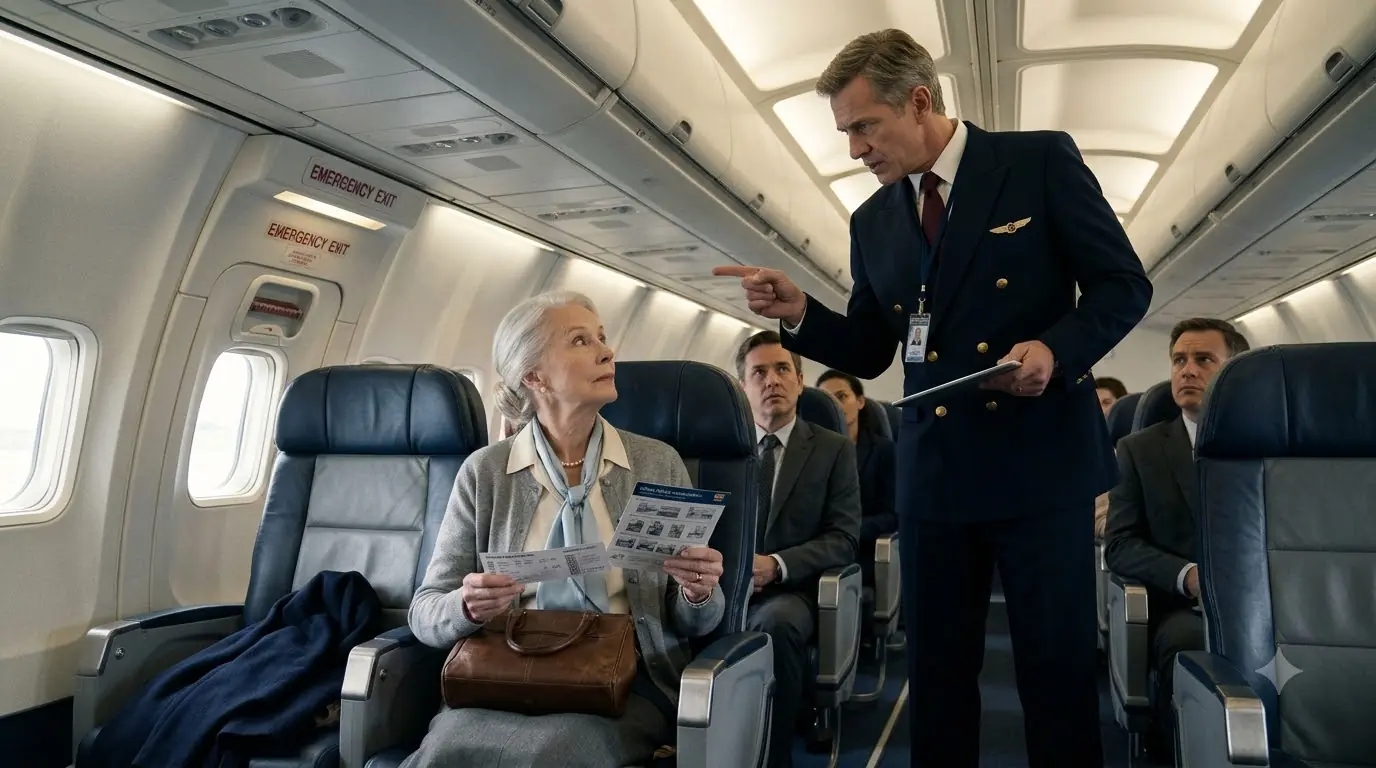
The woman in seat 34B had been reading the evacuation card for the third time when a flight attendant stopped beside her and asked her to leave. She looked up from the diagram of the overwing exit, taking a moment to fold the card along its existing crease.
Nothing in the young attendant's voice sounded hostile, but the man standing behind her was watching with an expression that made Margaret Davis understand the request before the words were spoken.
Beyond the windows, winter sunlight shone against an aircraft wing streaked with pale lines of frost that the ground crew had already cleared.
"Ma'am, I'm sorry," the attendant said. "I need you to move to row thirty-eight."
Margaret glanced at the open space above the seat in front of her. Her small canvas bag was tucked beneath it, her coat was folded on her lap, and her seat belt lay unfastened across her knees. She had checked in early, reached the airport with time to spare, and completed the exit-row briefing with the gate agent. She was seventy-six years old, but she had managed all of that without assistance, just as she had managed far more demanding things in her life.
"Row thirty-eight?" she asked. "Why?"
The attendant shifted her weight. Her name badge read CHLOE ANDERSON, and although her uniform was immaculate, there was a small indentation between her brows that Margaret recognized as the mark of someone repeating instructions she did not believe. Chloe looked over her shoulder toward the man behind her, who gave an almost invisible nod. It was the sort of gesture intended to leave no record of who had made the decision.
"Passengers seated beside an emergency exit must be able to assist during an evacuation," Chloe said carefully. "My supervisor has expressed concern about your age."
"Is that your safety judgment," Margaret asked, "or is it from Mr. Taylor?"
The man behind Chloe took a step forward. Grant Miller, the senior purser, wore his authority comfortably: straight shoulders, polished shoes, and a smile that arrived whenever he thought an audience was watching. His name was embroidered above the same Northridge Air emblem Margaret had watched people sew onto uniforms for four decades. He did not recognize the woman studying him.
"This is my decision," Miller said. "We don't have time to debate it."
Margaret looked past him at the passenger in seat 34A. Richard Taylor was a broad-shouldered man in a cashmere sweater, with silver-framed reading glasses, an expensive travel watch, and two phones arranged precisely on his armrest. He had boarded late, complained that the cabin was crowded, and asked Miller in a voice he had not bothered to lower whether the seat next to him could be kept empty. Taylor was the kind of frequent flyer whose status preceded him in staff briefings, and he seemed accustomed to treating the space around him as an extension of what he had purchased.