The Officer Slammed Him Face-Down at a Gas Station — Then One Device Started Ringing
Chapter 1
Reader Theme:
Font Size:
24px
The pepper spray struck Governor Noah Bradley before he had time to finish the word complying. A burning orange cloud filled his eyes, nose, and throat. He staggered backward into the side of his Ford Bronco. One hand still raised and the other pressed uselessly against his chest as every nerve in his face seemed to ignite at once. Rain hammered the roof of the deserted gas station, but not even the cold November water could cut through the chemical fire spreading across his skin.
"On the ground! " Officer Thomas Cleary shouted. Noah could barely see. He heard boots splash through a puddle, felt a forearm drive between his shoulder blades, and hit the concrete hard enough to knock the air from his lungs. His cheek landed in oily rainwater beneath the fluorescent lights. A knee settled against the base of his neck.
Both hands behind your back. Now they were visible, Noah forced out between coughs. My hands were visible. Cleary caught his right wrist and twisted until pain shot through his shoulder. The first steel cuff snapped shut.
The second closed a moment later, two clicks tighter than necessary. Noah lay face down beside Pump 6, soaked, blinded, and handcuffed while the officer above him breathed hard with triumph. Across the forecourt, Arthur Penhallagan, the 67-year-old night attendant, stood frozen behind the store window with his phone held at chest level. He had seen the entire encounter. He had seen the black driver step away from his truck with open palms.
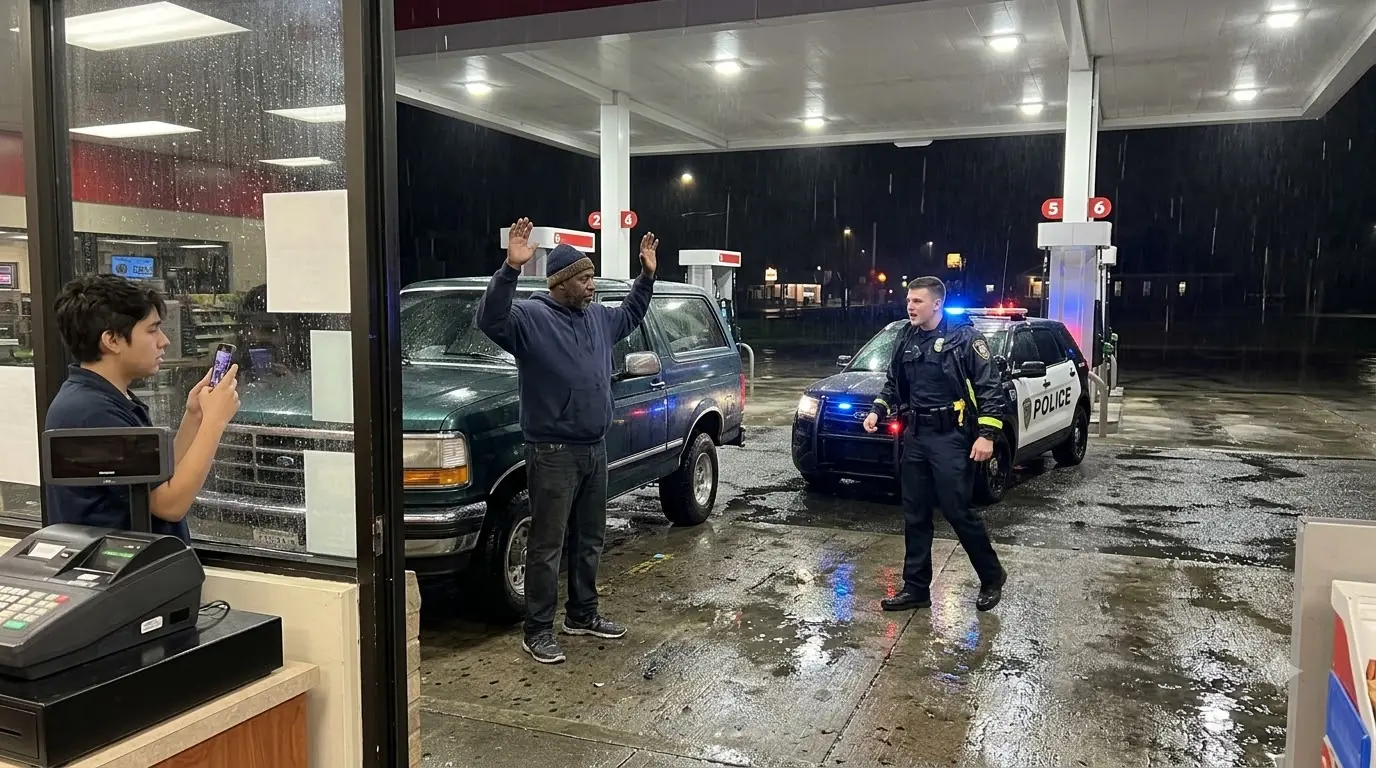
He had seen Cleary advance, spraying before the man made any threatening move. Arthur did not yet know the stranger's name, but he knew what he had witnessed was wrong. Cleary hauled Noah to his knees by the back of his faded Georgetown sweatshirt. "You should have followed instructions the first time. " Noah drew one careful breath, then another. His training as a civil rights lawyer returned before his vision did.
Identify the officer. State the facts. Create a record. Do not give fear permission to choose your next movement. Officer Thomas Cleary, he said, reading the silver name plate through streaming tears.
Badge number 4492. I did follow your instructions. Your dash camera and the station cameras will confirm that. Cleary's grip tightened. You people always think a camera is going to save you.
The words landed more cleanly than the spray. Noah raised his face toward the officer's voice. He was 48 years old, the first black governor in the state's history, and the former attorney who had once spent 14 hours cross-examining a sheriff without raising his voice. He had negotiated budgets, stared down bomb threats, and stood beside families after shootings. Yet, none of that was visible beneath the wet sweatshirt, old jeans, and dark knit cap.
To Cleary, he was simply a black man alone after midnight in a town that believed outsiders should pass through without stopping. "My name is Noah Bradley," he said. "I am the governor of this state. My identification is in the inside pocket of my jacket. My protection detail is nearby.
Verify me before this goes any further. " For half a second, Cleary said nothing. Then he laughed. ""Of course you are, and I'm the president. "" He pulled Noah upright and marched him toward the patrol car. Noah stumbled because his eyes were clamped shut and his balance was gone. Cleary did not slow down. He pushed Noah's head beneath the door frame and forced him into the molded plastic back seat.
The door slammed, sealing him inside a cage that smelled of sweat, disinfectant, and old fear. Only 11 minutes had passed since Noah pulled into the station. It was enough time for a quiet drive to become the most dangerous political crisis of his life. He had left the governor's mansion shortly after 10 that Sunday evening following a day of ceremonial duties and difficult phone calls. The legislature was due to reconvene in the morning for a budget session already poisoned by weeks of partisan threats.
His chief of staff wanted him rested. His security commander wanted him inside the mansion. Noah wanted one hour in which nobody asked him to decide the fate of a hospital, a school district, a prison, or a family. The Bronco had belonged to his father, Ellis Bradley, a high school history teacher who believed an old vehicle could be repaired more easily than a damaged promise. Ellis had taught Noah to change the oil beneath their apartment building, to listen before speaking, and to never confuse an office with the person trusted to hold it.
After Ellis died, Noah restored the truck but refused to replace its cracked leather steering wheel. Driving it was the closest he came to having a conversation with his father. That night, he had asked his executive protection unit for distance, not absence, just distance. Commander Dylan Cole had objected until Noah agreed to keep the encrypted state phone in his pocket and allow two unmarked vehicles to trail him by no more than 3 miles. Rain and poor cellular coverage in the northern counties had stretched that gap slightly.
Noah had welcomed the temporary loneliness. He crossed into Oak Haven County at 12:41 in the morning. The fuel gauge was low, and the old shell sign glowing through the rain seemed harmless. He pulled beneath the canopy, removed the nozzle, and began filling the tank. Cleary's cruiser arrived less than 2 minutes later.
There had been no traffic violation. Noah had not been followed from the road. The officer drove directly into the station and stopped diagonally across the Bronco's front bumper, trapping it beside the pump. Cleary emerged with one hand on his pistol and ordered Noah away from the vehicle. Noah complied.
When he asked why he was being detained, Cleary said there had been burglaries in a gated neighborhood 5 mi away and that Noah matched the description of a suspicious male in dark clothing. Noah asked for the suspect's height, age, vehicle, or any other identifying detail. Cleary told him questions were evidence of agitation. Noah offered to retrieve his wallet. Cleary ordered him not to move.
Noah stopped immediately and raised both hands again. Cleary told him to turn around. Noah began to turn. The spray came before he completed the movement. Now in the patrol car, Noah leaned forward because the cuffs forced his shoulders into an unnatural angle.
His eyes flooded uncontrollably. Each breath scraped his throat. He listened as Cleary searched the Bronco without asking permission. The officer opened the driver's door, then the center console. He found Noah's leather wallet exactly where Noah had said it would be.
He also found a slim government credential case bearing the state seal. Through the rain streaked window, Noah watched Cleary open it. The officer went still. Noah Bradley, Governor. The photograph was unmistakable.
So were the holographic security strip, the executive seal, and the emergency verification number printed beneath it. Cleary looked toward the patrol car, then back at the credential. His face did not soften. Fear appeared there, but it hardened almost instantly into calculation. He slipped the credential into his uniform pocket.
Noah saw him do it. Cleary returned to the cruiser and opened the rear door. Rain blew into the cramped compartment. "Where did you get that identification? " It was issued to me by the state whose laws you just violated. "Looks fake. " Call the verification number.
Run the license plate. Contact state police headquarters. You have several lawful ways to end this detention. Cleary stared at him. The officer's confidence had changed.
It no longer came from believing Noah was powerless. It came from believing he might still control the record. You reached toward the vehicle after I ordered you not to move, he said. No, you became aggressive. No, I feared you were reaching for a weapon.
My hands were above my shoulders when you sprayed me. Clearly leaned closer. That's not what my report will say. Noah blinked through the pain until the officer's face came into focus. "Then your report will be a confession. " Cleary slammed the door.
At the store window, Arthur lowered his phone just enough to check that the recording was still running. The officer had parked at an angle that blocked the store's main camera, but Arthur's phone had a clear view of the pumps. His hands shook so badly that the image wandered across the ceiling and floor. Still, the crucial seconds were there, the stranger's open palms, the unprovoked spray, the knee, the cuffs. Arthur considered calling the local police station, then realized the man committing the assault wore its uniform.
He called 911 instead. The dispatcher identified herself as Brenda Pike. Oak Haven Emergency Services. What is your location? Shell station on Route 9.
One of your officers just sprayed a man who had his hands up. There was a pause. Is the officer in danger? No. The other man never touched him.
He's handcuffed in the patrol car. Do you know the officer's name? Cleary. Thomas Cleary. The line went quiet again, longer this time.
Sir, remain inside and do not interfere with law enforcement activity. Are you sending a supervisor? The situation is under control. She disconnected. Arthur stared at the phone.
He had lived in Oak Haven for 39 years. He understood what silence meant in a small town. Silence could be caution. It could be cowardice. Sometimes it was cooperation.
He saved the video, attached it to a message addressed to his daughter, and typed, "If anything happens to this phone, keep this safe. " In the cruiser, Cleary removed Noah's encrypted device from the pocket of his jacket. It was heavier than an ordinary phone, protected by a rubberized black shell without a commercial logo. "What is this? " "A secure state communications device. Press the red side button and you will reach the executive command center. " Cleary turned it over. A burner.
That doesn't help your story. The device is transmitting my location and biometric status. My team already knows something is wrong. Your team, right? Cleary tossed it onto the passenger seat, then keyed his shoulder radio.
Dispatch, unit 4. One male detained at the Route 9 shell. Possible burglary suspect. Combative presenting false government identification. Run plate 7 David King 214.
Static filled the car. Copy. Unit four, Brenda answered. Her voice had lost its earlier boredom. Standby.
Noah closed his eyes. He could hear his own pulse, the rain, and the faint electronic chirp of the encrypted phone as it attempted to reconnect with the protection convoy. He thought of the clients he had represented before entering politics. A 19-year-old mechanic forced onto hot asphalt for driving his employer's luxury sedan. A black mother arrested after questioning why officers searched her son's backpack.
A grandfather whose complaint disappeared because the officer's body camera had supposedly failed. He had built a career from their testimony. Yet some private part of him had begun to believe that power had lifted him beyond their vulnerability. The belief shamed him now. The office had protected Governor Bradley.
It had never changed what Officer Cleary saw when he looked at Noah. The encrypted phone emitted a harsh two-tone alarm. Cleary frowned. The screen glowed red with the words, "Executive command. Priority override. " The phone answered automatically on speaker.
"Eagle 1, this is Vanguard. We have a biometric distress alert and loss of vehicle telemetry. Confirm status. " Dylan Cole's voice was controlled, but no one knew him well enough to hear the alarm beneath it. Cleary lifted the device. This is officer Thomas Cleary, Oak Haven Police Department.
The owner of this phone is detained. Identify yourself. Silence held for 2 seconds. Officer Cleary, Dylan said, step away from the detainee and place the device where he can hear me. You don't give orders in my jurisdiction.
I am Commander Dylan Cole of the Executive Protection Division. You are holding Governor Noah Bradley. My team is approaching your location. Keep your hands visible. Do not remove or alter any evidence and request a supervisor immediately.
Cleary's eyes moved to the rearview mirror. Noah met them through the wire partition. Anybody can say that over a phone, Cleary replied, but his voice had thinned. Your unit number is 4. Your badge number is 4492.
You at the Shell station at mile marker 87. State Police Troop C is now on your radio channel and your dispatch center has received the governor's identity verification. You will not touch him again. Brenda's voice exploded from Cleary's shoulder radio before he could answer. Unit 4, respond immediately.
The plate is a class, a protected executive registration. State command confirms the subject is Governor Bradley. Thomas, tell me he is safe. The station canopy seemed to grow very quiet despite the rain. Cleary looked down at the pepper spray canister on his belt, then at the credential protruding from his pocket.
For the first time, he appeared to understand not just who Noah was, but what the evidence would show. He opened the rear door and reached for his handcuff key. Governor, there has been a misunderstanding. Let me get those off. Noah shifted away from his hand.
Do not touch the cuffs until a state police supervisor photographs them and documents their position. They're too tight. They were too tight when you believed I was nobody. Cleary's face twitched. I was responding to a burglary call.
There was no call. You drove into the station after seeing me at the pump. You resisted. There are at least three cameras here. Which lie would you like preserved first.
Cleary stepped back. The small metal key trembled between his fingers. Headlights appeared through the rain at the end of the road. They multiplied as they approached. two black sport utility vehicles, three state police cruisers, and an ambulance. The vehicles entered the forecourt in a disciplined ark surrounding but not striking the Oak Haven cruiser.
Doors opened. Agents and troopers emerged with weapons holstered, hands ready, voices clear. Officer Cleary, move away from the vehicle. Keep both hands visible. Cleary obeyed.
The same man who had treated questions as defiance now followed each instruction with desperate precision. Dylan Cole crossed the pavement first. He was tall, broad- shouldered, and usually impossible to read. When he looked into the back seat and saw Noah's swollen eyes, wet clothes, and cuffed wrists, anger tightened every line of his face. "Governor, can you breathe? " "Yes, the spray is wearing off.
My right hand is going numb. " Dylan signaled to the paramedics. A state police captain named Lena Ortiz approached with a body camera recording and an evidence photographer beside her. "Sir, we need less than 30 seconds to document the cuffs, then they come off," Ortiz said. "Your circulation takes priority. " Noah nodded. He had no intention of sacrificing nerve function for a political image.
The photographer captured the position of the restraints, the double lock that had never been engaged, and the red grooves already forming beneath the steel. Ortiz read the cuff serial number aloud. A paramedic checked Noah's fingertips and told them to remove the restraints immediately. Dylan used Cleary's key. The cuffs opened with two small clicks.
Pain surged through Noah's arms as he brought them forward. His fingers tingled violently, then began to shake. The paramedics guided him to the ambulance and flushed his eyes with saline. One examined the abrasion on his cheek. Another wrapped cold gauze around his wrists.
Noah accepted treatment without argument, though his gaze never left the station forecourt. Captain Ortiz separated Cleary from the other officers and read him a formal notice that he was being detained pending investigation of excessive force, unlawful restraint, and possible evidence tampering. She did not tear off his badge or throw him into the mud. She took his weapon, radio, body camera, spray canister, and credential case, one item at a time, recording each transfer. The contrast was deliberate.
Accountability would not imitate humiliation. "My body camera malfunctioned," Cleary said when Ortiz requested the device password. "It appears to be powered on now," Ortiz replied. "It wasn't recording during the stop. " "Then the activation log will tell us when it was disabled. " Cleary glanced toward Noah. Governor, I swear I didn't know.
Noah wiped saline from his face. That is the problem, Officer Cleary. You believe knowing my job would have changed what I deserved. Arthur finally stepped outside, clutching his phone beneath a plastic grocery bag to protect it from the rain. "Captain," he called.
"I recorded it. I got the whole thing. " Cleary turned so quickly that two troopers moved between him and the attendant. Ortiz approached Arthur. Do not delete, edit, or send the original file anywhere else. We will make a forensic copy while you retain your phone.
Did you witness the entire encounter? From when the police car pulled in, the man had his hands up. That officer sprayed him anyway. Noah watched clearly absorbed the words. The officer's remaining hope had rested on controlling the story.
Arthur had taken that from him with a trembling hand and an ordinary phone. The ambulance doors stood open behind Noah. Dylan lowered his voice. We can take you directly to the mansion. Captain Ortiz will handle the scene.
First, secure every recording lawfully. Station video, dispatch audio, cruiser data, the officer's camera, Arthur's file. No shortcuts. Call Attorney General Hayes and the independent inspector general. I want preservation orders before anyone enters that department's servers.
Already moving. And Dylan, no one acts in anger. Not for me. If we break procedure now, Cleary becomes the victim in his own story. Dylan looked toward the officer who had sprayed and cuffed the man he was sworn to protect.
Understood. Noah turned to Captain Ortiz. He said they had been looking for people who matched my description because of burglaries across the ridge. Determine whether there was an actual alert. Pull every stop initiated by Oak Haven officers on Route 9 for the past 2 years.
Compare race, search rates, arrests, citations, and property seizures. Ortiz held his gaze. You think this was policy? He behaved like a man following a policy he trusted. From the back of Ortiz's cruiser, Cleary began to speak urgently to the trooper beside him.
I need to call Chief Carter. He'll explain the burglary detail. Noah heard the name and felt an old memory move through him. William Carter. Six years earlier, when Noah was attorney general, Oak Haven's police chief had resisted a statewide body camera standard, calling independent review an insult to local officers.
Carter's department had produced unusually high civil asset forfeiture revenue and unusually few sustained misconduct complaints. The numbers had bothered Noah then, but jurisdictional limits and a lack of cooperating witnesses had kept the inquiry narrow. Now a door had opened. Do not let him contact Carter until investigators preserve the evidence," Noah said. Captain Ortiz was already reaching for her phone.
The attorney general is seeking an emergency order now. 40 miles away, Chief William Carter was asleep in the small apartment he kept above Oak Haven's municipal courthouse when his private line began to ring. He answered on the fifth chime. "Chief, it's Brenda," the dispatcher said. Her breathing came fast and shallow.
Something happened with Cleary. Something always happens with Cleary. Put it in the morning log. He detained Governor Bradley at the Route 9 station. Pepper sprayed him.
Handcuffed him. State police have Cleary now. Carter sat upright. Say that again. The governor.
It was really him. His protection team is at the station. State command took over the channel. For several seconds, Carter heard nothing except blood pounding in his ears. Then he asked the only question that mattered to him.
News in the same category
Mafia Boss Cheated On His Pregnant Wife — Then She Disappeared With The Daughter He Never Met
She Saw Her Husband Holding Another Woman’s Hand With Their Daughter… Then Her Six-Year-Old Revealed the Secret Plan
Unaware His Wife Is A Billionaire Heiress Husband Divorces His Pregnant Wife At Thanksgiving Dinner.
The Officer Forced the Elderly Woman to the Ground — Then She Asked for One Phone Call
He Handcuffed Her for Chalk — Then Her Father Stormed Into the Police Station
The Officer Dragged His Daughter Toward the Cruiser — Then Her Father Came Storming Out
CHAPTER 2: THE FATHER WHO REFUSED TO LET IT GO
CHAPTER 3: WHEN JUSTICE BECAME REAL CHANGE
The HOA President Called Him a Thief on His Own Land — Then the Gate Started Coming Down
CHAPTER 2: THE CONFESSION BEHIND THE HIDDEN DOOR
CHAPTER 3: WHEN THE CORRUPT DETECTIVE LOST EVERYTHING
He Came Home Early and Found His Wife and Son at the Pool With Another Man… Then His Son Asked the Question That Changed Everything
Duke’s New Life After Two Years at the Shelter
He Came Home Early From His Business Trip… Then He Saw His Wife Kissing Her Coworker
The Detective Tore His Law Office Apart — He Had No Idea Someone Was Recording
CHAPTER 2: THE CONFESSION BEHIND THE HIDDEN DOOR
CHAPTER 3: WHEN THE CORRUPT DETECTIVE LOST EVERYTHING
Buddy Is Still Waiting for Someone to Choose Him
News Post
The Mafia Boss Called His Pregnant Wife a Cheap Toy—Unaware She Was the Sicilian Don’s Daughter
Mafia Boss Cheated On His Pregnant Wife — Then She Disappeared With The Daughter He Never Met
She Saw Her Husband Holding Another Woman’s Hand With Their Daughter… Then Her Six-Year-Old Revealed the Secret Plan
Unaware His Wife Is A Billionaire Heiress Husband Divorces His Pregnant Wife At Thanksgiving Dinner.
The Officer Forced the Elderly Woman to the Ground — Then She Asked for One Phone Call
He Handcuffed Her for Chalk — Then Her Father Stormed Into the Police Station
The Officer Dragged His Daughter Toward the Cruiser — Then Her Father Came Storming Out
CHAPTER 2: THE FATHER WHO REFUSED TO LET IT GO
CHAPTER 3: WHEN JUSTICE BECAME REAL CHANGE
The HOA President Called Him a Thief on His Own Land — Then the Gate Started Coming Down
CHAPTER 2: THE CONFESSION BEHIND THE HIDDEN DOOR
CHAPTER 3: WHEN THE CORRUPT DETECTIVE LOST EVERYTHING
He Came Home Early and Found His Wife and Son at the Pool With Another Man… Then His Son Asked the Question That Changed Everything
Duke’s New Life After Two Years at the Shelter
He Came Home Early From His Business Trip… Then He Saw His Wife Kissing Her Coworker
The Detective Tore His Law Office Apart — He Had No Idea Someone Was Recording
CHAPTER 2: THE CONFESSION BEHIND THE HIDDEN DOOR
CHAPTER 3: WHEN THE CORRUPT DETECTIVE LOST EVERYTHING
Buddy Is Still Waiting for Someone to Choose Him
The Officer Slammed Him Face-Down at a Gas Station — Then One Device Started Ringing
3 Part