Vera is home. Eight months after arriving at our shelter as a thirteen-year-old senior surrender, she finally walked through the same staff exit she had spent almost every night sleeping beside. This time, Marcus was beside her. Vera did not stop at the door. She did not lie down to wait. She simply walked through with him and never looked back.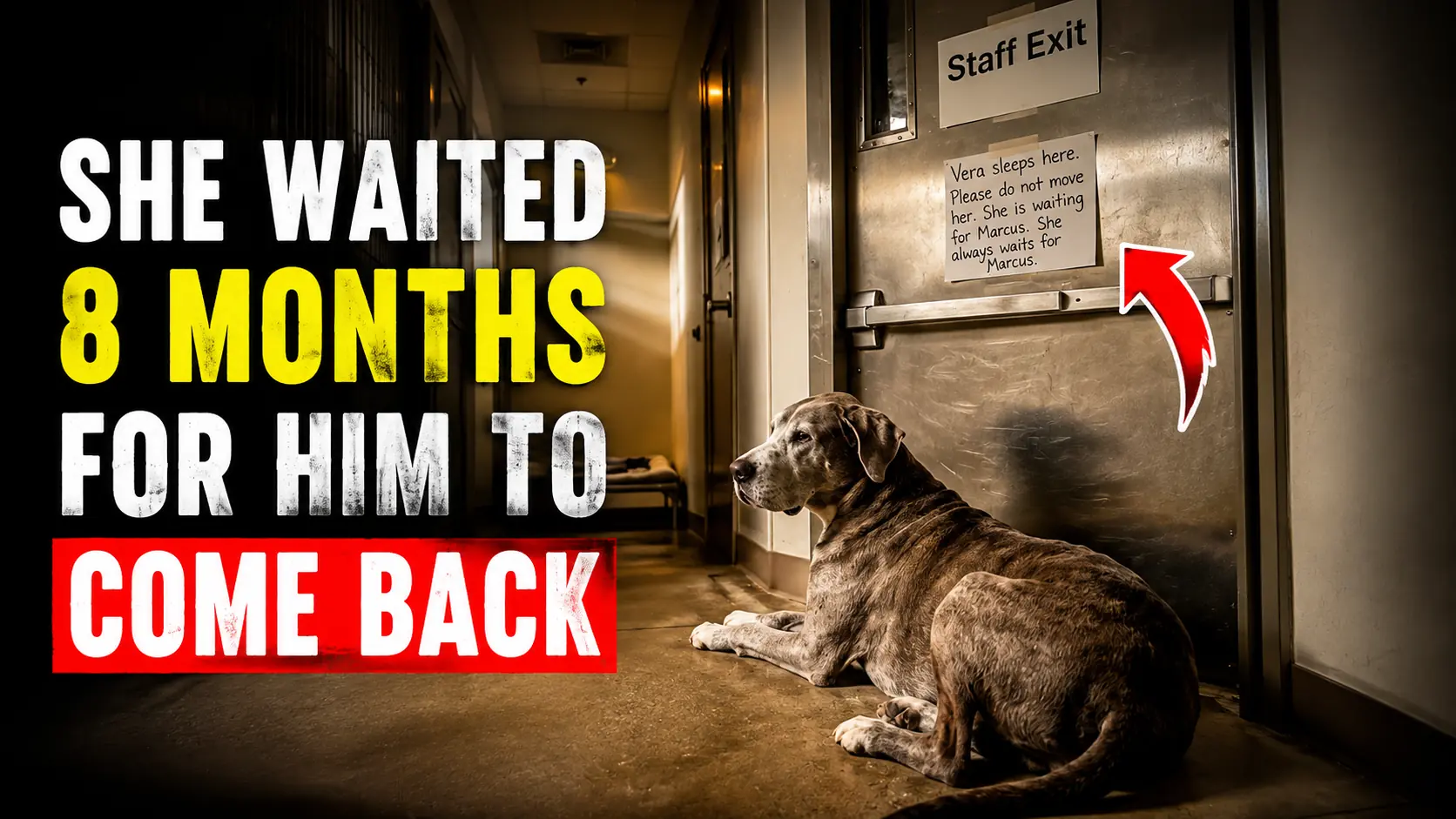
For everyone who cared for Vera, seeing her leave was especially meaningful because there was a time when we genuinely did not expect her to have eight months ahead of her. Her initial veterinary examination showed significant age-related arthritis, particularly through her hips and lower spine. She had lost muscle around her hindquarters, her movements were slow, and getting up after long periods of rest required considerable effort. There was no single catastrophic diagnosis. Instead, Vera had the accumulated physical challenges of a large dog who had reached thirteen years old.
From the beginning, our goal was quality of life. Vera started a carefully monitored pain-management plan along with joint supplements. Thick orthopedic bedding reduced pressure on her hips and elbows, while several short walks each day helped preserve mobility without exhausting her. Her response surprised us. Within several weeks, she was standing more comfortably and moving with less hesitation. She was never going to walk like a young dog again, but she maintained her appetite, kept a stable weight, and continued showing interest in everything happening around her.
Most of that interest centered on Marcus. Their relationship began on Vera’s third day at the shelter. Marcus arrived for his regular night shift and started walking through the building. Vera stood and followed him. At first, he assumed she simply wanted out of her kennel, but Vera walked past other employees and ignored volunteers who tried to call her over. She stayed behind Marcus until he finally came looking for another staff member and said, “The big gray one is following me.” From that moment, the pattern never really stopped.
When Marcus worked, Vera wanted to know where he was. She was never demanding about it. Sometimes she simply slept nearby while he completed paperwork. Other times she followed him down the hallway and settled somewhere she could still see him. Marcus became the person who could convince her to take medication on difficult days and the person who could coax her outside when cold mornings made her joints particularly stiff. When he crouched beside her, Vera often pressed her broad silver-gray head against him and remained completely still.
The most unusual part of their routine began with the staff exit. At the end of his shift, Marcus left through that door. On the first night Vera watched him leave, she walked over and lay down facing it. Our overnight staff assumed she would eventually return to her orthopedic bed. She did not. Someone checked around 2 a.m., and Vera was still there. At 4 a.m., she remained in the same place. At 6 a.m., she was sleeping beside the door with her head pointed toward it. Then Marcus returned, and Vera immediately stood to greet him.
It happened again the following night, and then again. Eventually, we stopped trying to convince Vera to sleep somewhere else. Instead, we brought comfort to the place she had chosen. A blanket was placed near the door, staff made sure she remained safe and out of the way, and a handwritten note was taped above her usual sleeping place asking everyone not to move her unnecessarily. Her kennel might be empty at night, but everyone knew where Vera was.
By her second month with us, Marcus wanted to make their arrangement permanent. He asked his landlord whether Vera could live in his apartment. The answer was no because of restrictions on large dogs. Marcus tried again later, but nothing changed. He had lived in that apartment for three years and had never planned to move because of a dog. Then Vera gave him a reason to reconsider.
While Marcus searched for another place, Vera’s medical care continued. Regular examinations showed that her arthritis remained manageable with treatment. Her medication was adjusted when necessary, and periodic blood work helped us monitor how her senior body was tolerating long-term therapy. She also showed some ordinary age-related changes. Her hearing was not as sharp as it once had been, her vision seemed reduced in dim lighting, and she occasionally needed extra time to find secure footing when standing.
None of that prevented Vera from recognizing Marcus. Sometimes she appeared to notice his footsteps. Other times she seemed to catch his scent before he even reached the hallway. Her head would rise, followed by that unmistakable tail wag. Vera did not have the frantic energy of a young dog. Her greetings were slower and heavier, but somehow that made them even more meaningful.
Her appetite remained one of the most reassuring parts of her condition. Vera enjoyed soft food mixed with her regular meals, which also made medication easier to administer. She quickly learned when dinner was supposed to arrive. If staff were late, she would lift her head and stare toward the food-preparation area until somebody noticed. Those ordinary preferences mattered because appetite, engagement, and interest in routine are important indicators of quality of life in senior dogs.
Her exercise remained gentle. On difficult mornings, Vera moved slowly for the first several minutes. Once her joints warmed up, however, she often wanted to continue. Marcus learned her pace and never pulled her forward. If Vera stopped to smell something, they stopped. If she became tired, they turned around. Some evenings they barely made it beyond the shelter property, but distance was never the point. Comfort was.
Over time, our veterinarian became more optimistic about Vera’s immediate outlook. Nobody could promise how much time a thirteen-year-old large dog had remaining, and we still cannot. But Vera had already exceeded those earliest expectations. Weeks became months, and throughout those months she continued eating, walking, seeking affection, resting comfortably, and waiting for Marcus.
Last Monday, the practical problem was finally solved. Marcus signed a lease on another apartment where large dogs were allowed. On Tuesday morning, he entered through the staff exit exactly as he had hundreds of times before. Vera was waiting in her usual place. Marcus crouched beside her, put his hands gently against her face, and told her, “We’re going home.”
Of course, Vera could not understand leases, landlord rules, or why it had taken eight months. She did not know Marcus had changed apartments partly because he wanted to give her somewhere safe to spend the rest of her life. She only knew Marcus, and apparently that had always been enough.
The adoption was finalized Wednesday. Before leaving, Vera received another veterinary examination. Her arthritis remains her primary ongoing medical concern, and she will continue prescribed medication and joint support. Because she is a senior dog receiving long-term treatment, routine blood testing will remain important. Marcus has also been taught what changes to watch for, including reduced appetite, worsening mobility, difficulty getting comfortable, unusual breathing, or changes in normal bathroom habits.
Her new home has been arranged around those limitations. Rugs cover slippery areas so Vera has better traction. Her orthopedic bed sits where she can remain near Marcus without repeatedly getting up to follow him. Food and water are easily accessible, stairs are avoided whenever possible, and walks remain short and gentle. Nobody expects Vera to become more active simply because she has been adopted. At thirteen, keeping her comfortable matters far more than how far she can walk.
Her first evening at home was wonderfully uneventful. Vera explored slowly, drank some water, ate dinner, and inspected her new bed. Then Marcus sat down in the living room. Vera followed him, lowered herself beside him, and eventually fell asleep. There was no kennel noise, no cleaning cart passing through the hallway, and most importantly, no metal staff door separating her from the person she had spent eight months waiting for.
Marcus told us she slept more deeply than he had ever seen her sleep at the shelter. The following morning brought another small milestone. When he prepared to leave briefly, Vera watched him but remained on her bed. Marcus returned a short time later. Vera lifted her head, gave him her familiar slow wag, and settled again. Perhaps that will be one of the most important things she learns in her new home: Marcus can leave and come back, and she no longer needs to sleep against a door to make sure she finds him again.
Medically, Vera remains a very old dog, and we will never pretend otherwise. There will probably be difficult days. Her arthritis may progress, her mobility will need monitoring, and medication may need adjustment as her needs change. At her age, even small changes deserve attention. Marcus understood all of this before signing the adoption paperwork. He did not adopt Vera because he expected years of easy companionship. He adopted the dog who was already in front of him: stiff hips, gray face, slow steps and all.
We often talk about finding the right home for a shelter dog. Sometimes that means a fenced yard. Sometimes it means another dog in the household. Sometimes it means someone experienced with medical needs. For Vera, the most important requirement turned out to be much simpler. It was Marcus.
She seemed to figure that out on day three. It took the humans eight months to solve the housing problem.
Today, Vera still has her orthopedic bed, medication, slow walks, and senior-dog limitations. What she no longer has is a reason to spend every night staring at a staff exit. She has the person she waited for and a home where they now sleep on the same side of the door.
Nobody knows how much time Vera has left. That is the reality of loving a thirteen-year-old dog. But whatever time remains will be spent somewhere she is comfortable, protected, understood, and deeply wanted.
For eight months, Vera waited for Marcus to come back.
Now she gets to go home with him.