Rain had been falling over downtown Philadelphia for nearly four hours when the old man stepped beneath the brass awning of the Asheford Grand.
Water ran from the shoulders of his dark wool coat, soaked through one sleeve, and gathered at the toes of shoes that had seen better years.
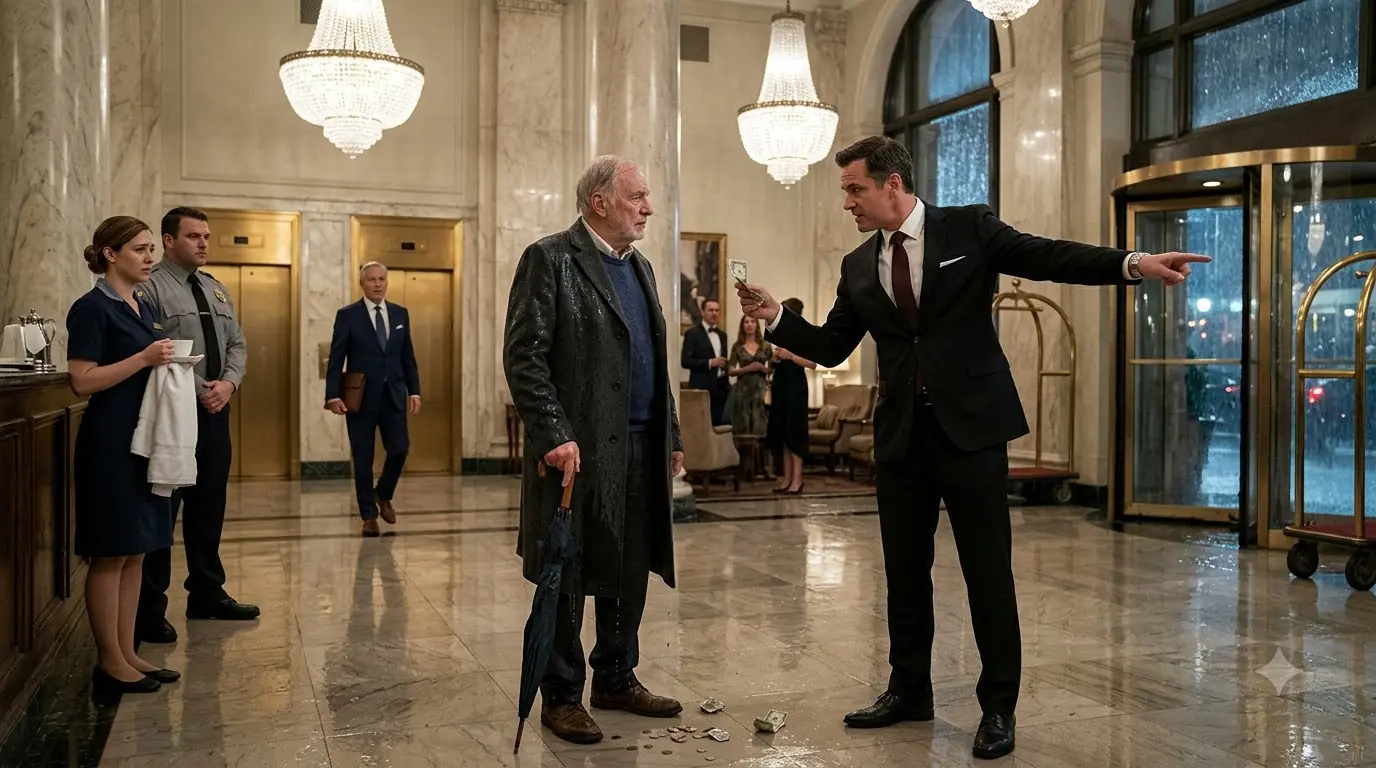
His gray hair lay flat against his forehead, and a week of silver stubble shadowed a face most people in the lobby did not recognize.
He stood just inside the revolving door for a moment, breathing in polished wood, lemon wax, fresh flowers, and the warm current of heated air that had once meant home to him.
The hotel was celebrating its fiftieth anniversary that week. Banners hung discreetly between the chandeliers, a grand arrangement of white roses occupied the center table, and the marble floor reflected the ceiling lights so cleanly that a person could almost mistake the reflection for another lobby beneath the first. Guests arrived in tailored coats and stepped around the dripping old man without looking at him. Bell carts rolled past, luggage wheels clicked over stone, and somewhere beyond the lounge a pianist was working through a slow jazz standard.
At the front desk, Hannah Cole noticed him before anyone else did. She was thirty-one, sharp-eyed, careful with people, and dressed in the navy jacket required for senior guest-service associates, though the silver assistant-manager pin she had been promised two years earlier had never appeared. Hannah had worked at the Asheford Grand for six years, long enough to know how the lobby changed when someone entered who did not look as though they belonged. Guests glanced once and looked away; employees looked toward management before deciding whether kindness was permitted.
Hannah did not wait for permission. She came around the desk with a clean towel folded over one arm and a paper cup of tea in her hand. “Sir, please sit,” she said. “You’re freezing.”
The old man looked at her as though the offer had surprised him. “Just a few minutes somewhere warm,” he said. “I won’t be any trouble.”
“You aren’t trouble.” Hannah nodded toward a chair near the fireplace. “Sit. I’ll bring you something dry for your hands.”
She had taken only two steps when Grant Holloway emerged from the corridor leading to the executive offices.
Holloway was forty-five, tall, trim, and polished in the manner of someone who believed appearance was part of authority. He wore a navy suit that never seemed to wrinkle, a white pocket square, and the same pale expression of irritation whether he was discussing staffing, room rates, or the temperature of banquet coffee. He had been general manager for three years, and during those three years the staff had learned that his voice became quieter when he was most dangerous.
His eyes found the old man first and Hannah second.
“What is this?” he asked.
Hannah stopped. “He came in out of the rain, Mr. Holloway.”
“I can see that.” Holloway’s gaze moved over the wet coat, worn shoes, and unshaven face. “I pay you to work, not to run a homeless shelter.”
A few guests near the concierge desk turned toward them. Hannah felt the old familiar pressure behind her ribs, the warning every employee under Holloway learned to recognize: do not embarrass him by making him repeat himself.
“He only asked for a few minutes to warm up,” she said.
Holloway looked at the tea in her hand. “Who gave him that?”
“I did.”
“Of course you did.”
The old man rose slowly from the chair. “I’m not asking for a room, sir.”
Holloway laughed once without humor. “The rain is exactly where you belong.”
Hannah’s face tightened. “Mr. Holloway.”
He turned on her. “Six years, Hannah, and you still can’t tell a guest from garbage.”
The sentence hung in the lobby. It was not loud, but it was sharp enough to cut through the piano and the soft murmur of arriving guests. Hannah saw the old man’s expression change, not with humiliation exactly, but with attention. He had been studying Holloway from the moment the manager appeared, and now he seemed to be measuring the room around him as well.
Holloway reached into his wallet, pulled out two bills, crumpled them in one hand, and dropped them at the old man’s feet. “Hungry? Buy yourself a bath, then crawl out of my lobby.”
The bills landed near the toe of the old man’s shoe.
He looked down at them but did not bend.
“Keep your money, son.”
Holloway’s face darkened. “Don’t you dare call me son.”
“That’s enough.”
The voice belonged to Luis Ortega, one of the hotel’s security officers. Luis was fifty-six, broad-shouldered, steady, and old enough to remember three general managers before Holloway. He had been standing near the service corridor watching the exchange grow worse. Now he stepped forward, not toward the old man but between Holloway and him.
Holloway stared. “What did you say?”
“I said that’s enough, sir.” Luis kept his hands at his sides. “He’s not threatening anyone. He’s not disturbing anyone. We can let him dry off and send him on his way.”
“You’re questioning my decision?”
“No. I’m asking you to treat him like a human being.”
Holloway’s mouth became a thin line. “One more word and I dock a week’s pay.”