"Put those down. Right now. I said put them down." Patricia Brennan's voice cut across the December afternoon before Jordan Davis had time to understand that she was speaking to him.
One moment he was standing on the edge of his own front lawn with a strand of white Christmas lights looped around both hands, and the next Patricia was marching toward him from two houses down, her wool coat open, her expression already fixed in accusation.
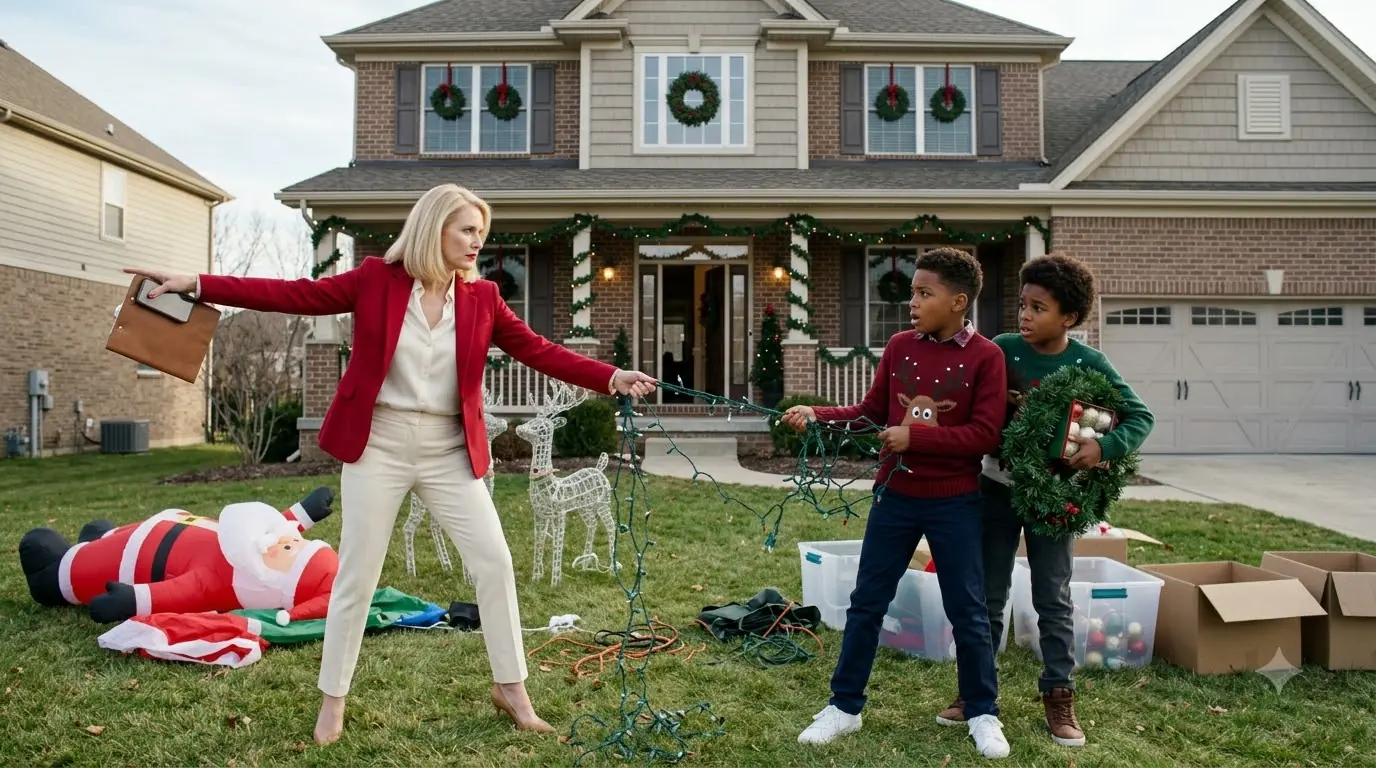
Julian, Jordan's twin brother, stood beside an unopened inflatable Santa with a plastic reindeer tucked against his hip.
Jordan looked behind him at the red-brick house where he and Julian had lived for two years, as if Patricia might somehow be addressing someone else. "Ma'am?" he said. "We're just decorating."
Patricia snatched the lights from his hands so sharply that one of the bulbs struck the stone edging along the walkway. "Don't lie to me. I have watched you two for half an hour. You think I don't know what theft looks like?"
Julian's face changed first. He had always been the more expressive twin, quick to laugh and quick to show fear, and now his eyes filled before he could hide it. "This is our house," he said. "We live here."
Patricia gave a short, cold laugh. "Your house? In Riverside Oaks? Do you have any idea what homes cost here?"
Jordan stepped closer to his brother. He was only ten, but he understood enough from the way Patricia looked at them to know that explaining would not be simple. "Our mom is Tanya Davis. She told us we could decorate."
"Shut your mouth when an adult is speaking to you," Patricia snapped. "I don't know what kind of parents let children run around other people's property unsupervised, but this ends now. I called the police. They know me. My husband has supported them for years, and they respond when I call."
Julian started crying quietly. Jordan's hands curled against the front of his Rudolph sweater, but he forced himself not to cry because he thought, wrongly, that one of them needed to look brave. From the portable speaker near the porch, "Jingle Bells" kept playing with a brightness that suddenly felt cruel.
Three minutes away, their mother was turning onto Riverside Oaks Drive.
Patricia Brennan had no idea what was about to come around the corner. More importantly, she had no idea that the argument on the Davis lawn would eventually expose seven years of calls, seven sustained complaints against one officer, a hidden body-camera recording, a pattern of unequal police response times, a campaign of HOA harassment, and a system that had learned to treat one resident's suspicion as more urgent than another resident's safety.
Three days earlier, Tanya Davis sat in a fourth-floor conference room at the Riverside County Administration Building with a red pen in one hand and eighty-two million dollars spread across her laptop in columns.
That was not literally cash sitting in front of her. It was the county operating plan, departmental allocations, contracts, equipment schedules, grant obligations, payroll forecasts, overtime projections, and the quiet machinery that determined whether public services worked when people needed them. Tanya had been county administrator for six years, elected with sixty-two percent of the vote after serving as deputy administrator and county counsel before that.
She had built her reputation by remembering that every large number was made out of smaller consequences. A one-percent reduction on a spreadsheet could mean a deputy sheriff position, two road-maintenance crews, a library branch's Saturday hours, or a youth counseling program. Tanya was the sort of administrator who asked what a number meant before deciding whether it was too high.
That Wednesday afternoon, line item twenty-three held her attention.
Police overtime.
Third month over projection.
She circled the figure on a printed sheet and wrote: CALL TYPES? STAFFING? EVENT DETAIL? She did not assume waste. Overtime could rise because of vacancies, court appearances, emergencies, training, major investigations, or poor scheduling. She wanted the reason before she wanted a reduction.
Across the table, Deputy Budget Director Elise Warren tapped at her keyboard. "We can move some of the public-works underrun if the department needs coverage through January."
"Not until I know why we're moving it," Tanya said.
Elise nodded. She had worked with Tanya long enough to know the sentence was neither approval nor rejection. It meant bring me the record.
Tanya checked her watch.
3:15.
Jordan and Julian got home from school at 3:30 on weekdays. She had promised she would be home that afternoon because the boys had a box of ornaments waiting on the kitchen table and wanted to begin planning the yard display they would set up on Saturday. For most adults, outdoor decorations were something to hang before company arrived. For the Davis twins, the first Saturday of December was an engineering project.
Jordan drew diagrams.
Julian made inventories.
Jordan cared about symmetry. Julian cared about brightness.
Every year they argued over where the reindeer should stand, then forgot the argument five minutes later and ended up lying on the lawn laughing at something neither could explain.
They had loved Christmas decorating since they were six.
That first year, in the small duplex where Tanya had lived before Riverside Oaks, they had decorated a six-foot chain-link fence with one string of mismatched lights bought from a discount store. Three sections did not work. Julian had called the dark sections "night lights" because he refused to admit the display was imperfect.
Tanya still had a photograph of the boys standing in front of that fence wearing pajamas under winter coats.
She closed the budget file at 3:18.
"Send me the overtime breakdown before Monday," she told Elise. "And ask the department to separate emergency callouts from neighborhood service calls."
"You think something's wrong?"
"I think the number is moving. I want to know why."
Tanya packed her laptop into a leather tote and checked her phone. A message from Jordan waited on the screen.
SATURDAY LIGHT PLAN UPDATED.
Three Christmas-tree emojis followed.
She smiled and typed back: On my way. Nobody starts without me.
That was Wednesday.
By Saturday, work had changed the plan.
Riverside Oaks sat twelve minutes from the county administration complex, though traffic made the trip twenty on a bad afternoon. Tanya had moved there two years earlier after almost a decade of saving, refinancing student loans, and telling herself that a bigger mortgage would be worth it if her sons could walk to a strong public school.
The neighborhood looked like the reward brochure people imagined when they talked about "making it." Tree-lined streets curved around small parks. Brick and stone houses sat behind clipped hedges. Sidewalks were wide enough for bicycles and strollers. In October, porches looked professionally staged. In December, half the houses could have been catalog photographs.
The homeowners association contributed to that appearance.
Riverside Oaks regulated mailbox colors, exterior paint, visible trash bins, fence styles, roof materials, lawn height, and seasonal display dates. Holiday decorations were allowed beginning the first Saturday in December, provided they remained within height and lighting limits. Tanya had read every page before buying the house.
She knew rules did not automatically make a place hostile. Predictability could be useful. The problem was not that Riverside Oaks had standards.
The problem was who Patricia Brennan believed those standards existed to control.
Patricia was fifty-four, a retired real-estate agent and the HOA president for the previous four years. She and her husband, Gerald Brennan, had lived in the neighborhood for eighteen years. Gerald owned a regional property-management firm and preferred golf outings to HOA meetings, but his money and connections hovered around Patricia like invisible staff.
Patricia knew who repainted without approval. She knew which family left a basketball hoop near the curb. She knew when someone's grass exceeded the association standard by half an inch. Her supporters called her attentive.
Tanya called her selective.
In the first six months after moving in, Tanya noticed a pattern that was easy to dismiss one incident at a time.
A noise complaint arrived after Jordan and Julian played basketball in the backyard at 4:30 on a Saturday afternoon. The complaint cited "repeated disruptive impacts" and "raised voices." Tanya walked outside with a phone decibel application, measured the ordinary bounce of a basketball, and sent a polite response stating that the boys would continue to play during permitted daytime hours.
Patricia replied within an hour.
HOA rules apply to everyone equally. Riverside Oaks has standards.