“This is the third time, Mrs. Caldwell.”
I stood on my side of the cedar fence with one hand resting against the weathered post my grandfather had driven into that soil more than fifty years earlier. 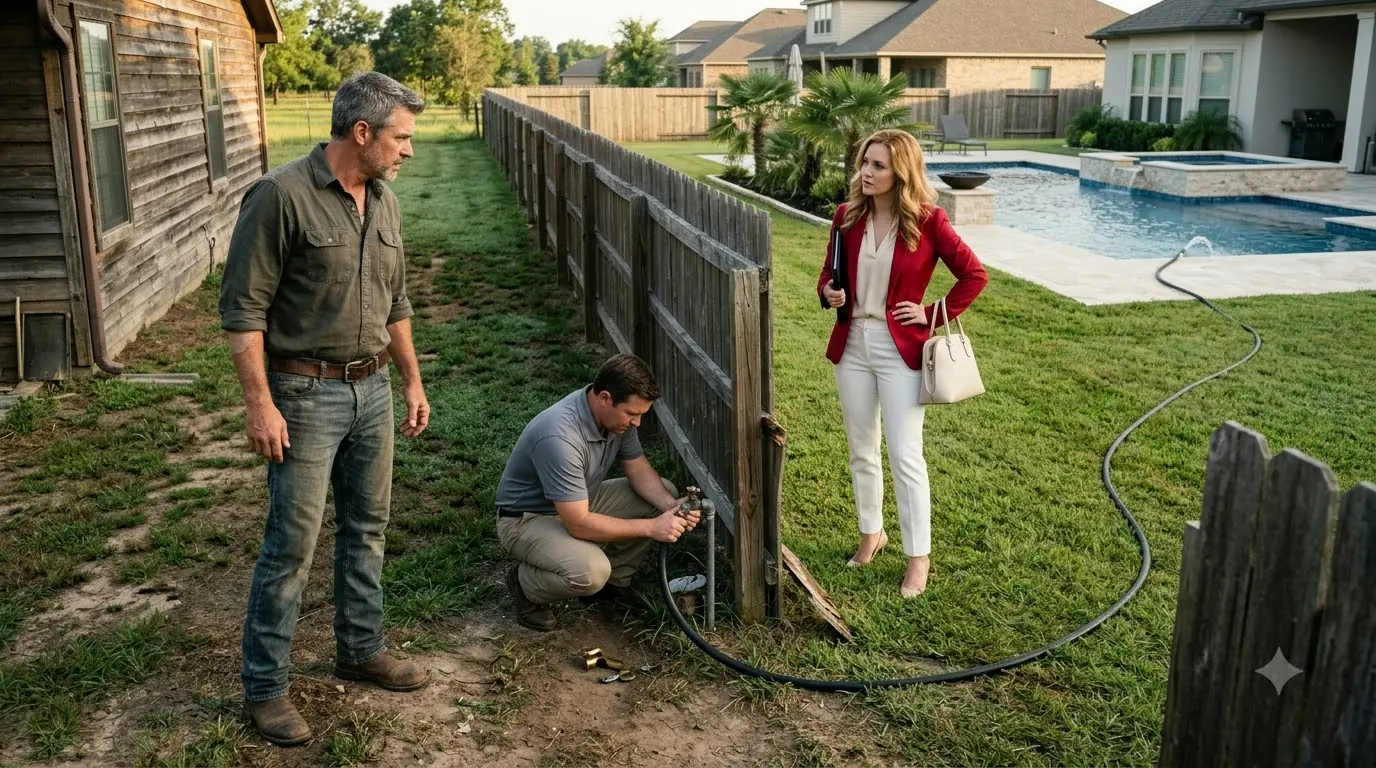
The June sun was already hard enough to make the metal fittings on the rear spigot hot to the touch, and on the other side of the fence, water shimmered blue beneath a limestone waterfall.
“I keep disconnecting that hose,” I said. “You keep sending somebody onto my property to hook it back up and fill your pool with my well water.”
Denise Caldwell looked at me over the rim of her sunglasses.
“Your point?”
For a moment, I wondered whether I had misheard her.
I hadn’t.
Behind her, the pool stretched across most of her backyard, eighteen thousand gallons of blue water surrounded by pale stone, sculpted landscaping, an attached spa, and a waterfall that made the place look like a hotel advertisement. A white inflatable lounger drifted slowly through the deep end.
“My point,” I said, “is that I want it to stop.”
Denise turned toward the pool as if I had insulted it.
“Mr. Harden, look at that.”
“I’ve seen it.”
“Eighteen thousand gallons. Custom gunite. Heated spa. Natural-stone coping. Imported tile. That pool is worth more than your entire property.”
I glanced back at my house.
Five acres.
Three-bedroom ranch house.
Detached workshop.
Stock pond.
Post oak and loblolly pine.
A spring-fed well that had served my family since Lyndon Johnson was president.
I looked at her again.
“And?”
“Your well sits under five acres of dirt doing nothing.”
“It supplies my house.”
“You live alone.”
“That doesn’t make it yours.”
Her mouth curved into a smile.
“My pool needs water.”
“That’s not my problem.”
“You should be grateful somebody is giving your well a purpose.”
I stared at her.
There are moments when a person says something so unreasonable that your mind briefly searches for a second interpretation. Some explanation that would make the sentence less ridiculous.
There wasn’t one.
“You cut my locks,” I said. “You sent your landscaper onto my land before sunrise.”
“And I’ll send him again tomorrow if I need to.”
She said it casually.
No anger.
No embarrassment.
No attempt to deny anything this time.
She simply folded her arms across a white linen blouse and looked at me with bright green eyes that had probably persuaded people to forgive things their common sense told them not to forgive.
Then she smiled.
Beautiful.
Cold.
Certain.
“What are you going to do about it, plumber?”
I didn’t answer.
That surprised her.
She expected anger. Denise Caldwell understood anger because anger could be dismissed. She could call it aggression, instability, harassment. She could tell the HOA board that the crude man next door had threatened her. She could turn raised voices into paperwork, paperwork into meetings, meetings into power.
So I gave her nothing.
I nodded once.
Then I went home.
That evening, I sat at the same kitchen table where my grandfather used to sharpen pencils with a pocketknife and calculate hay expenses on the back of feed-store receipts.
I pulled out graph paper.
I found a mechanical pencil.
And I began thinking.
I had spent twenty-eight years as a licensed master plumber in Texas.
Twenty-eight years tracing things people could not see.
Leaks behind walls.
Pressure losses beneath slabs.
Cross-connections somebody swore could not exist.
Backflow problems.
Broken mains.
Bad valves.
Improvised repairs buried behind expensive tile because somebody had wanted to save forty dollars twenty years earlier.
Plumbing teaches you something about people.
Most disasters do not begin dramatically.
They begin with somebody deciding that a small rule does not apply to them.
A fitting installed backward.
A valve nobody checks.
A warning ignored.
A shortcut justified because nothing bad happened the first time.
Denise Caldwell had spent two years treating my property as if it were another system she controlled.
She believed my silence meant permission.