“Go ahead,” I told my wife as she climbed into her ex-boyfriend’s car. “Spend the night with him.”
Meredith froze with one hand on the passenger door.
For the first time all evening, she looked unsure of herself.
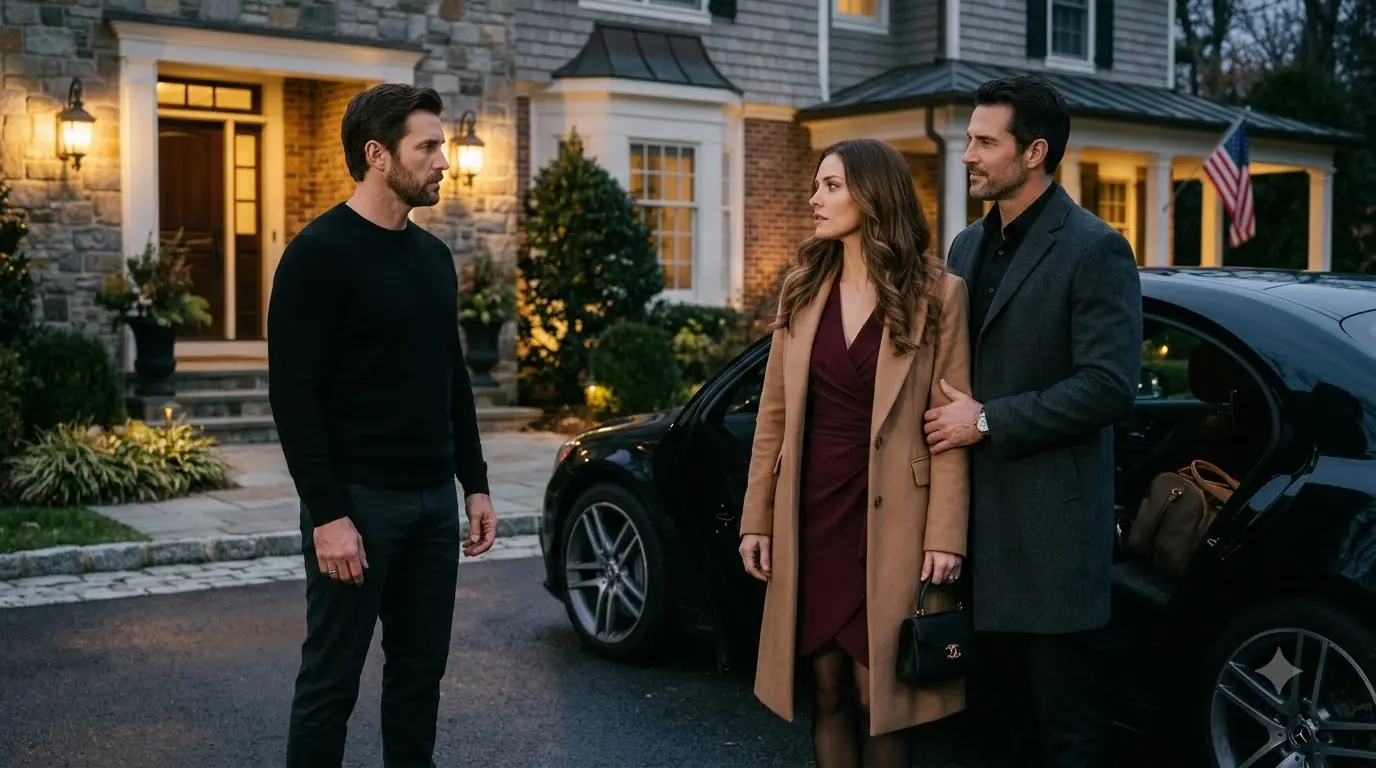
She had expected anger. Maybe shouting. Maybe me stepping into the driveway and demanding she remember that she was still married to me.
I think part of her wanted that.
For months, every argument about Callum Vance had followed the same pattern. Meredith pushed. I objected. She accused me of being controlling. I tried to explain. She became colder. Eventually, I backed down because protecting the marriage always seemed more important than winning the argument.
Tonight, she expected another version of that.
Instead, I smiled.
“Enjoy your evening.”
Relief flashed across her face before she covered it with a laugh.
“See?” she said. “This is exactly what I’ve been trying to explain. It doesn’t have to be dramatic.”
I said nothing.
Callum leaned across the center console and pushed open the passenger door from inside his black Mercedes.
Meredith slipped into the seat.
He looked at me through the windshield.
I couldn’t tell whether the expression on his face was embarrassment, victory, or pity.
Maybe all three.
Then Meredith lowered the window.
“You’re really not going to stop me?”
“No.”
Her eyebrows rose.
“But tomorrow,” I said quietly, “don’t pretend you weren’t warned.”
She stared at me.
Then laughed again.
To Meredith, it was another empty threat from the husband she believed she had finally defeated.
Callum pulled away from the curb.
The red taillights moved down our quiet Princeton street, past brick homes, old maples, and porch lights glowing against the cold New Jersey night.
An American flag stirred above our neighbor’s steps.
Somewhere beyond the neighborhood, a late train sounded its horn.
Meredith never looked back.
I remained in the driveway until the car disappeared around the curve.
Then I reached into my coat pocket and pulled out my phone.
A message from Callum’s wife was still glowing on the screen.
Her name was Elowen Vance.
Until fifteen minutes earlier, I had never spoken to her.
Her message contained three sentences.
Don’t stop them.
Callum booked room 614 at the Lake Maris Hotel tonight, and I have proof this has been going on much longer than either of them has admitted.
Meet me at eight tomorrow morning at Small World Coffee before they have time to coordinate another story.
Underneath was a photograph.
The first time I opened it, I thought I understood what I was seeing.
Then I enlarged it.
Once.
Then again.
My stomach turned cold.
Meredith and Callum stood together on the balcony of a hotel overlooking a lake.
His arms were around her waist.
Her head rested against his chest.
They weren’t standing like old friends.
They weren’t even standing like two married people who had crossed a line recently and still felt guilty about it.
They looked comfortable.
Familiar.
Practiced.
At the bottom of the photograph was a date.
Fourteen months earlier.
I stared at it.
Fourteen months.
Meredith had told me Callum came back into her life seven months ago.
According to her, they had accidentally reconnected after running into each other at a Princeton alumni fundraiser.
Seven months.
That had been the foundation of every conversation we had about him.
Seven months.
But the photograph existed seven months before that supposed reunion.
Then I noticed what Meredith was wearing.
A navy-blue cashmere sweater.
I knew that sweater.
I had bought it for our tenth wedding anniversary.
And I remembered the weekend in the photograph.
I had been in Philadelphia helping my father recover after minor heart surgery.
Meredith had told me she was spending Saturday alone because she had a migraine.
She had called me that evening from what she said was our bedroom.
I remembered lowering my voice in the hospital hallway and telling her I loved her.
She said she wished I were home.
Apparently, she had not been home.
I stared at the photograph until my hands stopped shaking.
Then I typed one word to Elowen.
Agreed.
My name is Nathan Mercer.
I was thirty-nine years old that winter.
Meredith and I had been married for ten years and together for nearly thirteen.
If you had met us a year earlier, you probably would have assumed we were stable.
That was the word people used.
Stable.
We had a four-bedroom colonial a few miles from downtown Princeton, two professional careers, good friends, retirement accounts, and the kind of marriage that looked unremarkable in ways I once considered comforting.
I worked in commercial real-estate finance.
Meredith was a corporate communications director for a pharmaceutical company headquartered near New Brunswick.
We had no children.
That had not been entirely intentional.
For several years, we assumed children would simply happen when the time was right.
Then careers became demanding.
My mother got sick.
Meredith changed companies.
We postponed.
Eventually, postponement became a decision neither of us knew how to discuss.
By thirty-eight, Meredith said she wasn’t sure she wanted children anymore.
I told her I could live with that.
At the time, I believed it.