The first thing Lily Monroe noticed about the elderly woman in 34B was that she boarded without asking anyone to make space for her.
That should not have been remarkable. Hundreds of passengers moved through the aircraft every week with the same quiet independence.
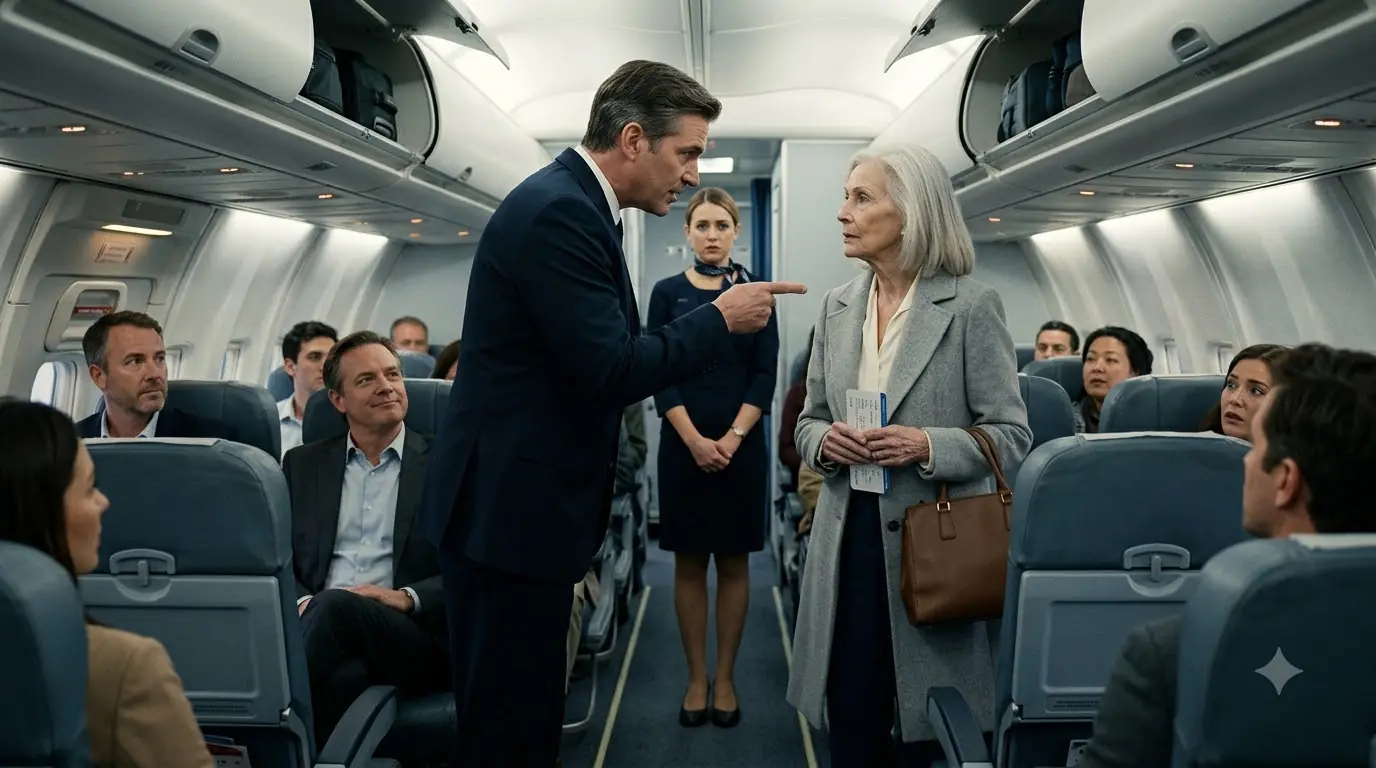
But Lily had been working as a flight attendant for only six months, and probation had sharpened her attention to every detail: who needed help but would never ask, who demanded help before they had even reached their seat, who smiled because they meant it, and who smiled because they expected something in return.
The woman in 34B was small, silver-haired, and dressed in a dark navy traveling coat that had been repaired neatly at one cuff. She carried a worn leather handbag and a compact roller case whose brass tag had been polished so many times the engraving was difficult to read. When Lily stepped forward and said, “Welcome aboard, ma’am. Let me help you with that,” the woman gave her a warm but amused look.
“Thank you, dear. I can manage.”
She lifted the case into the overhead compartment herself. Not quickly, not to prove anything, simply with the calm efficiency of someone accustomed to handling her own belongings. Then she checked the seat number printed on her boarding pass, 34B, and settled into the exit-row seat beside the wing.
Lily smiled and moved toward the forward cabin as the boarding line thickened behind her.
It was a Thursday afternoon flight from Chicago to Boston, scheduled to depart at 2:10. Outside the windows, November rain had turned the ramp into a reflective gray sheet broken by baggage carts and fluorescent safety vests. Inside, the cabin smelled of coffee, damp wool, and the faint industrial cleanliness of an aircraft that had already flown two segments that day.
The flight was almost full.
For Lily, that mattered more than usual because Friday was the last day of her probationary period.
Six months earlier, she had walked into the airline’s training center with fifty-three other new hires and a borrowed suitcase. She had been twenty-four, nervous enough to forget her own employee number during orientation, and so determined to succeed that she copied every slide from the training presentations into a notebook even when the instructors said the material would be posted online.
The job had never seemed glamorous to her. She knew what people imagined: hotels, uniforms, travel benefits, smiling through airports. Training corrected that fantasy quickly. They practiced evacuations in smoke-filled mock cabins. They learned CPR, fire suppression, decompression procedures, conflict management, first aid, dangerous-goods recognition, and the exact choreography required to get one hundred frightened people through exits while an alarm screamed in their ears.
Lily loved it.
Not the screaming alarms. Not the irregular sleep. Not the way her feet hurt after three consecutive days of service. What she loved was the clear purpose beneath everything else. Someone was frightened, lost, sick, overwhelmed, or alone, and her job was to notice before that person had to beg.
She knew exactly where that instinct came from.
When Lily was eight, her mother had placed her on a plane alone to visit her grandmother in Denver after a family emergency made it impossible for either parent to travel with her. Lily had tried to be brave at the gate. She had made it down the jet bridge without crying. Then the aircraft door closed, the engines started, and every bit of courage disappeared at once.
A flight attendant named Marlene had noticed.
She did not make a speech. She did not tell Lily she was too old to be frightened. She crouched beside the seat, asked whether Lily wanted company until takeoff, and held her hand during the climb.
Lily never forgot it.
Years later, when relatives asked why she wanted to become a flight attendant instead of taking an office job after college, she rarely told them the whole story. She usually said she liked people and travel. The truth felt too personal for casual conversation.
She wanted to become the person an eight-year-old remembered twenty years later.
That was why probation mattered so much.
And that was why Graham Doyle frightened her more than turbulence ever had.
Graham was the senior cabin supervisor on Flight 218 that afternoon. He had been with the airline for twenty years and wore that fact like an extra stripe on his uniform. He knew station managers by first name, remembered which vice presidents preferred sparkling water, and had mastered the subtle art of making his own preferences sound like company policy.
He was handsome in the tidy, polished way that photographed well on corporate brochures: silver beginning at his temples, immaculate uniform, perfect tie, shoes shined to a dark mirror. New hires were told he had trained half the senior attendants in the base. Managers described him as exacting. Graham described himself as consistent.
Lily had learned that his consistency depended heavily on who was watching.
To first-class passengers, Graham was charming.
To flight deck crews, he was deferential without appearing submissive.
To junior flight attendants, he was a weather system.
He could be generous one day and punishing the next. A minor service mistake might earn a quiet correction or an entry on an evaluation depending on his mood. He rarely raised his voice. He did not need to. Everyone on probation knew he completed their final cabin assessments, and a single poor evaluation could delay certification or end a contract.
Lily had worked with him three times before.
On the first flight, he told her she smiled too much.
On the second, he told her she did not smile enough.
On the third, she had stopped trying to interpret the contradiction and simply worked.
That afternoon, Graham stood near the boarding door greeting passengers when a broad-shouldered man in an expensive camel coat stepped onto the aircraft.
Graham’s entire face changed.
“Mr. Lane,” he said warmly. “Wonderful to have you with us again.”
“Graham.” The man smiled and extended his hand. “Good to see you.”
Lily recognized the passenger from the manifest. Charles Lane. Platinum status. Frequent corporate traveler. His original seat was 31D, an aisle seat several rows ahead of the exit. The notes attached to his customer profile included preferences for still water, an extra pillow, and priority assistance during irregular operations.
There was nothing unusual about that. High-frequency travelers accumulated preferences because airlines accumulated data.
What happened next was unusual.
Graham looked down the aisle toward row 34.
Lily followed his gaze.
Mrs. Ashcroft was fastening her seat belt.
Graham excused himself from Mr. Lane, walked down the aisle, and stopped beside 34B.
“Ma’am, I’m afraid I need you to move.”
The woman looked up.
“Why?”
“This row is reserved.”
She lifted the boarding pass lying on her lap. “It says 34B.”
“It was reassigned.”
“To whom?”
“Mr. Lane. He’ll be sitting here.”
Behind Graham, Charles Lane smiled as though the matter had already been settled.
“Thanks, Graham,” he said. “I appreciate it.”
Lily felt something tighten in her stomach.
Exit-row seat changes were not impossible. Operational needs, seating restrictions, aircraft swaps, weight-and-balance considerations, or passenger eligibility could require reseating. But none of those conditions applied here.