The first words Officer Derek Reigns said that morning were not about speed, a broken taillight, or a traffic law.
"A suspicious creep driving something this expensive," he said through Marcus Ellison's open window, the flashlight beam lingering on the leather dashboard. "Give me five hundred cash and we're done."
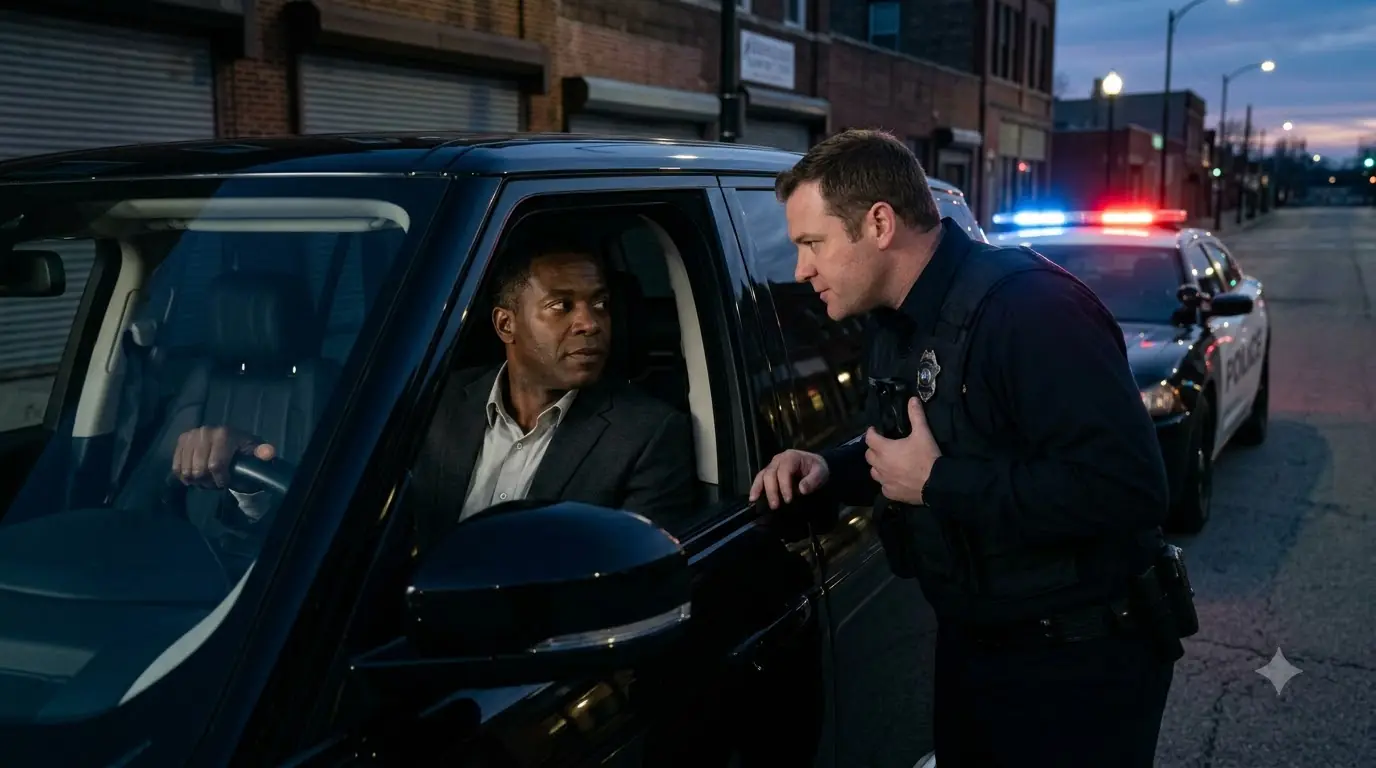
Marcus kept both hands in plain sight on the steering wheel. "Officer, I gave you my license and registration. Tell me exactly what law I broke."
Reigns leaned closer, his breath fogging faintly in the cold pre-dawn air. "Don't get smart with me. I can search your vehicle, tow it, and bury you in citations before breakfast."
"I'm not giving you five hundred dollars, and I'm not consenting to any search."
The officer's mouth tightened. "Keep pushing me and once those cuffs go on, five hundred will feel like a bargain." Marcus watched the red indicator on Reigns's body camera. A second later the light went dark. The officer smiled as if the absence of a recording transformed the street into private territory.
"Officer Reigns," Marcus said, "you should think very carefully about what you do next."
Reigns reached for the SUV's door handle with the confidence of a man who believed the badge on his chest gave him complete control. Marcus did not flinch. He did not reach for the credentials inside his jacket, and he did not tell Reigns that the Black man he was threatening was Captain Marcus Ellison, the new commanding officer of the Westbridge Police Department. Three hours from then, Marcus was supposed to stand in front of the department's command staff and introduce himself. At 5:47 that morning, however, he was simply a driver on the side of Highland Avenue, staring at an officer who had no idea he was extorting his new boss.
The day had begun with promise. Marcus had left his hotel before dawn because early arrival was a habit he had never lost. Twenty-three years in law enforcement had taught him that a department revealed itself most honestly before the administrative offices opened, when night-shift officers were tired, dispatchers were changing seats, custodians were emptying trash, and nobody had time to perform for command staff.
Westbridge was still asleep when he drove through it. Sodium streetlights washed the old brick storefronts in amber. A bakery truck idled beside a loading dock. A single bus moved through an intersection nearly empty of traffic, and the courthouse clock tower showed a few minutes before six.
Marcus liked cities at that hour. They looked stripped of slogans and public relations, reduced to what actually had to function. Street sweepers, nurses, patrol officers, delivery drivers, dispatchers, and people cleaning buildings before executives arrived to take credit for what had already been done.
He had accepted the Westbridge job because the city had asked for something difficult without pretending it would be easy. The previous captain had retired after a year of public criticism, internal complaints, and conflict with the city council over new accountability rules. Morale was low, the police union was suspicious of outside leadership, and several supervisors had publicly complained that civilian oversight made "real policing" impossible.
Marcus had heard versions of that argument before. In his experience, good officers rarely feared documentation. They feared bad systems, contradictory orders, weak supervision, and leaders who abandoned them when political pressure arrived. The officers most offended by basic accountability were often the ones who had grown comfortable with nobody checking their work.
His plan for the first week was intentionally modest. He would meet every shift, review dispatch procedures, sit with records staff, and ride with patrol. He would read recent citizen complaints and walk the evidence room without warning. Most of all, he wanted to learn where cameras failed, where reports disappeared, and where employees lowered their voices when supervisors entered.
He had not planned to begin with an extortion attempt. The SUV he drove was his own, a black four-year-old luxury model he had purchased used after years of driving practical sedans. It was comfortable and well maintained, not exotic, but in the empty street under Reigns's flashlight it apparently looked expensive enough to become evidence in itself.
When the patrol car had first appeared in his mirror, Marcus checked everything automatically. He was doing thirty-two in a thirty-five, centered in his lane, with his seat belt fastened and headlights on. His phone was nowhere near his hand. He had pulled over without hesitation and placed both hands on the wheel.
Reigns had approached slowly, flashlight sweeping through the cabin before settling on Marcus's face.
"License and registration."
Marcus had moved deliberately. "Here you go, officer. May I ask why I was stopped?"
Reigns studied the license longer than necessary. "You were drifting. Maybe swerving a little. You been drinking?"
"No. Can you tell me where you observed the lane violation?"
Instead of answering, Reigns shined the flashlight over the center console, the passenger seat, the back seat, and the luggage behind it. "Nice vehicle. What do you do?"
"I work in law enforcement."
"What department?"
That was the moment Marcus had almost ended it. One motion, one credential case, one sentence could have changed Reigns's entire posture. Yet something in the officer's tone stopped him. Reigns was not curious. He was evaluating.