Ethan Cole left the production line for five minutes to drink water after nearly ten straight hours on his feet.
When he came back, the chief executive of Blackwood Industries was standing at his locker, announcing to everyone within earshot that a man without discipline did not deserve a paycheck from her company.
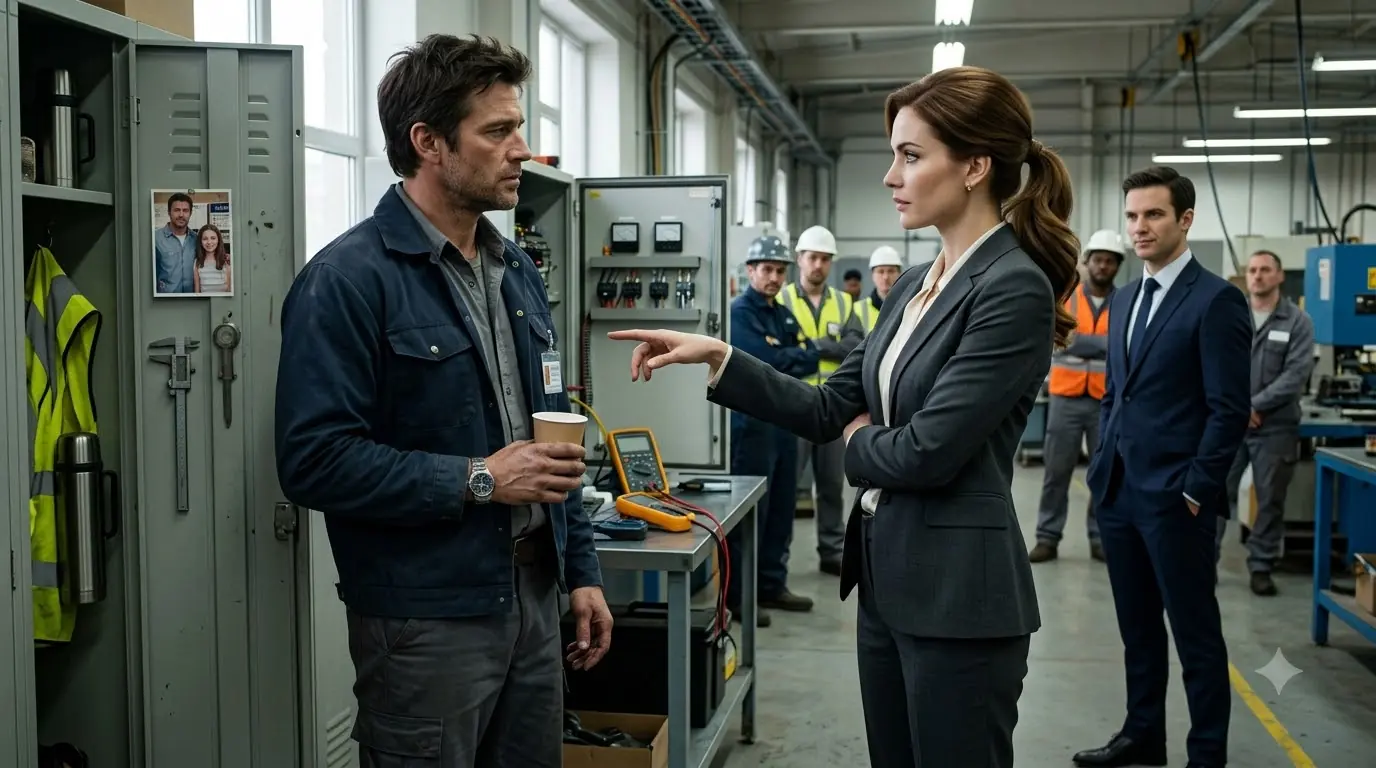
No explanation was requested, no defense was allowed, and he was escorted out through a floor full of silent faces. Every one of those people knew something Vanessa Blackwood did not.
Before Ethan reached the east gate, his phone rang. The caller was Sterling Carrington, chairman of Blackwood's largest client. The first sentence out of that man's mouth would stop Vanessa Blackwood cold less than an hour later.
I have stood inside a lot of buildings where money is made, and I can tell you that the loudest room is almost never the important one. Blackwood Industries occupied forty acres of flat gray land outside a mid-sized American city, and from the highway it looked like nothing at all. A low white manufacturing building sat behind chain-link fencing, half a dozen loading docks, three employee parking lots, and a water tower that had needed paint since the late 1990s. Trucks entered at one gate and left at another, and most people driving past never knew what happened inside.
Inside that plain building, technicians built precision control assemblies for aerospace and energy companies. The hardware was small enough to fit inside cabinets and housings, but the consequences of getting it wrong were enormous. A single defective module could stall a turbine qualification program, invalidate weeks of test data, or ground an experimental aircraft while engineers searched backward through a production chain for the first uncertain measurement. The public had never heard of Blackwood Industries, but everyone in the narrow world of high-reliability manufacturing knew the name.
Ethan Cole had worked on that floor for almost fifteen years. He was forty-two, quiet, broad through the shoulders, and built like a man who still lifted things himself even after younger workers were available. He wore the same faded navy technical jacket he had bought years earlier when the plant still ran a second shift on Saturdays, and he kept a small notebook in the left chest pocket because he trusted handwriting more than memory when a fault went strange at three in the morning.
His title was Senior Systems Technician. To people in human resources, that title fit inside a payroll band and a job-description template. To the production floor, it meant something else. When line four threw an intermittent fault that vanished whenever an engineer arrived, when line six drifted out of tolerance for reasons the diagnostic software refused to name, when a calibration fixture passed self-test and still produced numbers no one trusted, somebody eventually said the same three words into a radio.
"Get Ethan down."
I knew things about him that his own management never bothered to learn. He always requested the morning rotation and never traded out of it unless the plant had a genuine emergency. His daughter, Claire, was seventeen and in her final year of high school, and he had decided years earlier that he would be in the kitchen when she came home whenever humanly possible.
The photograph in his wallet showed Claire at a science fair when she was fourteen. She stood beside a tabletop wind-tunnel model with her mother's eyes and Ethan's stubborn mouth, wearing a second-place ribbon she had complained about for a month because she believed the first-place project had copied half its data from the internet. Ethan kept the photograph behind an insurance card worn soft at the corners.
He had raised Claire alone since she was six. His wife, Lauren, had died after a sudden illness that moved from diagnosis to funeral faster than either of them had been able to understand. Ethan almost never talked about that year at work, and he never put grief on a form as an explanation for anything.
He took overtime when the plant genuinely needed him. He refused overtime when it existed only because a manager wanted a dashboard to look busier than reality. That distinction had cost him promotions over the years because saying no to meaningless urgency is rarely rewarded inside organizations that confuse exhaustion with commitment.
What Ethan had instead of a title was a map, and the map lived entirely in his head. He knew that line six's conveyor drifted by a fraction when humidity climbed above sixty percent. He knew which calibration fixture had been rebuilt after a forklift clipped it in 2019 and which replacement bracket had been machined from a slightly different alloy because the original drawing called out a material nobody stocked anymore.
He knew the sound of a failing spindle bearing three weeks before vibration analysis confirmed it. He knew that a loose connector in cabinet seven did not fail when cold because thermal expansion was the real trigger. He knew which vendor firmware release had been installed during a holiday shutdown and never fully documented because the controls contractor went bankrupt two months later.
That knowledge did not exist in a manual because the men and women who could have written it down were busy using it. I have seen companies spend millions of dollars hiring outside consultants to reconstruct exactly what a man like Ethan Cole carried around for free.
Vanessa Blackwood was thirty-seven when she took the chief executive chair from her father. She had been in the role six months when everything happened, and I want to be fair to her because the story is better when the antagonist is not stupid. Vanessa was intelligent, disciplined, highly educated, and ambitious in the way ambitious people become when they have already proved themselves outside the family name.
Before returning to Blackwood, she had worked at two manufacturing companies her father did not own. She had helped stabilize a struggling medical-device plant and later reorganized a consumer-electronics supplier that was bleeding cash through duplicated management layers. Those successes were real. They convinced her of something dangerous only because it was partly true: that organizations decay when tradition becomes more powerful than measurement.
Her initiative was called Blackwood 2.0. The logo appeared in internal presentations in dark blue letters beside phrases like accountability, velocity, ownership, and disciplined execution. The program meant trimming long-tenured staff, raising output targets, installing real-time production dashboards, revising overtime approvals, and forcing every department to explain work in numbers that executive management could see.
Vanessa believed sincerely that seniority was often a word people hid behind. She believed that workers who said, "That's the way we've always done it," were usually protecting comfort rather than quality. In a lot of places, she would have been right.
The problem was that she began treating all unwritten knowledge as resistance simply because it was unwritten. She had not yet learned the difference between undocumented habit and undocumented expertise.
The first time she noticed Ethan was during a Tuesday walk-through in her second month. She came down the main aisle in a charcoal suit with Grant Whitmore, her newly appointed operations director, half a step behind her. Ethan was kneeling beside an open control cabinet with a meter in one hand and grease on two knuckles.
Vanessa did not ask what he was doing. She asked Grant what he was, which is a different question entirely and reveals more about the person asking than the person being described.
Grant Whitmore was thirty-four, sharp-faced, polished, and gifted at exactly one thing: arranging other people's accomplishments into sentences that sounded like his own. Vanessa had recruited him from an automotive supplier where he had managed production metrics and executive reporting. He had excellent slide decks, excellent posture, and an instinctive understanding of which details powerful people did not have time to verify.
He looked at Ethan and smiled the way men smile when they are about to be clever in front of authority.
"Ethan?" Grant said. "He's the type who is convinced the place would fall apart without him."
Vanessa gave a short, polite laugh and kept walking.
The sentence cost Grant nothing. He did not accuse Ethan of misconduct. He did not falsify a record. He simply planted an interpretation and left it there.
Some seeds are patient. That sentence went into the ground on a Tuesday in spring and stayed there while the seasons turned, waiting for exactly the right conditions to break through the concrete.
Those conditions arrived in October in the form of a purchase order everyone at Blackwood had been thinking about for most of a year. Carrington Aerospace Systems accounted for close to thirty percent of Blackwood's annual revenue. Its current supply agreement was approaching a renewal window, and the shipment moving through the plant that month was a high-value batch of precision control assemblies destined for a flight-test program.
Delivering the lot clean, complete, and on schedule would make renewal highly likely. The next contract would be worth eight figures over its term. Vanessa had said exactly that to the board in September in a room with soft lighting, filtered water, and coffee no one on the production floor ever tasted.
She had also told the board that improved on-time performance reflected Blackwood 2.0's new operating discipline. The chart behind her had been green. The trend line had gone upward. The board had nodded.
Down on the floor, the people making that green line real were working ten- and eleven-hour days because two senior technicians had been laid off in the previous quarter and their replacements had not yet finished training. The dashboard showed output. It did not show the informal labor required to hold the system together.
Four days before Carrington's scheduled acceptance visit, a synchronization sensor on line four began reporting a fault that appeared, disappeared, and appeared again with no pattern anybody could name. The units kept coming off the line inside specification. That was not reassuring.
In precision manufacturing, one of the most dangerous situations is a process that produces apparently good product while the reference system itself is becoming uncertain. A clear failure stops the line. A drifting standard allows people to keep working while confidence quietly disappears beneath them.
Grant Whitmore wanted the line to keep running. His logic was not insane. Output was ahead of plan for the first time since he took over, the executive dashboard was green, and stopping the line to chase a ghost fault could put a red bar on a chart Vanessa checked every morning at seven.
"Probably noise," Grant said during the first review. "Flag it for maintenance after the batch."
Ethan said no.
He did not say it dramatically. He stood beside the terminal with Diane Reyes from quality, two younger technicians, and a controls engineer named Katherine Doyle, and explained why the symptom bothered him.
"A synchronization drift doesn't stay where it starts," Ethan said. "If the timing reference is wandering, everything downstream can still look consistent against a standard that's moving with it."
Katherine folded her arms. "The finished units are measuring in spec."
"Against what reference?"
"The calibration fixture."
"Exactly. If the reference chain is compromised, good numbers don't mean good product. They mean the numbers agree with each other."
Grant exhaled in irritation. "How long to prove it?"
Ethan looked toward line four. "I don't know yet."
That answer made Grant dislike him more than a wrong estimate would have. Executives and managers often prefer a confident number to an honest uncertainty because numbers can be entered into plans.