My wife left for two weeks with the man she had loved before me.
She called it closure.
For a while, I tried to call it that too.
It was easier than calling it what it was.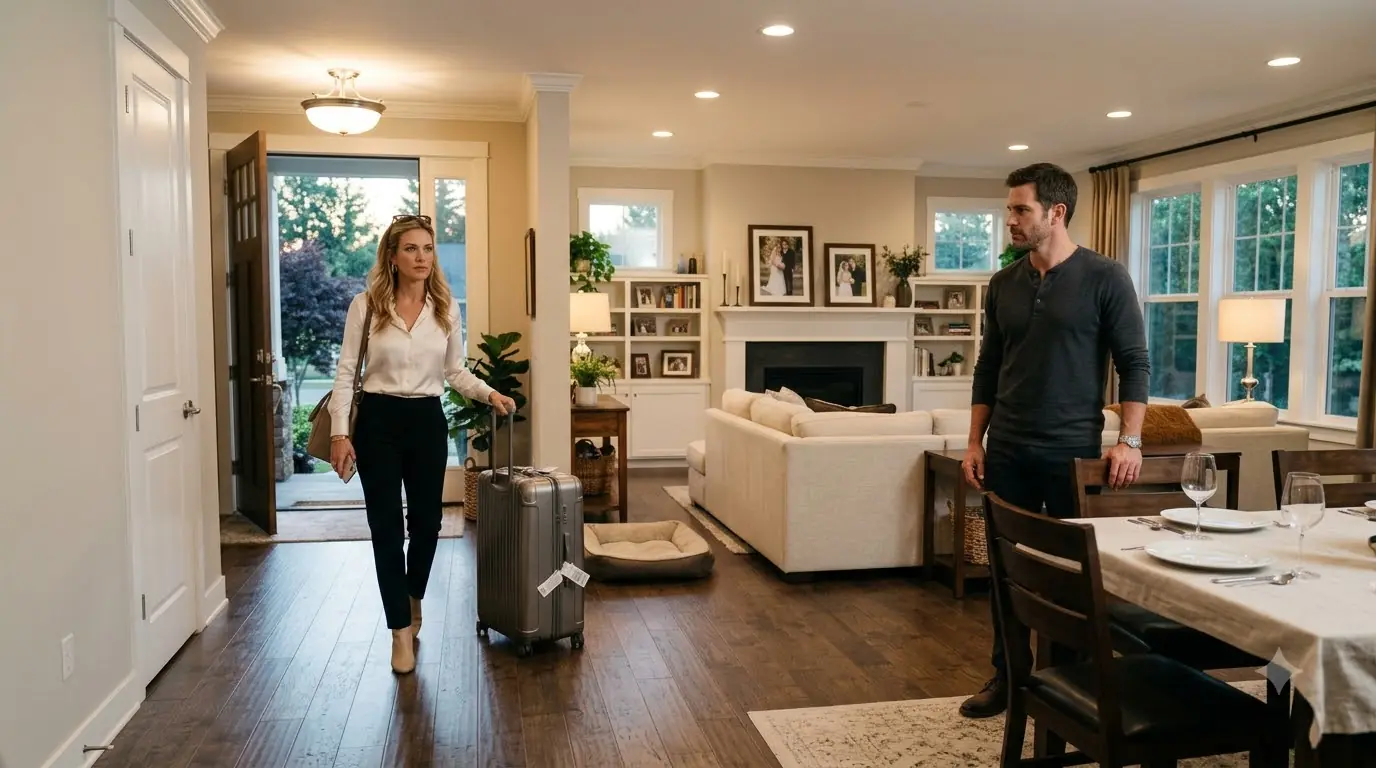
My name is Nathan Ward. I was thirty-seven when this happened, and Claire and I had been married for nine years. We had met in our late twenties, dated for a little more than two years, married in a vineyard outside Boulder, Colorado, bought a house in a quiet Denver suburb, adopted a rescue dog named Milo, and built the kind of life that rarely attracts anyone's attention because almost nothing in it appears dramatic from the outside.
We both worked. Claire was a senior marketing manager for a regional technology company, and I managed financial planning for a construction-services firm. We paid our mortgage on time, had respectable retirement accounts, took one real vacation most years, argued about where to order dinner, and owned far too many coffee mugs for two people.
We did not have children.
Not yet.
That distinction had begun to matter during the year before everything fell apart.
We had spent our early thirties saying there was plenty of time. First we wanted stability. Then we wanted the house. Then Claire wanted a promotion. Then my company went through a restructuring. Then the pandemic years made every future decision feel provisional.
By thirty-seven, "someday" had started sounding less casual.
We had begun talking seriously about trying.
There were doctor appointments scheduled.
Prenatal vitamins in the bathroom cabinet.
A spreadsheet I had built because spreadsheets were apparently how I coped with biological uncertainty.
Claire made fun of it.
"You've turned having a baby into quarterly forecasting."
"I prefer preparedness."
"You're going to ask the kid for projected expenses before kindergarten."
"Obviously."
She had laughed.
That memory would come back later with such force that I once had to pull my car into a parking lot.
The worst part about betrayal is not that it destroys all your good memories.
It leaves them intact.
They remain exactly as warm as they were, and now you have nowhere sensible to put them.
For most of our marriage, I believed Claire and I were solid.
Not perfect.
Solid.
That word mattered to me more than exciting.
I had grown up watching my parents turn love into volatility. They separated twice, reconciled twice, and finally divorced when I was seventeen. Doors slammed. Cars disappeared overnight. Promises changed depending on who had been drinking or who had apologized last.
I had promised myself adulthood would be different.
Claire seemed to want the same thing.
She was more spontaneous than I was, but she liked stability. She liked knowing bills were paid. She liked Sunday mornings with coffee on the deck. She liked that Milo slept upside down between us while pretending the expensive dog bed on the floor did not exist.
In the first several years, we traveled often.
New Orleans.
Seattle.
Costa Rica.
Once, on impulse, Claire convinced me to drive eight hours to Santa Fe because she had seen a hotel online and decided we "needed color."
I loved that about her.
She made movement feel less dangerous.
I gave her structure.
She gave me momentum.
At least that was the story we told ourselves.
Over the years, momentum slowed.
The house came with maintenance.
Our jobs became more demanding.
Vacations became planned months in advance.
Date nights became things we said we should schedule and then postponed because we were tired.
Nothing collapsed.
That was what fooled me.
There was no single crisis before her ex returned.
Claire and I did not scream at each other.
We did not sleep in separate rooms.
We still kissed goodbye.
Still had sex, although less often.
Still texted during work.
Still made each other laugh.
But in retrospect, we had become exceptionally good roommates who occasionally remembered they were married.
That is different from a dead marriage.
It is also not the same thing as an alive one.
Three months before Claire left, a man named Julian Mercer sent her a message on Instagram.
I knew Julian's name before I knew almost anything else about him.
Claire had dated him for four years.
From twenty-two to twenty-six.
He had been her first serious adult relationship.
Her first shared apartment.
First conversation about marriage.
First person she had imagined children with.
They broke up before Claire and I met.
Whenever she told the story, it sounded less like an explosion and more like erosion.
Julian wanted to move to California for work.
Claire did not.
Then he stayed.
Then resentment followed.
They started fighting.
They separated once.
Got back together.
Eventually stopped trying.
"He was my first real love," Claire told me once early in our relationship.
I remember that sentence because I had asked a question I should not have asked.
"Do you think you'd still be with him if he hadn't wanted California?"
Claire thought about it.
Then said:
"No."
I believed her.
Maybe she believed herself too.
Over the years, Julian appeared occasionally in stories.
The camping trip where a bear got into their food.
The terrible apartment with the upstairs neighbor who practiced drums at midnight.
The restaurant in Estes Park where Julian once proposed a ridiculous business idea after three margaritas.
I never felt particularly threatened.
The past was the past.
I had ex-girlfriends too.
Everyone arrives in marriage with ghosts.
Healthy people do not demand that their spouse pretend otherwise.
When Julian messaged Claire, she told me the same evening.