Chapter 1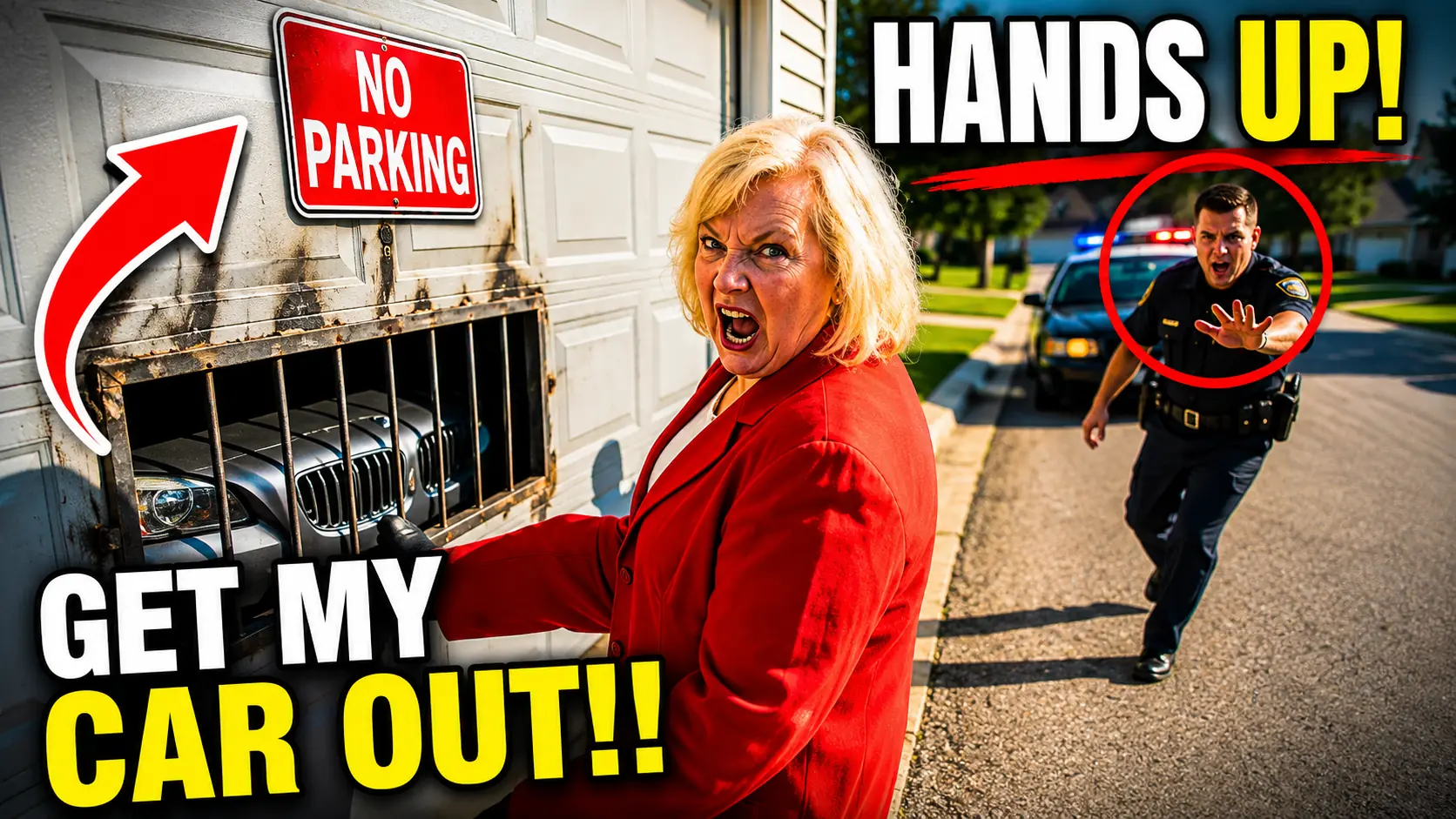
The smell of scorched metal still hung in the air when I wheeled my suitcase out the front door and locked the gate behind me. Behind me, Linda Prescott was standing in front of my garage door, the one I had just welded completely shut with her silver Mercedes still parked inside. She was screaming. I didn’t turn around. Twenty minutes later, my plane lifted off the runway. Fourteen days after that, I came home to a collapsed reputation, a stack of documented evidence, and a car repair bill she would never forget. But none of it would have happened if Linda Prescott hadn’t decided on a perfectly ordinary Saturday morning in June that my private garage was her personal parking spot.
I am not a man who raises his voice. I spent 22 years working industrial welding contracts, and then another decade consulting on mechanical engineering projects. Somewhere along the way, I learned that the loudest person in the room is almost never the most dangerous one. My garage taught me that—not the structure itself, though I had poured close to $40,000 into that space over the years, turning it into a fully equipped private workshop, but the discipline of the work done inside it. A MIG welder does not care about your feelings. Steel does not negotiate. You either know what you’re doing or the metal tells you that you don’t.
It was the first Saturday of June when Linda Prescott decided to test that lesson on my property. I had been awake since 6:00 in the morning, moving through the garage with a specific kind of focus that comes from knowing you’re about to leave for two weeks. Florida. Clearwater Beach. A fishing charter I had booked in December. A scuba certification course I had been putting off for three years. And a bungalow rental 30 steps from the water. I had planned this trip for half a year. I was not going to rush the preparation. I moved each tool to its labeled position, the MIG welder powered down and covered, the C-clamps all racked by size, the parts cabinets locked. The garage door was open to let the morning air circulate. My truck was already parked on the street. Inside, everything was exactly as I wanted it.
The horn came first—two sharp blasts, the kind that says I am not asking a question. I stepped out of the garage and watched a silver Mercedes E-Class, 2019 model, reversing smoothly and deliberately into my workshop. Not pulling up. Not pausing. Reversing in, as though the decision had already been made and my presence on the driveway was merely a formality to be processed. Linda Prescott stepped out of the driver’s side door in a navy blazer and expensive sunglasses, a tablet tucked under one arm. She looked the way people look when they’re performing official business rather than conducting human interaction. She gave the garage a brief, satisfied scan, the way a manager surveys a room before a meeting she called, and then she looked at me.
“I need to use this space for a few hours,” she said. “The midsummer block party is right across the street. We don’t have enough parking. You’re not going to be using this today anyway, are you?” It was not a question. I want to be clear about that. There was no rising inflection. There was no pause that suggested she expected a response. It was a declarative statement dressed in the grammatical clothing of a question. And the distinction mattered because it told me exactly what kind of conversation I was dealing with before I said a single word. Before I could respond, she reached into the car and I heard the soft chime of the Mercedes’ infotainment system activating. “My car has a comfort cooling system,” she said, not looking at me. “I’m going to leave it running. It’s already warm out.” The screen in the center console lit up, the three-pointed star logo rotating slowly. She did not cut the ignition. She switched it to accessory mode, display bright, keyless entry module active and humming.
I told her clearly and without any particular heat that this was private property and that I did not authorize the use of my garage by anyone while I was absent. I told her she would need to find another arrangement. She pulled up the HOA’s governing document on her tablet and pointed to section 4.7, a clause permitting the association to request temporary use of personal space for community-approved events. She read a line of it aloud with the practiced confidence of someone who has wielded a policy document before. I listened, and while I listened, I was already noting quietly and without expression that section 4.7 was written to cover front yards and shared walkways, not enclosed structures. It did not apply to a sealed garage, not even close. But I did not say that to her. There was nothing tactically useful in correcting her in the driveway. I told her again that she did not have my permission to leave the vehicle there. She looked at me the way people look at something mildly inconvenient—a traffic cone, a misplaced sign—and said that she would be noting my non-cooperation in the HOA’s official violation log. Then she turned on her heel and walked across the street toward the block party, leaving the Mercedes sitting in my workshop, the garage door still open, the infotainment display glowing softly in the morning light.
I stood in the driveway for a moment and looked at the car. I could see the center screen from where I was standing, the rotating logo, the ambient lighting still cycling through its welcome sequence. The alternator was off. The system was drawing directly from the 12-V battery, steady and uninterrupted. I looked at my watch. I looked at the truck parked on the street. Then I went inside, sat down at the kitchen table, and called my attorney. Tom Hendricks answered on the second ring, which is one of the things I appreciate about him. He’s been handling real estate law in this county for 17 years, and he does not waste time on social pleasantries when someone calls him on a Saturday morning. I described the situation in under three minutes. He asked two clarifying questions: whether Linda had a written authorization from the full HOA board and whether the garage had a fixed enclosing structure. I answered no and yes. He was quiet for four seconds. Then he said, “Section 4.7 does not cover enclosed private structures. That clause was written for driveways and front lawn use during neighborhood events. Her car is an unauthorized vehicle on your private property. You are within your rights to secure that property by any legal means available to you.” I thanked him, ended the call, and walked back out to the garage with my phone.
I documented everything methodically—the Mercedes’ position relative to the property line, the license plate, the timestamp on each photo, the angle of the garage door, the position of the infotainment display still glowing in the interior. I photographed the HOA violation notice she had mentioned, which I found tucked in my mailbox by the time I came back around. I composed an email to the HOA board’s general address, not Linda’s personal account, but the shared governance inbox that all five board members received, and I wrote it in the tone of a man filing a maintenance report rather than a man who is angry. I described the vehicle, the date, the time, the request I had made, the refusal that followed. I noted that section 4.7 did not apply to my garage under its plain language, cited the relevant paragraph, and stated that I was requesting immediate removal of the vehicle. I added a single closing line: “If the matter is not resolved within 30 minutes, I will exercise my legal right to secure my private property.” I sent the email, put the phone in my pocket, and went back into the workshop. No response came. I gave it 35 minutes. Nothing from the board. Nothing from Linda. No movement near the Mercedes.
I looked at the garage door—a steel roll-up, commercial grade, with a fixed steel frame bolted into the poured concrete footer on both sides. I had installed it myself six years ago. I knew every weld point and stress junction on that frame the way a musician knows a piece they have played a thousand times. What I was considering was not complicated. It was not permanent. It was not destructive. It was a temporary mechanical modification to my own property, something I could reverse with an angle grinder in under 20 minutes. It would, however, be entirely, unambiguously effective. I pulled on my welding jacket, clipped the auto-darkening helmet to the bench hook, and powered up the MIG welder. I brought the garage door down to its fully closed position and used four C-clamps to fix it against the frame while the metal settled. Then I ran the first bead—a 15-cm continuous pass along the lower left contact point between the door panel and the fixed frame. The arc crackled and spat, filling the space with the familiar sharp smell of burning steel. I moved to the lower right, then the upper corners, then two intermediate points on each side—eight weld positions in total. Each bead laid with the same even hand pressure I use on structural work, not hurried, not excessive, just thorough. When I finished, I let the metal cool for five minutes, then gripped the door handle with both hands and pulled with my full body weight. The door did not move. It did not flex. It did not rattle. It held the way a thing holds when it has been done correctly.
I mounted a wide-angle security camera to the soffit above the garage door, the kind with cloud backup and 30-day rolling storage, angled to cover the full approach from the street and both sides of the driveway. I affixed two notices to the property, both printed at the correct dimensions required by the state statute I had looked up while waiting for Tom to call back. Private Property. Trespassing Prohibited. Video Surveillance in Effect. One on the garage door, one on the front gate post. Then I sent a single text message to Linda Prescott’s number. I told her that I had secured my garage under my rights as a property owner, that her vehicle was safe inside, and that when she was prepared to address the matter through proper legal channels, she should contact me through her attorney. I walked back inside, finished packing my bags, and loaded the truck. As I backed out of the driveway, I glanced at the sealed garage door one last time. The welds were already cooling to that dark, clean gray that good steel takes on when it’s done properly. The Mercedes would be fine in there. Climate stable. No direct sun. No physical risk. The car had everything it needed to sit safely for two weeks. Everything, that is, except a functioning alternator to recharge the battery that was still, at that very moment, quietly powering an infotainment system nobody was watching.
>>>NEXT CHAPTER 2: HOA Karen Parked in My Garage Without Asking — So I Sealed It Shut and Left for Vacation<<<