HOA Karen Had My Car Booted on My Own Property — Then Her Tow Company Turned Against Her in Court
Reader Theme:
Font Size:
24px
Chapter 1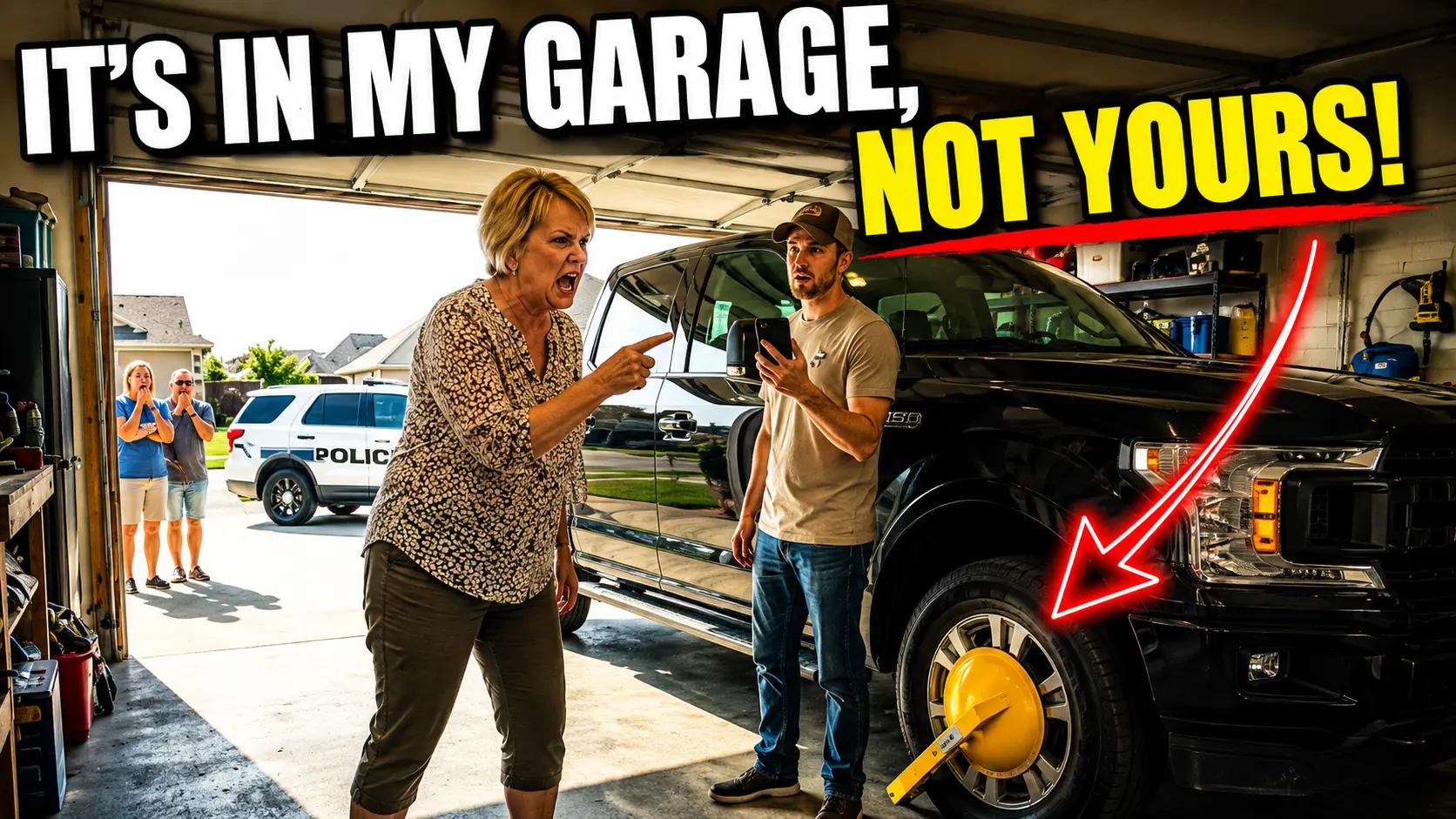
I came home from a 12-hour shift at the hospital in Portland, Oregon to find a bright yellow boot clamped onto the front wheel of my Tesla Model 3, which was parked exactly where it should have been—inside my own garage. The sheer audacity of what I was seeing made me stand there for a solid 30 seconds, my brain refusing to process the reality in front of me. Someone had entered my private garage, accessed my private property, and immobilized my vehicle without my permission or knowledge.
My name is Marcus Chen, and I’m an emergency room physician at Providence Portland Medical Center. I’d bought my townhouse in the Meadowbrook Heights community six months earlier, attracted by the modern architecture and the promise of a quiet, well-maintained neighborhood. The homeowners association seemed reasonable enough during the buying process. The monthly fees were a bit steep at $280, but the amenities included a gym, pool, and landscaping services. What I hadn’t counted on was Brenda Carmichael, the HOA board president, who seemed to believe her position gave her unlimited authority over every single aspect of our lives.
I pulled out my phone and took about 20 photos of the boot from every conceivable angle, documenting the violation. The boot itself had a company name emblazoned on it, Quick Lock Towing and Recovery, along with a phone number. There was also a bright orange sticker plastered on my driver’s side window that read, “Violation, unauthorized vehicle. Contact HOA immediately.” My hands were shaking, not from fear, but from pure rage. This was my home, my garage, my car.
I dialed the number on the boot. My jaw clenched so tight I could feel a headache forming behind my eyes. A gruff voice answered on the third ring. “Quick Lock Towing, this is Dave.” “Hi, Dave. My name is Marcus Chen, and I just got home to find one of your boots on my car in my private garage. I need this removed immediately.” There was a pause on the other end. “What’s the address?” “42 Meadowbrook Lane, unit number seven, but I think you’re missing the point here. This is my private garage. Someone had to have entered my property without permission to do this.” Dave sighed, and I could hear papers rustling. “Yeah, I see the work order here. We were contracted by the Meadowbrook Heights HOA. Says here the vehicle was in violation of parking regulations.” “In my own garage?” My voice was rising despite my best efforts to stay calm. “How is that even possible?” “Look, man, I just follow the work orders we get. You’ll need to take this up with your HOA. The fee to remove the boot is $350 plus a $50 administrative charge.” “$400? You’ve got to be kidding me. I’m not paying a single cent. This is illegal. You entered private property without the owner’s consent.” Dave’s voice hardened. “The HOA gave us authorization. We have it in writing. If you don’t pay the fee, the vehicle will be towed within 24 hours, and that’ll run you another $600 plus daily storage fees.” I hung up before I said something I’d regret.
My next call was to the non-emergency police line. I explained the situation to the dispatcher, who seemed sympathetic, but ultimately told me that since it was a civil matter involving the HOA, they couldn’t intervene unless there was evidence of criminal trespass or property damage. She suggested I document everything and contact an attorney. By this point, it was almost 8:00 in the evening. I was exhausted, hungry, and furious, but I wasn’t about to let this go. I pulled up the HOA contact information from my welcome packet and found Brenda Carmichael’s phone number. She answered on the first ring, her voice saccharine sweet. “Meadowbrook Heights HOA, Brenda speaking.” “Brenda, this is Marcus Chen from unit 7. I need to know why there’s a boot on my car in my private garage.” The sweetness evaporated instantly. “Mr. Chen, your vehicle was in violation of community standards as outlined in section 12, subsection 4 of the HOA covenants, conditions, and restrictions.” “Which says what, exactly?” “All vehicles parked on community property must be registered with the HOA and display the appropriate parking permit. Your vehicle has no permit.” I took a deep breath, trying to keep my voice level. “Brenda, my car is in my garage. That’s not community property. That’s my property.” “The garage is part of the community structure and therefore subject to HOA regulations. You should have received your parking permit in your welcome packet. Since your vehicle displayed no permit, it was marked for boot and potential tow.” “You had someone enter my garage without my permission. That’s trespassing.” Brenda’s laugh was sharp and humorless. “I’m afraid you’re mistaken, Mr. Chen. As per the CC&Rs you signed when you purchased your property, the HOA retains the right to enter any part of the community to ensure compliance with regulations. That includes garages. I suggest you read your paperwork more carefully. Now, if you want that boot removed, you’ll need to pay the fee and come by my office tomorrow to pick up your parking permit. Good evening.” She hung up before I could respond.
I stood in my garage staring at my immobilized car, feeling like I’d stepped into some kind of dystopian nightmare. I’d bought this place. I owned it. And yet someone had just claimed the right to enter my private space and hold my property hostage over a parking permit I’d never been told about. I went inside and immediately started going through all the paperwork for my home purchase. The CC&R document was 147 pages of dense legal text. I made coffee and started reading, highlighting anything related to parking or HOA access rights. What I found made my blood run cold. There was indeed a section about parking permits buried on page 93. It stated that all vehicles must display an HOA-issued permit when parked on community property. However, the definition of community property was vague and seemed to primarily refer to common areas like the parking lot, streets, and visitor spaces. There was no explicit mention of private garages being included in this definition. More troubling was section 7, subsection 2, which granted the HOA reasonable access to individual units for the purpose of maintenance, inspection, and enforcement of community standards. The word “reasonable” was doing a lot of heavy lifting there, and I was pretty sure that entering someone’s garage to boot their car didn’t qualify.
I spent the next hour researching Oregon HOA laws online. What I learned was both encouraging and frustrating. Oregon law did give HOAs significant power, but it also placed limitations on that power. Specifically, HOAs couldn’t violate an owner’s reasonable expectation of privacy. And they had to provide notice before entering private areas except in emergencies. A missing parking sticker definitely didn’t constitute an emergency. I also discovered that booting a vehicle on private property without the owner’s consent was legally questionable at best. Several court cases in Oregon had ruled that such actions could constitute unlawful detention of property, especially when done without proper notice or due process. By midnight, I had a plan. First thing in the morning, I’d contact a lawyer who specialized in HOA disputes. Second, I’d file a formal complaint with the HOA board. Third, I’d refuse to pay the boot removal fee and see if they actually tried to tow my car. If they did, I’d have even more ammunition for a lawsuit. I barely slept that night, my mind racing through various scenarios and arguments. When my alarm went off at 6:00, I was already awake staring at the ceiling. I got up, showered, and made breakfast, then started making calls.
The first attorney I contacted didn’t handle HOA cases. The second one did, but was booked for the next three weeks. The third one, a woman named Patricia Hoffman, agreed to see me that afternoon. Her voice on the phone was crisp and professional, and when I briefly explained the situation, she made a sound that was almost a laugh. “They booted your car in your own garage. That’s a new one. Come in at 2:00 and bring all your paperwork, including photos of the boot and any communications with the HOA.” I thanked her and hung up, feeling a small measure of relief. At least I had someone on my side who understood the legal landscape. My shift at the hospital didn’t start until 3:00, so I had time to handle the HOA meeting first. I drove my backup car, an old Honda Civic I kept for situations exactly like this, to the HOA office located in the community clubhouse. The building was nice enough with a lobby area that had been decorated with generic landscape paintings and artificial plants. A receptionist sat behind a desk typing on a computer. “I’m here to see Brenda Carmichael,” I said, keeping my voice neutral. The receptionist, a young woman who looked barely out of college, glanced up. “Do you have an appointment?” “No, but this is urgent. She had my car booted yesterday and I need to discuss it with her.” The receptionist’s eyes widened slightly and she picked up her phone, murmuring something I couldn’t quite hear. A moment later, she nodded at me. “She’ll see you. Down the hall, second door on the right.”
Brenda’s office was exactly what I expected. Meticulously organized with motivational posters on the walls and a large desk that created a barrier between her and visitors. Brenda herself was in her mid-50s with short blonde hair styled in a severe bob and glasses that hung from a chain around her neck. She looked up as I entered, her expression neutral. “Mr. Chen. I assume you’re here about the parking situation.” “That’s right. I want to know under what authority you had my car booted in my private garage.” Brenda leaned back in her chair, folding her hands on her desk. “As I explained on the phone, your vehicle was not displaying the required parking permit. This is a violation of community standards.” “My garage is not community property. It’s private property that I own.” “The CC&Rs clearly state that all areas of the community are subject to HOA oversight. That includes individual units and their attached structures.” I pulled out my phone and opened the photos I’d taken. “You had someone enter my garage without my knowledge or consent. That’s trespassing, Brenda. Oregon law requires notice before the HOA can enter private areas except in emergencies. A missing sticker is not an emergency.” Her jaw tightened. “We have the right to ensure compliance with community standards. If you had registered your vehicle as required, this wouldn’t have happened.” “I was never given a parking permit or told I needed to register my vehicle. I’ve lived here for six months and this is the first I’m hearing about it.” “All homeowners receive a welcome packet with complete information about community rules and regulations. If you failed to read it, that’s not the HOA’s responsibility.” I pulled out my copy of the welcome packet I’d received when I moved in. “This is everything I was given. There’s no mention of parking permits in here. No registration form, no instructions, nothing.” Brenda’s eyes narrowed as she looked at the packet. For just a moment, I saw uncertainty flicker across her face, but it was gone in an instant. “Then there was an administrative error. Regardless, ignorance of the rules is not an excuse for violating them.” “So you’re admitting that I was never properly informed of this requirement.” “I’m saying that the rule exists and must be followed. Now, if you want the boot removed from your vehicle, you’ll need to pay the fee and complete the vehicle registration form.” She pulled a form from her desk drawer and slid it across to me along with a small blue sticker. “Fill this out, pay the $400 boot removal fee, and you’ll be in compliance.” I didn’t touch the form. “I’m not paying anything. What you did was illegal. You entered my private property without notice or consent, and you’re holding my vehicle hostage over a rule I was never informed about. I want the boot removed immediately at no charge, and I want a formal apology.” Brenda’s expression hardened into something cold and mean. “That’s not going to happen, Mr. Chen. The boot stays until you pay, and if you don’t pay within 24 hours, your vehicle will be towed at your expense. Those are the rules.” “Then I’ll see you in court.” I walked out before she could respond, my heart pounding. I’d never been the type to engage in confrontation, but there was something about Brenda’s smug certainty that ignited a fire in me. She genuinely believed she had the right to do whatever she wanted, and I was going to prove her wrong.
My meeting with Patricia Hoffman went better than I could have hoped. Her office was in downtown Portland, a sleek space with modern furniture and a wall of law books that probably cost more than my car. Patricia herself was in her early 40s with dark hair pulled back in a ponytail and sharp, intelligent eyes that seemed to miss nothing. I walked her through everything that had happened, showing her the photos, the CC&Rs, the welcome packet, and my communications with Brenda. She listened carefully, occasionally making notes on a legal pad. When I finished, she sat back and tapped her pen against her desk. “This is actually a pretty clear-cut case of HOA overreach. Oregon law is very specific about when and how an HOA can enter private property. They need to provide reasonable notice except in genuine emergencies, and they need to have a legitimate reason for the entry. Booting your car over a parking sticker doesn’t meet that threshold.” “So what are my options?” “Several. First, we can file for an emergency injunction to have the boot removed immediately. Given the circumstances, I think a judge would grant it. Second, we can sue the HOA for trespassing, unlawful detention of property, and violation of your rights under Oregon’s Planned Community Act. Third, we can file a complaint with the Oregon Department of Justice, which oversees HOA conduct.” “What about the towing company? They’re the ones who actually put the boot on.” Patricia nodded. “Good question. If they entered your property based on false or misleading information from the HOA, they might actually be witnesses in your favor rather than defendants. Towing companies don’t like getting dragged into legal disputes. If we can show that the HOA misrepresented the situation to them, they might cooperate with us.” “How much is all this going to cost me?” “My retainer for HOA cases is $5,000. Given the strength of your case, I think we can resolve this relatively quickly, either through settlement or summary judgment. You’ll likely recover your legal fees if we win, plus damages for your time and trouble.” I thought about it for maybe 10 seconds before nodding. “Let’s do it.” Patricia smiled, a predatory expression that made me glad she was on my side. “Excellent. I’ll draft the paperwork today and file it tomorrow morning. In the meantime, don’t pay that boot fee. Don’t sign anything from the HOA and document everything. If they tow your car, let them. It’ll just add to the damages.” I left her office feeling energized and vindicated. For the first time since finding that boot, I felt like I had some control over the situation.
>>>NEXT CHAPTER 2: HOA Karen Had My Car Booted Inside My Own Garage — Then the Tow Company Testified Against Her<<<